


Archive for the ‘Kidsdata News’ Category
Welcome to Data Points!
Our goal for this new kidsdata.org blog is to foster helpful conversations among people who use data to improve the health and well being of children. We hope that kidsdata.org, which now offers data on children for all counties, cities and school districts in California, will be a valuable tool for you. Please check in regularly to post your comments and to keep up to date on new data and enhancements.
On the blog, you’ll find:
- Information about data efforts taking place throughout the state
- Examples of how others use data in their work
- Data analysis and information from kidsdata.org’s expert staff
- A forum to ask questions about data
- Updates on issues affecting the health of California’s kids, and more!
You can help build a community of data users by posting items on our Kidsdata In Action page about how you are using kidsdata to improve the health of children. That page also features items about how others are utilizing the site’s many offerings. Also, if you blog about children’s health or data, link to us from your blogroll, and let us know what you’re blogging about.
Our foundation launched kidsdata to further our vision that all children in the communities we serve are able to reach their maximum health potential. We believe that decisions based on data are most likely to bring that vision to reality.
David Alexander, MD
President and CEO, Lucile Packard Foundation for Children’s Health
Posted by David Alexander, MD
Tags: News About Kidsdata.org
Help Make the 2010 Census Fair and Accurate
 The 2010 Census is fast approaching. As data users, we all know how important it is to have accurate data about the populations in our communities. Historically, low-income communities, communities of color, and immigrants have been less likely to respond to the Census. Undercounting people in these communities leads
to less fair decisions about political representation and the distribution of
federal, state, and county funds – including funding for education, health,
and social services.
Of concern to all of us across California: Ten of the 50 “hardest to count” counties in the nation are right here in California, though all counties contain pockets of people at risk of being undercounted.
What can you do? Organizations working in these communities will be critical to ensuring a fair and accurate count. The Nonprofits Count website is a hub for nonprofits interested in engaging in Census-related activities; this resource provides a comprehensive tool kit and suggests ways to reach your community. Community-based organizations also can partner with the Census to spread the word in your community through posters, newsletter announcements, brochures, and other customizable materials. And you can use the Healthy City California website to find out where the “hard-to-count” communities in your area are located. Multi-lingual outreach materials and other information are available on the 2010 Census website.
Posted by Sarah Marxer
Tags: Data Challenges, Data Sources
Child Safety Data Added for All CA Counties
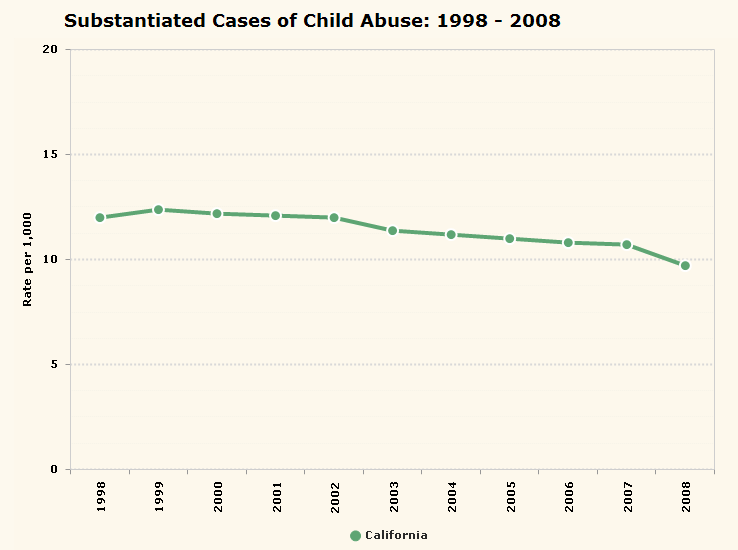 The kidsdata.org expansion continued in January with the addition of data about child safety — child abuse, foster care, and domestic violence — for all counties in California. In all, more than 25 indicators were added, and the data show some interesting tidbits
of information:
Child Abuse
- California’s rate of substantiated cases of abuse is declining, as are the number of cases.
- Race/Ethnicity: Native American, African American/Black kids disproportionately affected.
- Type of Abuse: Neglect is the most common.
- One-page highlights on child abuse >>
Foster Care
- In ‘08, 68,127 children in CA were in foster care, a 37% decline since ’98.
- The rate of first entries is down statewide and in most CA counties since ’98.
- CA infants enter foster care at roughly three times the rate of any other age group.
- One-page highlights on foster care >>
Domestic Violence
- Rate: The statewide rate of calls for assistance dropped 29% from ’98 to ’08.
- In 2008, there were 166,343 domestic violence calls to law enforcement.
- One-page highlights on domestic violence >>
As you may know, statewide data on many other topics will be added over the next few months as kidsdata.org continues its statewide expansion. View a timeline of when data will be added>>
Looking for data that aren’t included on that timeline? Let us know.
Posted by Felicity Simmons
Tags: New Data, Statewide Expansion
Just Released: Children Now’s Annual Report Card
 Children Now recently released its annual report card, offering an issue-by-issue assessment on how California’s kids are faring. Most of the grades ranged from Cs to Ds. The highest grade was a B+ in the afterschool category. Children Now points out that the overall grade point average in 2010 was lower than at any other time in the 20-year history of the report card.
Posted by Andy Krackov
Tags: Child Health Initiatives, Data Projects
How Will Recession Affect CA’s Kids? New Projections Point to Impact
Our foundation just released this concerning piece of news: More than a quarter of California’s children could be living below the stringent federal poverty level this year, according to new projections from a Duke University study that was commissioned by our foundation.
The projections suggest that as many as 2.7 million California children may live in households where earnings are less than $22,000 per year for a family of four, an increase of about 850,000 children since 2008. Research shows that, on average, families in California need to earn at least twice the federal poverty level to cover their basic expenses.
Also of concern: Even if the economy recovers in the next few years, the impact of the recession on children’s well-being will likely be lasting, as the projected percent of children living in poverty in 2012 still will be higher than before the downturn, as the table below shows:
| Region | 2008 Poverty Level | 2010 Projections | 2012 Projections |
| California | 18.5% | 27% | 24% |
| Los Angeles County | 22% | 35% | 30-32% |
| The Bay Area | 8-13% | 15-16% | 13-14% |
Posted by Andy Krackov
Tags: News About Kidsdata.org
A Decade of Improvement for CA’s Kids
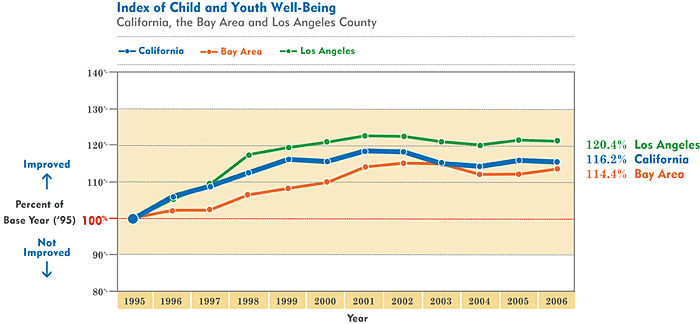 There are, of course, numerous ways to measure how kids in California are doing –
you need only look at the list of individual indicators available through kidsdata.org to find hundreds of different measurements, from poverty to infant mortality to college readiness. But have you ever wondered whether the overall well-being of California’s children is improving or deteriorating? California now has a tool, the California Index of Child and Youth Well-Being, to do just this – that is, provide a measure of kids’ overall status over time. The index, which is based on 16 key indicators from kidsdata.org, shows a consistent pattern of improvement in how children have fared over the last decade, but it also warns that the present economic recession could undermine and possibly even reverse those gains. Some key results from this study:
- Child well-being from 1995 to 2006 improved by about 16% for children in
California. Results also are available for the state’s two
major population centers (the Bay Area and Los Angeles
County), both of which also registered gains in child well-being.
- Child well-being also improved for all racial/ethnic groups that could be
examined by available data (African American, Asian, Caucasian, and
Latino). However, racial/ethnic disparities persisted over time.
African American children, in particular, consistently fared worse than their
Caucasian peers during the period studied.
The Lucile Packard Foundation for Children’s Health commissioned Kenneth Land,
Ph.D., of Duke University to create the California Index of Child and Youth Well-Being.
The composite index is modeled after Dr. Land’s national Child and Youth Well-Being
Index.
Posted by Andy Krackov
Tags: Data Projects
Making a Case for Statewide School Attendance Data
A recent opinion piece in the Los Angeles Times — Why tracking chronic student absenteeism is key for California — points to a notable data gap that we’ve heard about elsewhere.
In the opinion piece, Hedy Cheng and Yolie Flores point out that California doesn’t have a systematic way to capture chronic student absences. Rates of chronic absence may be more significant than we realize – and affect children far younger than we may expect. Cheng and Flores, for example, point to a national study that estimates that as many as 1 in 10 kindergarten and first-grade students miss at least a month of school.
This issue of attendance in school was important enough for San Diego County to include these data in its report card on children’s well being, published by that county’s Children’s Initiative. According to 2007 data from that report card, about one in four kids in public schools in San Diego County missed at least 5 percent of school days (amounting to about 9 days a year).
However, collecting these data were not easy for San Diego County, requiring extensive collaboration from the county’s school districts. If this indicator is so key – the SD report card describes school attendance as “one of the strongest predictors of school success or failure” – how can we make these data easier to analyze? Fortunately, Cheng and Flores point to some possible improvements, noting that the state’s Board of Education is looking into the possibility of tapping federal sources to track school attendance.
Posted by Andy Krackov
Tags: Data Challenges
SPREAD THE WORD: Data Available for All of California!
Starting today, data on the health and well being of children across California are more accessible than ever before.
Kidsdata.org just expanded statewide! The site now offers data for all counties, cities, and school districts in California — nearly 1,600 regions. Data are available for dozens of topics measuring the health and well being of children, and much more data will be phased in over the coming months. (Visit http://www.kidsdata.org/statewide for a complete schedule.)
We hope this free public service can benefit everyone who works on behalf of children in California. To help us spread the word, you can:
- Help raise the profile of kids in your community by adding a link and facts from kidsdata.org to your organization’s website or newsletter.
- If you’re on Facebook and/or Twitter, consider tweeting or updating your status with facts you found on kidsdata.org, or the news of this expansion.
- Co-host a webinar or meeting in your community to learn more about how kidsdata.org can be used in your work. Contact Felicity Ayles, manager of marketing and online communications, at (650) 724-5778 or [email protected].
In the meantime, stay up to date on what’s happening on kidsdata.org by signing up for our newsletter.
Posted by Felicity Simmons
Tags: News About Kidsdata.org
KIDSCOUNT DataBook Ranks California 20th
According to Annie E. Casey Foundation’s 2009 KIDSCOUNT DataBook, California ranks 20th in terms of how children are faring. The annual DataBook profiles the well-being of America’s children on a state-by-state basis and ranks states on 10 key measures. Accompanying the DataBook, KIDSCOUNT released an essay on the importance of making data-driven decisions regarding children. View the DataBook profile for California.
Many of the indicators noted in the DataBook also are available on kidsdata.org for your community. These include infant mortality, child deaths, teen births and poverty, among others.
Children Now, KIDSCOUNT’s California partner, offers a state analysis of the Data Book on their site.
Posted by Felicity Simmons
Tags: Data Projects
Today the Bay Area, Soon the Whole State. Kidsdata Expands!
We’re thrilled to announce that we’ll be expanding kidsdata.org to all counties, cities, and school districts in California this fall! That means six categories and 42 topics and 206 indicators for 58 counties and 480 cities and 1,035 school districts and … phew! That’s a lot of data!
We’ll be rolling out the topics gradually. First to be posted will be physical health data (asthma, health care, fitness, cancer, etc.), demographics data (languages, family structure, etc.) and family economics data (housing affordability, poverty, family income, etc.) this Fall, then child safety data (child abuse, domestic violence, etc.) and disabilities data in late 2009 and early 2010. For a full schedule, check www.kidsdata.org/statewide.
And, most importantly, tell your friends! We want anyone and everyone with an interest in children’s health to know about this valuable resource and use it in their work. Want to help us spread the word about kidsdata in your community? Contact us.
Posted by Felicity Simmons
Tags: News About Kidsdata.org