


California’s Health Care Safety Net Catches More Than Half of All Kids—Many Could Start Falling Through
Medicaid was designed for kids. Together with the Children’s Health Insurance Program (CHIP), Medicaid pays for almost half of all births nationwide and is the largest source of health insurance for children. These programs play especially important roles in providing coverage and filling coverage gaps for young children, children in lower-income families, children and youth with special health care needs (CYSHCN), and other young people who otherwise couldn’t get the health services they need.
Children enrolled in Medicaid and CHIP—or Medi-Cal, as these programs are known in California—don’t just have better access to care than children without insurance. They also experience a host of lifelong well-being benefits—they do better in school, are more likely to finish high school and graduate college, have fewer health problems later in life, and earn higher incomes as adults.
Average Percentage of California Children and Young Adults Ages 0 to 20 Enrolled in
Medi-Cal per Month: 2024
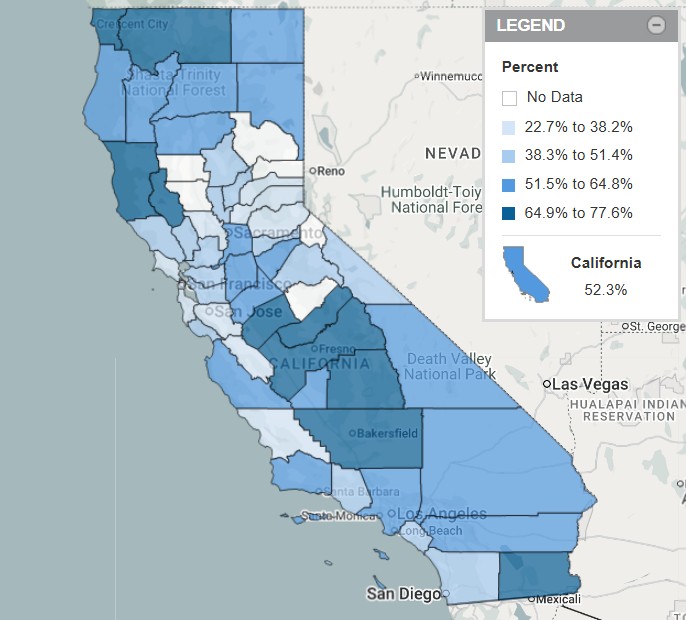
In 2024, nearly 5.5 million Californians ages 0 to 20 were enrolled in Medi-Cal on average each month—this translates to 52% of kids statewide, up from 36% in 2012. Across counties with data, average monthly enrollments ranged from more than three in four young people (Tulare, at 78%) to fewer than one in four (Placer, at 23%).
Medi-Cal is an important source of health coverage for children and youth of color in California. More than 60% of African American/Black and Hispanic/Latino youth were enrolled in Medi-Cal each month in 2024—rates more than double that of their white peers (23%).
Around a third of Medi-Cal enrollees under age 21 have a written language other than English. Spanish is the most common non-English language by a large margin (more than 1.6 million enrollees), but more than 40,000 enrollees use a Chinese language such as Cantonese or Mandarin, more than 30,000 use Vietnamese, and more than 20,000 use Russian.
Recently enacted changes to Medicaid and CHIP financing, eligibility, and access at the federal level have the potential to impact enrollments dramatically in future years, reshaping state health care systems in California and across the nation. Visit KidsData for policy and program options to protect and strengthen health care for children.
Opportunities
The Day Federal Data Went Dark: A Year of Monitoring and Action
On January 29, at 2:00 p.m. ET—one year after thousands of federal webpages began going dark—dataindex.us and the Association of Public Data Users are co-hosting a webinar on the current state of federal data. Featuring PRB alongside other data community leaders, the event will highlight tools developed to monitor public datasets and actions being taken to safeguard these essential resources.
On Wednesday, February 4, at 11:00 a.m. PT, the California School-Based Health Alliance will host a session with California Surgeon General Diana Ramos highlighting school-based efforts to reduce ACEs, strengthen PCEs, and support whole-child well-being through screenings, trauma-informed practices, and youth-centered strategies.
Children’s Health Resources
National Survey of Children’s Health (NSCH) Data Briefs
The Maternal and Child Health Bureau has released three new data briefs highlighting 2022-2023 and 2024 data from NSCH on children and youth with special health care needs, young children’s school readiness, and school-age children’s healthy behaviors.
Recent Changes in Children’s Vaccination Rates by Race and Ethnicity
An analysis by KFF finds declining vaccine coverage against measles, mumps, rubella (MMR) and influenza among U.S. children overall, along with persistent coverage gaps by race and ethnicity.
Posted by kidsdata.org
This entry was posted on Thursday, January 29th, 2026 at 10:18 am. You can follow any responses to this entry through the RSS 2.0 feed. You can leave a response, or trackback from your own site.