


Adverse and Positive Childhood Experiences Point to Patterns of Risk and Resilience
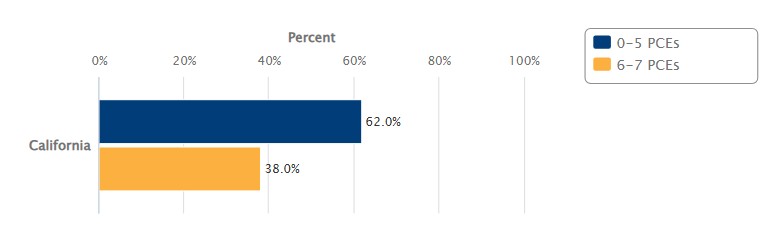
Percentage of California Adolescents Ages 12 to 17 by Number of Positive Childhood Experiences (PCEs): 2022
KidsData is excited to announce a new suite of indicators on Positive and Adverse Childhood Experiences (PACEs) in California, released in partnership with the California Department of Public Health, Injury and Violence Prevention Branch, Essentials for Childhood Initiative.
The data, drawn from the California Health Interview Survey, provide information on PACEs among teens and adults statewide, broken down by race/ethnicity, sexual orientation, income, insurance coverage, and other characteristics. Youth mental health indicators also are available by teens’ exposure to PACEs.
Estimates are available for 2021 and 2022, with youth data for 2023 and 2024 coming soon. Key findings include:
- In 2022, around 2 in 5 California youth had at least one of five Adverse Childhood Experiences (ACEs) asked about in the survey—parent divorce or separation, parent incarceration, household domestic violence, household mental illness, or household substance abuse.
- Positive Childhood Experiences (PCEs) also were common, with a similar share estimated to have at least six of the seven PCEs asked about. These youth were less likely to have ACEs than their peers with five or fewer PCEs.
- Among adults statewide in 2021, those with at least a bachelor’s degree or with annual income of at least $100,000 had lower rates of 4-8 ACEs than those with less education or income, as did heterosexual adults when compared with homosexual and bisexual adults.
Explore the data:
Youth-reported PACEs
- PCEs overall and by type, gender, income level, and race/ethnicity
- ACEs overall and by type, gender, income level, race/ethnicity, and number of PCEs
Youth-reported mental health and PACEs
- Anxiety by number of PCEs and ACEs
- Depression by number of PCEs and ACEs
- Suicidal thoughts by number of PCEs and ACEs
Adult-reported PACEs
- PCEs overall and by type
- ACEs overall and by type, education level, income level, type of insurance, race/ethnicity, sexual orientation, and number of PCEs
Also, visit KidsData’s Childhood Adversity, Resilience, and Positive Experiences topic page for related measures and resources.
Funding for KidsData’s PACEs indicators from the California Health Interview Survey is provided by the California Department of Public Health under contract #24-10589.
Posted by kidsdata.org
This entry was posted on Thursday, May 28th, 2026 at 11:50 am. You can follow any responses to this entry through the RSS 2.0 feed. You can leave a response, or trackback from your own site.