


Archive for the ‘Kidsdata News’ Category
New Report Projects that Conditions for U.S. Kids Will Worsen
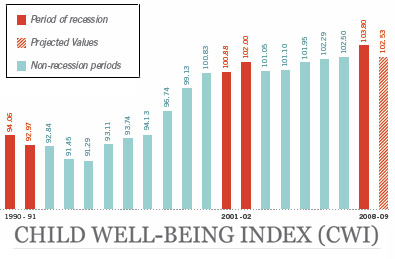 The 2010 Child Well-Being Index (CWI), released this month by the Foundation for Child Development, reveals some startling statistics about how America’s children may be weathering the Great Recession. In 2010, the Great Recession may well wipe out almost all progress made since 1975 for children in the CWI’s Family Economic Well-Being Domain, which brings together measures of children in families living beneath the poverty line, median family income, parental employment, and health insurance coverage. Among the more concerning findings from this year’s
CWI report:
- More than 1 in 5 kids currently live in poverty, according to projections, an increase of 5 percent in only 4 years. A related analysis, issued by our foundation, shows that poverty rates in California may be increasing by even greater amounts.
- Risky behavior, including violent crime and illegal drug use, are anticipated to increase.
- Reliance on cheap food with low nutrition may worsen the child obesity epidemic.
Also, although many measures point to a slowly recovering economy, the CWI shows a lag between when a recession first hits and its eventual impact, which means deteriorating conditions for children through the end of this year – or longer.
The researchers at Duke University who prepared this report also developed a similar index for California that projected that the Great Recession would leave a long-lasting impact on children in the form of sustained high levels of poverty. This California Index of Child and Youth Well Being, commissioned by the Lucile Packard Foundation for Children’s Health, employs measures from kidsdata.org to help illuminate how kids have been faring over time for California and two of the state’s most populous regions, Los Angeles County and the Bay Area.
Posted by Andy Krackov
Tags: Child Health Issues, Data Projects
How Are Kids Faring in CA’s 2nd Biggest County?
The Children’s Initiative recently released the 2009 edition of the San Diego County Report Card on Children and Families, a summary of the overall health and well being of children, youth, and families in the state’s 2nd biggest county, as measured by child population.
Among the highlights from the report: Although San Diego County child poverty rates are lower than both state and national averages, the rate increased to 16.6 percent of children in 2008 – the highest in the county since 2000.
Some other notable trends from the report include:
- 93 percent of families reported having health care coverage for their children, on par with state averages and well above national averages.
- Domestic violence and child abuse trends are improving, but county rates still remain above the state average. Also, child victims of violent crime have dropped only slightly.
- Despite annual fluctuations, motor vehicle crashes involving DUIs among drivers ages 16-20 are still at the same level as they were in 1996. And DUI arrests among adolescents in this non-legal drinking age group actually are increasing.
The 2009 Report Card also offered 10 recommendations focused on prevention and intervention, including:
- Intensive home visiting of vulnerable families to improve parenting skills and reduce child abuse, neglect, and repeat teen births.
- Closely monitoring school attendance; providing after school programs to help prevent substance abuse; and restoring driver education in schools to reduce DUI cases.
- Improving parent-to-teen communication. Teens reporting good relationships with parents are less likely to engage in truancy, substance abuse, DUI, and crime, the report notes.
- Raising the economic status of poverty-stricken families through health and housing benefits, as well as job training and educational opportunities.
Kidsdata.org has long been affiliated with children’s reports, particularly those in San Mateo and Santa Clara counties, so we know how vital such reports can be in drawing local attention to how kids are faring, and focusing the community on related improvements. If you’re at work on – or recently have released – a summary report on local children, please let us know by adding a comment/link below.
Posted by kidsdata.org
Tags: Data Projects
Just Added to Kidsdata.org: Dating Violence and Teen Sexual Health Data
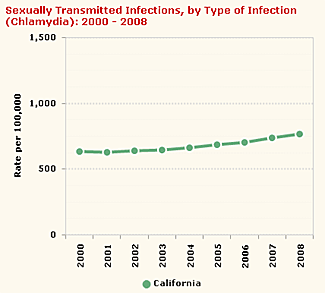 What do we know about dating and sexual health among California adolescents? Here are some highlights: Four out of five teens ages 14-17 say they have not had sex. About 5% of California’s 7th, 9th, and 11th-graders report that they have experienced physical violence in a dating relationship. And chlamydia rates among California’s youth ages 10-19 increased by roughly 20% from 2000 to 2008.
These and other local data on teen sexual health and dating violence now are available on kidsdata.org. Dating violence data come from the California Healthy Kids Survey (CHKS), a statewide survey of students that was developed and is administered by WestEd for the California Department of Education, while the teen sexual health data have two sources – the California Health Interview Survey and the California Department of Public Health.
View Local Data on Dating Violence and Teen Sexual Health
- Youth Experiencing Dating Violence in the Last Year – for School Districts Statewide
By Gender and Grade | By School Connectedness | By Race/Ethnicity
- Selected Facts About Dating Violence
- Teens Who Have Not Had Sex (data available only for CA’s 9 most populous counties)
- Selected Facts About Teen Sexual Health
Posted by kidsdata.org
Tags: New Data, Statewide Expansion
The Quest for Local Data
 On kidsdata.org, we offer data down to the city or school district level. But we often hear that, while useful, those data just aren’t local enough for some purposes.
Last week, we presented kidsdata.org at the 22nd annual Demographic Workshop at USC. This year’s conference focused on the future of California’s children, and brought together key groups of demographers, economists, city planners, and children’s health experts from across the state.
At this conference — and during our many other trips to the Los Angeles area — we hear that LA in particular needs more local data. The vast diversity within the county — as well as it’s sheer geographic size — mean that information about particular communities cannot be derived from data at the county level. Even within school districts or cities, socioeconomic diversity exists.
In LA County, we know that data would be valuable at the zip code level, or by Service Planning Area (SPA). Trouble is, many of the most trusted and reliable data sources don’t offer data at that local a level. When those data are available, the resources needed to cut the data that way can be prohibitive.
But there are a couple of resources that may be helpful. Try HealthyCity, or AskCHIS for local data.
Do you face this issue in your work? If you know of data sources that offer zip code — or even more local — data, please note them here, and be a resource for your colleagues working on behalf of kids.
Posted by Felicity Simmons
Tags: Data Challenges
CA Ranks 48th for Kids’ Dental Health; An ‘Epidemic of Dental Disease’
 A recent article in the New York Times sheds light on the current state of California’s children and their dental health, a condition which one Alameda County public health administrator called “an epidemic of dental disease in children that’s absurdly pervasive.”
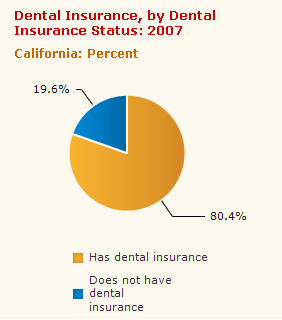
The numbers are alarming – in 2007, nearly 20 percent of California children ages 2-17 were without dental insurance, compared to 6% of kids statewide who lacked health insurance. In the same year, more than a half-million California children ages 5-17 missed at least one day of school in a year due to dental problems.
Add on the fact that the state’s subsidized dental programs for low-income families are at risk of budget cuts, combined with the small percentage of dentists who are willing to participate in these programs, it’s clear to see why dental disease is considered a epidemic.
For a local perspective on dental care in California, check out a 2007 brief from our foundation, Children’s Dental Health: the 2007 Check-Up for Santa Clara and San Mateo Counties. This summary report highlights data that are available on kids’ dental care;
opportunities for action; and related local and statewide resources.
Posted by kidsdata.org
Tags: Child Health Issues
Where Are California’s Highest Childhood Poverty Rates?
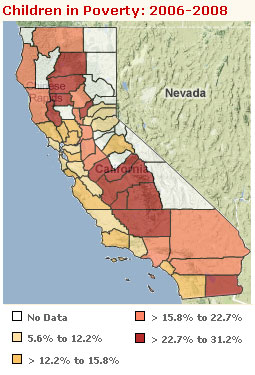 Childhood poverty can have wide-ranging and long-lasting effects on the health and well-being of children. Kids living in poverty are more likely to have inadequate nutrition and less access to health care, and to live in unstable, unsafe neighborhoods. Children in poverty are also more likely to receive a poorer education.
But where in California is poverty most prevalent? According to newly posted data from the Census Bureau’s American Community Survey (ACS), California’s Central Valley is overwhelmingly represented.
Of the 12 counties reporting the highest percentage of children in poverty in 2006-08, ten are in the Central Valley. Tulare County, where nearly 1 in 3 children lives in poverty, has the highest level of childhood poverty.
Posted by kidsdata.org
Post Comment
Just Added: Economic & Demographic Data for 750 Regions Statewide
This week, kidsdata.org adds important economic and demographic data for more than 750 regions across California. These indicators, from the Census Bureau’s American Community Survey (ACS), provide data for three-year periods on child population, immigration, family structure, family income , and poverty for counties, cities, and school districts statewide of 20,000 residents or more. ACS data for single years still are available on kidsdata.org for regions in California with more than 250,000 residents.
Find the New Demographic and Economic Data for Your Community:
-
Demographics: Child Population
-
Grandparents: Children in the Care of Grandparents
-
Households with Children: By Number | By Percent
-
Immigration: Foreign-Born Population, by Age Group
-
Income: Median Family Income
-
Poverty: Children in Poverty | By Race/Ethnicity
-
Single/Married Households: By Number | By Percent
Sign up to receive a customized e-mail alert when these and other data you select are updated.
Posted by kidsdata.org
Tags: New Data, Statewide Expansion
Reading Report Puts California Data in Perspective
 A report released this week by the Annie E. Casey Foundation highlights the percentage of students nationwide who miss the mark in terms of 3rd grade reading proficiency — and what should be done about it.
The report, “Early Warning! Why Reading by the End of Third Grade Matters,” notes that 33% of 4th graders nationwide scored below “basic” on the 2009 National Assessment of Educational Progress (NAEP) reading test. The percentage scoring below basic was even higher — 49% — among low-income students, and higher still for African American, Hispanic, and American Indian students.
In comparison to other states, California 4th graders ranked close to the top; but no state reached “proficient” status, according to the 2007 NAEP scale.
The Annie E. Casey Foundation offers several recommendations for tackling this issue, including increased family/caregiver involvement, more help for low-performing schools, solutions for chronic school absences and summer learning loss, and early education coordination from birth through 3rd grade. But most of all, the foundation asks public officials to honor the bipartisan work that has already been done in this area with regard to national standards of excellence.
To download the report, visit http://datacenter.kidscount.org/reports/readingmatters.aspx. For local reading proficiency data on kidsdata.org (statewide data coming soon!) visit http://www.kidsdata.org/data/topic/dashboard.aspx?cat=25.
Posted by Felicity Simmons
Tags: Data Projects, Data Sources
How Safe Do CA Youth Feel? Gangs, Bullying and School Safety Data Offer Insights
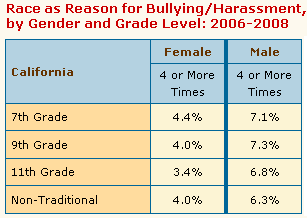 Kidsdata.org’s statewide expansion continues with new data for school districts statewide from the California Healthy Kids Survey (CHKS) specific to gang involvement, bullying, and school safety.
All three measures of youth safety play a crucial role in students’ overall health and well being. Safe school environments foster social and intellectual interactions required for a student’s academic achievement. Being bullied can cause extreme anxiety, and is linked to depression and thoughts of suicide. Gang members are responsible for the majority of serious violent crimes committed by youth, and they are more likely to be involved in selling drugs.
Insights from these newly posted data data:
- Race/national origin is the most common reason cited for bullying in schools. About 15 percent of female students and 20 percent of males in 2006-08 reported at least one incident of being bullied in the year prior to the survey for this reason.
- About 30% of California 7th graders in 2006-2008 say that at least one time in the year prior to the survey, they were afraid they would be beaten up at school.
- According to these 2006-08 data, Caucasian students in California feel safest at school (64 percent said they feel safe or very safe), and African American students are least likely to say they feel safe (50 percent).
- In California in 2006-08, about 8% of 7th, 9th, and 11th grade boys said they had brought a gun to school at least once in the year prior to the survey, and 3% said they brought a gun to school four or more times.
- In California in 2006-08, about 11 percent of boys in grades 7, 9, and 11 considered themselves a member of a gang; roughly 6-8 percent of girls said the same.
Posted by kidsdata.org
Tags: New Data, Statewide Expansion
Think YOU Can Balance Our State’s Budget?
Today, Gov. Schwarzenegger released his revised budget proposal. Don’t like the proposed cuts? Now you can balance the budget yourself.
The SF Chronicle recently featured the California Budget Challenge, an online game that allows users to attempt to balance the state’s $85 billion budget. Are you hoping California will allocate more funding for kids and families? More money for schools, parks, or health programs? Here’s your chance to spend as you please, but be wary – the Challenge also asks you to decide how you would pay for your dream version of the state budget.
The Challenge, created by the nonpartisan organization Next 10, allows users to build a state budget based on individual “values and vision,” but it also serves to educate voters about the numerous policy choices our legislators must make. For each major budget decision (prison cuts, increases in per pupil spending, gas taxes, etc.), the Challenge offers background information, as well as the arguments for and against each cut or expenditure. After each decision you make, you also can see how fellow Californians chose from the many budget options. Next 10 also offers several other resources to educate the public about the budget process in California, such as the handy 7 facts about the state budget.
To access the California Budget Challenge and other resources, visit their website at http://www.next10.org/next10/programs/budget_challenge.html#.
Posted by Jordan Handcox
Tags: Child Health Initiatives, Data Projects