


Archive for the ‘Kidsdata News’ Category
Top 10 Health Achievements This Century
 The Centers for Disease Control and Prevention (CDC) has put together a list of the top 10 public health achievements in the first 10 years of the new millennium. The list was chosen by CDC public health scientists. In no particular order, here are 10 great accomplishments from 2001-2010:
- Vaccine-Preventable Diseases (see local data on immunizations)
- Prevention and Control of Infectious Diseases
- Tobacco Control (see local data on teen smoking)
- Maternal and Infant Health (see local data on infants)
- Motor Vehicle Safety (see local data on drinking and driving)
- Cardiovascular Disease Prevention
- Occupational Safety
- Cancer Prevention (see local data on childhood cancer)
- Childhood Lead Poisoning Prevention (see local data on poisoning)
- Public Health Preparedness and Response
All of the above have an impact on the health and well being of children and families. Read more here. Is there anything you’d add? Or remove?
Posted by kidsdata.org
Post Comment
A Portrait of Well Being in California
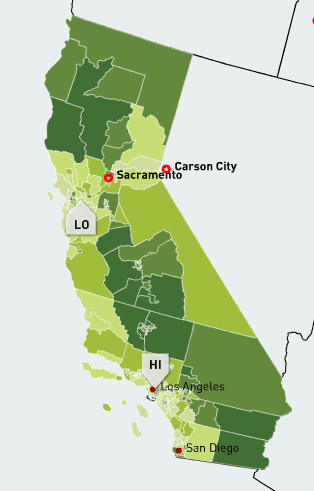 Here at the Lucile Packard Foundation for Children’s Health, we’re always on the lookout for compelling uses of data, so we took note of a report released this week by the American Human Development Project, “A Portrait of California.”
The report examines the well being of the people of California, using the American Human Development Index. Accompanying the index are interactive maps that show dozens of measures of health, including child poverty, life expectancy at birth, school enrollment, unemployment, and much more. Users also can find data by county, zip code, metro area, and even legislative district.
Here are a few highlights noted in the report’s fact sheets:
- Within the San Francisco metro area, life expectancy at birth ranges from 85 years in the San Mateo communities of Burlingame and Milbrae to only 74 years in the Elmhurst section of Oakland, an 11‐year gap within the same metro area.
- In Los Angeles, personal earnings are highest among whites, at $43,000 per year, followed by $35,000 for Asian Americans, $30,000 for African Americans, and $21,000 for Latinos.
- In the San Joaquin Valley, over 28 percent of adults have not completed high school.
See what’s happening in your community>>
Posted by kidsdata.org
Tags: Data Projects
The Skinny on Using Data for Telling Stories, Raising Funds, and Pushing Your Mission
 As you may have seen, our foundation’s Andy Krackov recently wrote a guest blog post on the Nonprofit Technology Network’s blog about using Google’s free tools to animate data.
Turns out, the NTEN blog’s May theme is all things data – fundraising with data, telling stories with data, showing data in compelling ways, and much more. What could be more exciting?! Here’s a sampling of their posts:
- First, NTEN Executive Director Holly Ross tackles the issue of proving your organization’s impact through data. She discusses a four-step approach to making the most of your data: defining data, giving it meaning, using it to tell a story, and then sharing it with other organizations. Read more>>
- A guest post by Colin Holtz and Steve Daigneault of M+R Strategic Services about storytelling with data notes that sometimes the most compelling stories don’t have the most impact. Often, a more data-driven, conventional approach can better outline your accomplishments and needs, the authors say. Read more>>
- Another post from Jeff Stanger of the Center for Digital Information discusses the difference between data and information, noting that data come from research, and information comes from the communication surrounding those data. And, says Stanger, technology is constantly changing the way we collect and communicate data. Read more>>
- Most recently, NTEN Publications Director Annaliese Hoehling encourages us to think about the people behind our data, noting that data has “infinite potential for stories.” Read more>>
Kudos to NTEN for discussing so many different aspects of data in such a thoughtful way. Visit the NTEN blog for even more posts about data this month.
Posted by Felicity Simmons
Post Comment
Case Study: Use Google’s Free Tools to Animate Your Data
Originally posted on the Nonprofit Technology Network blog
At the Lucile Packard Foundation for Children’s Health, we publish data on children’s health and well being in California through our own www.kidsdata.org website. The site makes it easy to find, describe, and share wide-ranging facts – millions of data points in all – about how kids in California are faring.
With a robust data website like ours, why, then, would we want to make use of Google’s own data offerings, as we did on this blog post about the rise in autism diagnoses (http://www.kidsdata.org/blog/?p=2113)? In short, the charts that Google makes available are slick, especially in the way they animate data, and Google’s tools can be of benefit to wide-ranging nonprofits that work with data.
In our case, Google’s chart animation allowed us to clearly communicate the increase over time in autism diagnoses, as compared to other special education diagnoses. In the post above, click on the bar graph tab in the 2nd graph, then press play to see how Google makes it easy to animate data. The effect can be quite powerful and attention-grabbing, which is a key consideration for an organization like ours working to raise the priority of children’s health.
It’s relatively easy for nonprofits to create these charts: Just upload your own data into Google Docs (the data can be on any topic of interest to your organization), build your animation, then grab the code to put on your site/blog. Even better, Google offers this service for free (other than the roughly 30 minutes to an hour it will take you to build your animated chart).
In addition to integrating these charting capabilities into Google Docs for individual users, the search giant also is building out a comprehensive site, Google Public Data Explorer, which, so far, offers dozens of indicators from data sources worldwide.
Our foundation is experimenting with Google’s Public Data Explorer, too (nonprofits can upload public data into this system). Our thinking is that if we can make data available through Google itself, we may get even more exposure to the issues to which we’re trying to bring attention.
Unlike Google Docs, however, we’ve found that Google’s system to upload data into Public Data Explorer – called Dataset Publishing Language (DSPL) – is somewhat cumbersome to use, requiring us to have at least some programming knowledge. This requirement has slowed us down, but we’re still trying to figure out how this new language works, especially as Google transitions DSPL into something more user-friendly for those uploading data.
The upside of using Public Data Explorer is too significant for us to ignore. After all, given its reach, Google has the capacity to draw more attention to our data than we potentially can through kidsdata.org (the same surely applies to most nonprofits). And, once these data are uploaded, Public Data Explorer offers some engaging data displays. So we’re hoping that Google will simplify the upload process for Public Data Explorer – that is, the DSPL language – to the point where it will be worth our time to add our data to Google’s own site.
Posted by Andy Krackov
Tags: Data Challenges
Even More Data Available for Small Regions – See How Kids in Your Community Are Faring
Nine measures of demographic and income data recently were updated on kidsdata.org. These data, which come to us from the Census Bureau’s American Community Survey, include three-year estimates (2007 – 2009) for California counties, cities, and school districts with 20,000 or more residents. Data for these regions are aggregated across three years in order to provide reliable estimates. These data can be helpful in understanding population trends and planning services and investments for children and families. Soon kidsdata.org will offer five-year estimates for regions with populations of at least 10,000.
Data updates for regions of 20,000 residents or more include:
- Households with and without children
- Family structure among households with children (single or married parents)
- Children in poverty
- Median family income
- Child population
- Foreign-born population by age group
- Children in the care of grandparents
Here are some interesting highlights of the ’07-’09 data:
- Of all California counties with available data, San Francisco had the smallest percentage of households with children (18%). Click here for a large-scale, interactive map of the data to see regional differences.
- The percentage of households with kids headed by married couples in California also varied by county, from over 75% in Santa Clara, San Mateo and Marin, to about 53% in Del Norte.
- Of California cities with available data, Cupertino, in Santa Clara County, had the highest percentage of foreign-born children ages 5-17, with 23%, compared to 8% statewide. Two other cities have 20% or more – Arcadia and Glendale, both in Los Angeles County.
- From ’05-’07 to ’07-’09, the percentage of children living below the federal poverty level increased in 28 California counties.
- Median family income varies widely across California cities, from $32,534 annually in Corcoran (Kings County) to $184,837 in Los Altos (Santa Clara County) in ’07-’09. Here is another map highlighting these regional differences across the state.
Posted by kidsdata.org
Tags: New Data
Just Added: Survey Data About Health Care, Asthma, and Teen Sexual Health
Our most recent addition to kidsdata.org: 2009 data from the California Health Interview Survey (CHIS) on health care, asthma diagnoses, and teens who say they have not had sex. Highlights of these data are noted below.
Health Care Data Highlights:
- In most regions for which data are available, more than 90% of children were insured in ’09.
- The percentage of California children with employer-based health care has decreased, while the percentage with public insurance increased.
- Read our recent data advisory for more details.
Teen Sexual Health Data Highlight:
- An estimated 81% of California teens ages 14-17 in ’09 reported that they have not had sex, similar to previous years.
Asthma Data Highlights:
- About 13% of California kids have been diagnosed with asthma, according to survey estimates.
- Statewide, asthma diagnoses declined slightly from 2005 to 2009.
The California Health Interview Survey is sponsored by the UCLA Center for Health Policy Research. For more data from the survey, visit http://www.askchis.org.
Posted by kidsdata.org
Tags: New Data
The Changing Demographics of U.S. Kids and Families and More Top Stories
Following are some recent news highlights about children and families from our April News Round-Up:
Demographics
White Children to Become the New Minority Within the Decade, Report Predicts
(NY Times, 4/6/11, by Tavernise)
Study: 40% of Adoptions in America Involve Kids Whose Race Is Different from that of Their Adoptive Parents’
(USA Today, 4/11/11, by Jayson)
Census Shows Rise in Multiracial Population of Youth
(NY Times, 3/24/11, by Saulny)
Divorce Becoming More Common in Rural America, Changing the Face of Its Families, Census Data Show
(NY Times, 3/23/11, by Tavernise and Gebeloff)
See the Data:
In California, White children already are a minority (30.6%); Latino children account for about half of the child population.
The overall California child population rose from about 9 to 10 million from 1995-2009.
The number of multiracial kids in California rose steadily from 2000 to 2005, but leveled off since then, to about 369,000 in 2009.
Juvenile Arrests
Counties Differ Radically Across California on Handling of Youth Offenders
(The Bay Citizen, 4/17/11, by Bundy)
See the Data:
The juvenile felony arrest rate in California varies widely by county, from 7.7 to 34.7 arrests per 1,000 youth ages 10-17, according to 2008 data.
Substance Abuse
Teen Substance Abuse in the U.S. on the Rise Over Past 3 Years, Study Finds
(LA Times, 4/6/11, by Marsh)
Study: Many Teens Don’t See Harm in Drinking 5 or More Alcoholic Drinks a Day
(San Jose Mercury, 4/6/11, by Kerr)
See the Data:
In California, roughly one in five 11th graders reported binge drinking at least one time in the past 30 days, according to 06-08 data.
In 2010, about 15% of California children lived in households with smokers, according to a survey of California parents.
Posted by Jordan Handcox
Tags: Child Health Issues
Child Welfare in California: A Slideshow of Key Findings
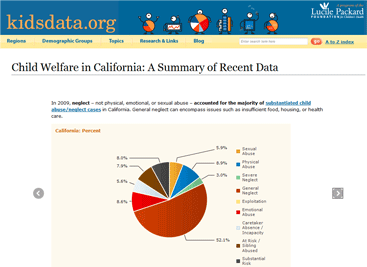 In case you missed our recent advisory, kidsdata.org now has updated child abuse and foster care data. To summarize some of the key findings, we’ve compiled a slideshow to tell the story of child abuse and foster care in California. You can view the slideshow at http://www.kidsdata.org/childwelfare/.
A few key findings:
- In 2009, there were more than 90,000 substantiated (verified) cases of child abuse/neglect in California.
- In 2009, neglect – not physical, emotional, or sexual abuse – accounted for the majority of substantiated child abuse/neglect cases in California.
- The youngest children in California – those under age 3 – accounted for more than 25% of substantiated cases of child abuse/neglect in 2009, a percentage that has increased slightly over the last 10 years.
- Young children in California also are the most likely to be placed in the foster care system. Infants, for example, entered foster care at a rate more than 6 times that of teenagers in ’07-’09.
Check out the slideshow for more key findings with accompanying graphs, and please feel free to share with your colleagues.
Posted by Jordan Handcox
Tags: New Data
Report Card Sheds Light on How Kids Are Faring in San Joaquin Valley
 Widespread poverty emerged as the main headline in the Kern County Report Card, released this week by the Kern County Network for Children.
The report, which includes 160+ measures of child and youth well being, notes the toll that the recession has taken on youth in the area, with family income dropping, unemployment rising, and 25% of kids living below the federal poverty line. But the report showed some areas of improvement as well, including notable decreases in rates of child abuse and children in foster care.
We applaud the Kern County Network for Children for producing this report for 13 years, as data reports such as these help policymakers and community leaders make informed decisions on behalf of kids across California. To read the full report, visit http://www.kcnc.org/stories/storyReader$1328.
Also see data about Kern County kids on kidsdata.org, at http://www.kidsdata.org/kern.
Posted by kidsdata.org
Tags: Child Health Issues, Data Projects
Organizations Statewide Win Grants to Use Data to Promote Children’s Health
Last fall, kidsdata.org launched a pilot program to offer grants to organizations statewide that want to make better use of children’s data in their work. Our goal: To encourage creative strategies for using data to bring attention to key issues facing children, and to promote the use of data in efforts to improve children’s lives.
Interest was strong; we received dozens of worthy proposals from across the state. We ultimately chose 14 proposals, all of which are for approximately $10,000. The grants will be used for a range of purposes, including data analysis and development, training and education, and public information campaigns. Much of the data to be used in the projects will come from kidsdata.org, and the grants will serve children across the state, from Shasta County to Stockton to San Diego. See the full list of grantees >>
As we begin to see results from these grants over the next year, we’ll showcase the projects on kidsdata.org and through this blog. And while this program is a pilot, we encourage you to sign up to be notified of any future kidsdata.org grant opportunities.
Posted by kidsdata.org
Tags: Data Projects, News About Kidsdata.org