


Archive for the ‘Kidsdata News’ Category
Snapshot of Teen Substance Abuse in CA
See this recent article on teen alcohol and drug use in the U.S.
Here in California:
- Nearly 40 percent of male 11th-graders say they have tried marijuana at least once in their lifetime. Just over one-quarter report that they have tried it four times or more.
- 37 percent of 11th-grade girls reported drinking alcohol in the past 30 days.
- Nearly one-third (31%) of 11th grade boys reported ever smoking a cigarette.
- Statewide, about 20% of 11th grade girls and 24% of 11th grade boys reported binge drinking at least once in the past 30 days.
These data come from the 2006-2008 California Healthy Kids Survey (WestEd). Find more data on alcohol, tobacco, and other drugs on kidsdata.org.
Posted by Jordan Handcox
Post Comment
Top 5 Reasons to Use Kidsdata.org: Reason #2 – Get Local
 This week, we continue counting down the Top 5 reasons to use kidsdata.org with an emphasis on the local data available on the site.
County data are good, but city and school district data are even better. On kidsdata.org, we have all three — with statewide comparisons, of course. Better yet, you can compare these local regions to each other to see how children in your community are faring vs. another locale, or any set of regions that you choose.
An example of putting local data into action comes from the Beaumont Unified School District in Riverside County, who reported using kidsdata.org when visiting the Legislative Action Committee for Child Nutrition in Washington, D.C., to give legislators “a snapshot of our district.”
Here’s a sampling of just some of the data on kidsdata.org that are available at a very local level:
- Child population, family structure, immigration, family income, and poverty for regions of 20,000 residents or more.
- College readiness, high school dropouts, math proficiency, and more education data, available by school district.
- Emotional and behavioral health data including alcohol and drug use, dating violence, gang involvement, bullying, depression, and much more, available by school district.
How have you made use of the local data on kidsdata.org for your region?
Posted by Felicity Simmons
Post Comment
Raising Kids in Tulare County: How Are We Doing?
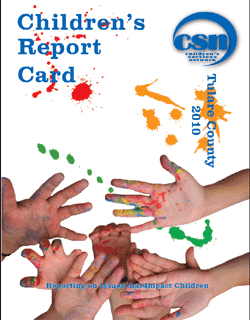 This guest post is by Kalyn Gereg, administrative specialist with the Tulare County Health and Human Services Agency
Recently released by the Children’s Services Network of Tulare County, the Children’s Report Card presents data on 24 demographic, economic, and health-related indicators, providing a synopsis of the status of children and families in this Central Valley county. Four generalized outcome areas are represented, including health indicators for children and youth; school readiness of younger children; economic self-sufficiency of families; and family and community safety.
The Children’s Report Card shows that Tulare County is doing better in several areas, but many challenges remain. The rate of births to teens in Tulare County has been far above the state rate for several years; however, a decrease in recent years is a notable improvement. Other areas of improvement include physical fitness levels, number of children in foster care, and children with required immunizations.
The purpose of the Children’s Report Card is to inform and educate the community; to raise awareness of the need for targeted interventions to improve outcomes; and to highlight “promising practices” contributing to improved outcomes. Data reports such as these help policymakers, funders, service providers, and community leaders make informed decisions regarding planning and implementing services throughout the community.
Please read the full report on the Children’s Services Network of Tulare County website, http://www.tccsn.org. See a profile of data about children in Tulare County on kidsdata.org at http://www.kidsdata.org/tulare.
Posted by kidsdata.org
Post Comment
Why Use Kidsdata.org? Let Us Count the Ways…
 Following the completion of kidsdata.org’s statewide expansion last summer, our foundation pointed out the top 5 reasons to use the site. This summer, in order to mark the one-year anniversary of the website going statewide, we’ll highlight each of those Top 5 — in no particular order — and share some examples of how kidsdata is being used to improve the lives of children across California.
This week, we feature Reason #1 to Use Kidsdata.org — to save time, money, and effort. Ok, maybe that’s three reasons; but they’re all about using resources efficiently — something for which we all strive.
Why surf the web for hours looking for 10 different data points for a grant proposal when you may be able to find them all in one place? (Hint: that place is kidsdata.org) As a public service, we offer free access to data from more than 35 public data sources.
For example, the Central California Children’s Institute says they use kidsdata “almost on a daily basis to look for socioeconomic, health, safety and education data on children of the eight-county-wide San Joaquin Valley region.”
What a time-saver!
Has kidsdata.org helped you save time or money? Tell us about it!
Posted by Felicity Simmons
Post Comment
Data Updates: High School Dropouts and Homelessness
We recently updated two important measures of the well being of California students: homelessness and high school dropouts.
Data from ’09 on high school dropouts, from the California Department of Education, indicate that an estimated one in five public high school students in California (22%) will drop out at some point during high school. These data also are available at the county and school district level. Find data for your school district>>
The data show wide disparities among racial/ethnic groups. The lowest estimated dropout rates are for Asian American and Filipino students (about 10%). African American/Black, Native American, Hispanic/Latino, and Pacific Islander students have the highest estimated dropout rates, at or above 25%.
For homelessness, data are available at the state level and show that about 3% — or nearly 194,000 — public school students in grades K-12 were homeless in 2010. The data source, the National Center for Homeless Education, designates a student as homeless if their primary nighttime residence is a shelter, hotel or motel, a shared space with another family due to economic hardship, or no shelter. Learn more about these data>>
Posted by kidsdata.org
Post Comment
More Than Half of U.S. Babies Are Minorities, Census Estimates Show
Recent Census Bureau estimates of the 2010 census results show that for the first time in the U.S., minorities make up the majority of births. According to related ’09 census data, slightly less than half of children age 3 are non-Hispanic whites, compared to 60% in 1990.
Here in California, the percent of births to Caucasian/White mothers has been dropping steadily. In 1995, 36% of births were to Caucasian/White mothers, and by 2007, that dropped to 27% of births.
Posted by Jordan Handcox
Tags: Child Diversity
Study: Employer-Based Health Coverage Rates Falling Across U.S. — See Related Data for CA Children
According to a recent report from the State Health Access Data Assistance Center at the University of Minnesota, the rate of U.S. non-elderly workers with employer-based health insurance dropped 8 percentage points between 1999-00 and 2008-09, from 69% to 61%. Low- and moderate-income families were affected the most, according to the study.
In California, the study indicates that the percentage of employees with health coverage from their jobs fell from 62% in 1999-00 to 55% in 2008-09.
Related data on kidsdata.org from the California Health Interview Survey (CHIS) show that in 2009, 53% of California children ages 0-17 had employer-based coverage and about 43% were insured from other sources, leaving roughly 5% uninsured. According to the CHIS data, the percentage of children with employer-based coverage has decreased since 2001.
Posted by kidsdata.org
Post Comment
Santa Clara County Supervisors Vote to Make Use of Child Impact Statements
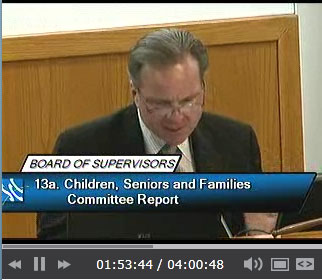 Given our foundation’s mission to elevate the priority of children’s health, it’s encouraging to see that the Santa Clara County Board of Supervisors has taken steps to consider the impact its decisions have on the county’s 430,000 children.
On June 21, the Board voted to adopt Child Impact Statements as part of every decision, beginning July 1. Proposed by Supervisor Dave Cortese as part of his Year of the Child initiative for 2011, these impact statements will help supervisors consider implications of given policies on children and youth.
To hear the Board’s vote, and accompanying support statements, watch the video.
See data about Santa Clara County kids at http://www.kidsdata.org/santaclara.
Posted by kidsdata.org
Post Comment
Allergies May Affect More Kids Than Thought — See Related CA Data for Kids with Special Needs
You may have seen the study released this week noting that nearly 6 million U.S. children have food allergies — more than some previous research suggested. According to this article in the Los Angeles Times, a recent study of 38,000 children, conducted by the Northwestern University Feinberg School of Medicine, found that many children suffer severe reactions from allergies, and that many are allergic to more than one food.
Among children with special health care needs in California, nearly half (48%) have allergies (of any type — not only food), according to 2005-2006 data. For more data on California’s children with special health care needs, visit http://www.kidsdata.org/cshcn.
Posted by kidsdata.org
Tags: CSHCN
A New Look at the History of American Families
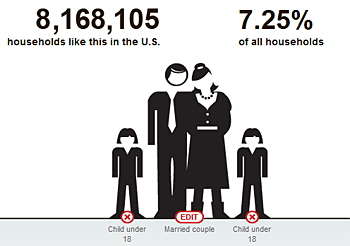 Have you ever wondered how many other families are just like yours?
This interactive tool from the New York Times analyzes census data since 1900, and shows the make-up of households in the U.S. For example, in 2009, about 8 million households in the U.S. consisted of a married couple with two children (about 7% of all households). That’s almost the exact same percentage as in 1900.
As for other types of families, the percentage of households with single women and two children increased from about .4% to 1.6% in the last century, and recent data indicate that more than 62% of those households has an income below $30,000. Male unmarried partners with one child make up about 17,000 households in the U.S., and unmarried female partners with one child account for about 30,000 households.
If you’re looking for more local data, kidsdata.org has data on family structure for cities, counties, and school districts across California, including single parent households, and children in the care of grandparents.
Posted by kidsdata.org
Tags: Data Projects, Data Sources