


Archive for the ‘Kidsdata News’ Category
California Ranks 16th in Annual KidsCOUNT Data Book
The state of California ranks 16th in the 2011 KidsCOUNT Data Book, an annual profile of the status of children, released this week by the Annie E. Casey Foundation. The Data Book ranks states on 10 measures of child well being, and California’s ranking this year is an improvement since last year’s rank of 19.
In fact, the 2011 Data Book shows improvements for California in many areas, including the number of babies born at a low birthweight, child and teen deaths, teen births, and teens ages 16-19 not in school.
Some areas, however, do not show improvement. Infant mortality rates have increased slightly in recent years, according to National KidsCOUNT indicators. Additionally, the number of children living in poverty and living in single-parent families has increased, the Data Book shows.
In order to address the impact of the recession on California children, this year’s Data Book includes two new indicators: the number of children affected by foreclosure, and households with at least one unemployed parent.
In California, nearly 1 million children have been affected by foreclosure since 2007. And, in 2010, 1.2 million California children had a parent who was unemployed. Overall, the economic well-being for low-income children and families in California has declined significantly in the past decade, according to the Data Book.
Visit kidsdata.org for additional data by county, city, school district, and legislative district>>
Posted by kidsdata.org
Tags: Data Projects, Data Sources
Measuring Environmental Factors that Influence Children’s Health
Children’s environmental health is an emerging area of research. While available data do not yet address all aspects of environmental health, kidsdata.org just launched five key measures with local data to draw attention to environmental influences on children’s health and to encourage exploration of these issues.
What are environmental influences on kids’ health? Examples include air pollution from traffic, lead in old paints and plastic, pesticides, and chemical contaminants in tap water. These environmental pollutants can put children at risk of developing serious illnesses, such as respiratory disease (e.g., asthma), cognitive defects, and cancer1,2.
Here’s more about the new measures on kidsdata.org and why they matter:
Air Quality
Long-term exposure to high levels of ozone (the primary constituent of smog), as well as high concentrations of fine particulate matter in the air (largely from motor vehicle exhaust), are associated with a variety of breathing and heart problems3,4. Children living within 75 meters of a major road are at significantly higher risk for developing asthma and have a greater number of asthma-related emergency room visits than children who live fartherfrom traffic5. See related data >>
Lead Poisoning
Lead, found mostly in old/chipping paint and contaminated soil, can cause low IQ scores, behavioral problems, seizures, and coma at different levels of exposure6. Children are especially vulnerable to toxic substances such as lead, as their systems are more fragile and their skin is more permeable. Young children also come into greater contact with toxins by playing or crawling on the ground, and through hand-mouth contact7. See related data >>
Water Quality
Levels of contamination that exceed the maximum allowed for drinking water — and documented failure to monitor drinking water contamination — indicate a higher risk of childhood exposure to toxic levels of bacteria, metals, and chemical residue. See related data >>
Sex Ratio at Birth
Environmental factors, such as exposure to endocrine disruptors (synthetic chemicals that mimic or block hormones) and second-hand smoke, may influence the sex ratio at birth by affecting human sex hormones and their regulation. The expected ratio of males to females born is 1.05 males to every 1 female (1.05:1). Concern mounts when there are fewer males than females born, i.e., less than 1 male to every 1 female8. See the data >>
Indicators within all of these topics will be updated and expanded as new data emerge. We welcome your feedback and insights on these new important measures of child well being.
Also see kidsdata.org’s Research & Links section for websites and reports with more information related to environmental health.
(1) Centers for Disease Control and Prevention (CDC). (2009). National Report on Human Exposure to Environmental Chemicals. http://www.cdc.gov/exposurereport/
(2) California Department of Public Health (CDPH). (2009). Prematurity & Growth Retardation.
http://www.ehib.org/page.jsp?page_key=69
(3) California Department of Public Health. (2009). Air Contaminants: Particulate Matter.
http://www.ehib.org/page.jsp?page_key=90#pm_health
(4) United States Environmental Protection Agency.(2011). Ground-level Ozone. http://www.epa.gov/glo/
(5) McConnell, et al. (2006). “Traffic, Susceptibility, and Childhood Asthma.” Environmental Health Perspectives, 114(5), 766–772. http://www.ncbi.nlm.nih.gov/pmc/articles/PMC1459934/
(6) Godwin, H. (2009). “Southern California Environmental Report Card: Lead Exposure and Poisoning in Children.” UCLA Institute of the Environment.
http://www.environment.ucla.edu/reportcard/article.asp?parentid=3772
(7) United States Environmental Protection Agency. (2007). A Decade of Children’s Environmental Health Research: Highlights from EPA’s Science to Achieve Results Program. http://www.epa.gov/ncer/publications/research_results_synthesis/
(8) Centers for Disease Control and Prevention. (2010). Sex Ratio and the Environment.
http://ephtracking.cdc.gov/showRbSrEnv.action
Posted by Andy Krackov
Tags: New Data
Another Use for Kidsdata.org: See the Status of Kids in Your County
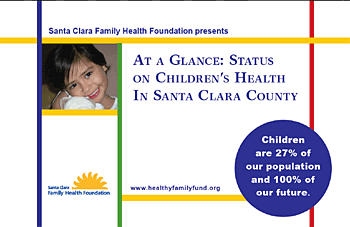 The Santa Clara Family Health Foundation’s data book “At a Glance: Status of Children’s Health in Santa Clara County” is an excellent example of how kidsdata.org can be used to facilitate discussions about child health issues.
The 40-page booklet includes data about birth rates, teen births, and immunizations from kidsdata.org, and many other topics from other data sources, including health coverage, water fluoridation, and mental health. While this booklet focuses on Santa Clara County, a similar report could be made for any county in California.
Kudos to the health foundation for creating a valuable snapshot of the status of child health in its county. This book is a useful reference for elected officials and other local policymakers. View the data book>>
Posted by Felicity Simmons
Tags: Data Projects, Data Sources
Back to School Checklist Helps Get Kids Off to a Healthy Start
 PICO California and the 100% campaign (a joint venture of the Children’s Partnership, Children Now, and the Children’s Defense Fund) have released a new checklist to help parents get their kids off to a healthy start this school year. The checklist reminds parents to schedule dental appointments (and set a reminder to re-schedule every six months), obtain required immunizations and physicals, and ensure coverage in a healthcare insurance plan.
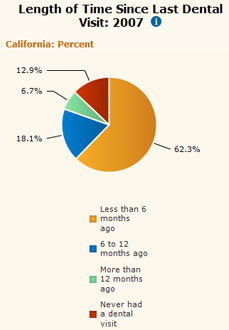
According to 2007 data on kidsdata.org, over 6% of children had not seen a dentist in over 12 months, and another 13% of children had never seen a dentist.
In 2009, 5% of children ages 0-17 in California did not have any health coverage.
See the checklist to make sure your child is healthy for back-to-school >>
Posted by kidsdata.org
Tags: Child Health Issues
Just Updated – Resource Guide for After-School Programs
 The companion Resource Guide to the 2008 report, Putting It All Together: Guiding Principles for Quality After-School Programs Serving Preteens, has just been updated. Both the report and this companion guide were commissioned by the Lucile Packard Foundation for Children’s Health and produced by Public/Private Ventures.
This online Resource Guide provides recent research and tools to help service providers strengthen their after-school programs, particularly those serving preteens. The guide is organized around the six principles of quality after-school programs that are described in the above-mentioned report from 2008.
For data on preteens, visit kidsdata.org.
Learn more:
Posted by kidsdata.org
Tags: Reports
New HHS Guidelines Help Ensure Preventive Health Care for Women
 The U.S. Department of Health and Human Services announced this week a set of guidelines that require health insurance plans to provide preventive health care services to women at no additional cost (i.e., without the need for co-payments, co-insurance, or deductibles). The guidelines, developed by the nonpartisan Institute of Medicine, will take effect in January 2013 for most insurance plans, according to an article in the New York Times.
Among the covered services are FDA-approved contraception methods, breastfeeding support, and counseling for domestic violence victims. Providing these, and other, preventative services to women at no additional cost is one way HHS aims to prevent teen and unintended pregnancies (the latter of which accounts for 35% of U.S. pregnancies, according to the National Survey of Family Growth).
Kidsdata.org offers data that relate to many of these issues, including:
- Teen births: In 2007, there were 37 births for every 1,000 teens ages 15-19 in California. Find data for your county. See more information about teen births.
- Breastfeeding: 2009 data show that 52% of California infants were breastfed exclusively in the hospital after birth, but percentages vary widely by county, from 14% to 86%. Find data for your county. See more information about breastfeeding.
- And domestic violence: In 2008, over 160,000 Californians placed calls for assistance with domestic violence. Find data for your county. See more information about dating and domestic violence.
Posted by kidsdata.org
1 Comment
Brief Ranks CA Counties on Healthful Food Options
 A recent study by the UCLA Center for Health Policy Research shows that providing accessible, healthier food options where children live leads to healthier kids. The study focuses on the food environments in which teens live and go to school, and particularly on the amount of healthy and unhealthy food outlets available in those environments.
The brief measures the Home and School Retail Food Environment Index for each county. Healthful food outlets include grocery stores and produce vendors, and unhealthy food outlets include liquor stores, fast food restaurants, and convenience stores.
According to the brief, a majority of California counties have too many unhealthy food outlets and not enough healthy outlets in the vicinity of children and teens.
So how does your county fare? Overall, the county with the most healthful food options is Nevada County, whereas the county with least amount of healthful food options is Sutter County. See how your county fared in the study>>
Results are also broken down regionally. The Central Coast is the region with the healthiest food options, and the Sacramento area has the unhealthiest food choices. See how healthy your region’s food options are>>
On kidsdata.org, you can find related data on nutrition and children’s weight.
Posted by kidsdata.org
Tags: Child Health Issues, Data Sources
A Roundup of Recent News Stories: Articles About Tooth Decay, Insurance for the Poor, the Media, and More
Following are some recent news highlights about children and families from our July News Round-Up, along with related data from kidsdata.org:
Dental Care (see related data)
- Tooth Decay Prevalent Among Poor Children, Government Figures Show
(LA Times, 7/1/11, by Mascarelli)
Family Structure (see related data)
- Study: Dads Spend More Time with Children Now Than 50 Years Ago
(AP, 6/16/11, by Yen) - Study Finds Health Disparities for Single Mothers
(NY Times, 6/13/11, by Rabin)
Health Care (see related data)
- First Study of Its Kind Shows Major Benefits of Providing Medical Insurance to Poor
(NY Times, 7/7/11, by Kolata) - Opinion: For Children on Medicaid, the Doctor Is Out
(NY Times, 6/16/11, by Parker-Pope)
Media (see related data)
- Study: Youth of Color Spend More Time Consuming Media Than White Youth
(New America Media, 6/10/11)
Posted by Jordan Handcox
Tags: Child Diversity, Child Health Issues
In Case You Missed It: The Top 5 Reasons to Use Kidsdata.org
 |
Watch this video about the Top 5 Reasons to Use Kidsdata.org |
In any line of work on behalf of kids, kidsdata.org can be an invaluable resource for grant writing, program planning, community assessments, communications and advocacy work, policymaking, and many other in initiatives. Earlier this summer, we blogged about the Top 5 Reasons to Use Kidsdata.org. In case you missed them, here they are again:
- Kidsdata helps you use resources more efficiently by bringing together more than 35 trusted public data sources into one, free public service.
- Find and compare local data — for every city, county, and school district in California.
- Customize data for regions or demographic groups, and find the data display (map, bar graph, table, etc.) that works best for you.
- Share data instantly via social media, e-mail, or by downloading into Word, Powerpoint, or Excel.
- Stay up-to-date on new data for the children you serve via customized e-mail alerts, Kidsdata Advisory newsletters, Facebook and Twitter.
Learn how others have used kidsdata.org on our Kidsdata In Action page.
Posted by kidsdata.org
Post Comment
This Week Is World Breastfeeding Week
It’s World Breastfeeding Week, and we’re celebrating by sharing updated breastfeeding data for California. Breast milk is widely acknowledged as the most complete form of nutrition for infants, and offers variety of benefits for infant health, growth, and development. Breastfeeding also offers multiple health advantages to mothers, including reducing breast and ovarian cancer risk. Increasing the proportion of children who are breastfed during the first year of life — as well as the proportion who are breastfed exclusively up to the age of three months — are important public health goals.
According to the California Department of Public Health, in 2009, 52% of infants in California were breastfed exclusively in the hospital after birth. Among counties, percentages of exclusive breastfeeding ranged widely from 14% to 86%. Find data for your county >>
Percentages also ranged among racial/ethnic groups; Caucasian/White infants had the highest exclusive breastfeeding percentages, while Hispanic/Latino and African American infants had the lowest.
Learn more about breastfeeding >>
Posted by kidsdata.org
Tags: Child Health Issues, Health Observances