


Archive for the ‘Kidsdata News’ Category
Health Observances for September: Cancer, Suicide Prevention, and More
 September is a busy month for health observances. Following is a partial list with accompanying data from kidsdata.org.
Fruits and Veggies- More Matters Month
National Childhood Obesity Awareness Month
- The percentage of California 5th and 7th graders at a healthy weight (69% for both in 2010) has held fairly steady over the past decade, while the percentage of 9th graders at a healthy weight improved slightly, from 65% in 2002 to 71% in 2010.
Childhood Cancer Awareness Month
- According to 2002-2006 data, leukemia was the most commonly diagnosed type of cancer in CA children ages 0-19, with a rate of 4.9 per 100,000.
- 16 of every 100,000 CA children were diagnosed with cancer, according to 2002-2006 data.
National Infant Mortality Awareness Month
- 5.2 of every 1,000 infants died before their first birthday in CA, according to 2005-2007 data.
National Alcohol and Drug Addiction Recovery Month
- Data from 2006-2008 show that a higher percentage of CA male vs. female 7th graders report that they don’t use drugs (64% vs. 52%), but by 11th grade, the opposite is true: a higher percentage of female vs. male 11th graders report that they don’t use drugs (71% vs. 67%).
National Suicide Prevention Week
- Overall, youth suicide rates in CA are trending downward. The state’s youth suicide rate in 2005-07 was 6.9 per 100,000 youth ages 15-24, substantially lower than the rate of 9.4 in 1995-97.
Posted by kidsdata.org
Tags: Health Observances
Long-Term Growth in CA’s Public School Enrollment Masks Recent Declines
The take-home message from this accompanying graph of public school enrollment in California may seem to be the overall rise in California’s student population from 1994 to 2011. Last school year, California’s public schools enrolled 6.2 million students, which is about 1 million more students than in 1994. That’s an 18% increase.
At closer examination, however, the slight decrease from 2005 to 2011 is also a noteworthy trend. Across California, there were about 105,000 fewer students enrolled in public schools last school year than in 2005. And of 1013 school districts with both 2005 and 2011 data, more than half enrolled fewer students last school year than they did in 2005 (see data for your school district). 60% of counties experienced enrollment declines, too; rural counties were the hardest hit with enrollment declines.
In general, as school enrollment decreases, so does average daily attendance (ADA). Declines in ADA result in decreased per pupil funding from the state.
Some other noteworthy facts from the public school enrollment data recently updated on kidsdata.org:
- According to 2011 data, more than half (55%) of California’s public school students are in five Southern Californian counties (Los Angeles, Orange, San Diego, Riverside, and San Bernardino).
- In the ’10-’11 school year, Los Angeles County alone made up over 25% of public school enrollment for California; on its own, the Los Angeles Unified School District made up over 10%.
- From 1994 to 2011, enrollment growth was particularly notable in two counties – Placer (74%) and Riverside (69%).
Posted by Andy Krackov
Tags: New Data
California’s Changing Demographics Mirrored in School Enrollment Trends
Last school year, more than half (51%) of students in California’s public schools were Hispanic/Latino. But this hasn’t always been the case; Hispanic/Latino students only recently became a majority of California’s public school population.
Over the past two decades, in fact, we’ve seen notable shifts in the racial/ethnic composition of California’s public school students, as evidenced by this graph (click the bar graph tab, then press play).
Here in California, about three out of every four students in public schools are students of color. As noted, more than half of these students were Hispanic/Latino in 2011, up from 37% in 1994. By comparison, the proportion of students who were Caucasian/White dropped from 42% in 1994 to 27% in 2011.
Map Racial/Ethnic Enrollment Data for Your Community
Following are maps providing local-level data on public school enrollment in California. In each map, you can use the “Show Regions” menu to toggle between school district and county-level data.
- African-American/Black Students
In California, Solano County (17%) and Alameda and Sacramento counties (both at 14%) had the largest percentage of African American/Black public school students last school year. See map >>
- Asian-American Students
Among California counties, San Francisco (39%) and Santa Clara (27%) had the largest percentage of Asian American public school students last school year. See map >>
- Caucasian/White Students
The California counties where 60% or more of students are Caucasian/White all are in Northern California, according to data from last school year. See map >>
- Filipino Students
Among California counties, Solano (9%), San Mateo (8%), and San Francisco (5%) had the largest percentage of Filipino public school students last school year. See map >>
- Hispanic/Latino Students
Among California counties, Imperial (89%) and Monterey (74%) had the largest percentage of Hispanic/Latino public school students last school year. See map >>
- Multiracial Students
Multiracial students make up 1.8% of public school students in California, according to 2011 data. See map >>
- Native American/Alaskan Native Students
Across California, there were 43,546 Native American/Alaskan Native public school students last school year. See map >>
- Pacific Islander Students
San Mateo County had the largest percentage of Pacific Islander public school students in 2011 (2.5%). See map >>
Posted by Andy Krackov
Tags: New Data
How Would You Improve Kidsdata.org?
One of our goals here at the Lucile Packard Foundation for Children’s Health is to make key children’s health data accessible and easy for you to use in your work on behalf of children in California. To that end, we’re constantly working to improve kidsdata.org — and many of those enhancements come directly from user suggestions. A few examples:
- The ability to add a graph from kidsdata.org to your website
- Customizable e-mail alerts when data are updated
- A video tutorial of the site
- An alphabetical listing of data available on kidsdata.org
- This blog, as a forum for discussion about data
And many, many more.
While we certainly have a number of improvements in the works, including a few that we will announce this fall, we want to hear from you. What enhancement would you like to see on kidsdata.org? Please share your thoughts in a comment below, or by e-mailing us at [email protected]. We’ll be sure to consider your insights in our plans for the website.
Posted by Felicity Simmons
Post Comment
Health Observance Highlights Importance of Childhood Injury Prevention
National Child Injury Prevention Week begins this Thursday, Sept. 1. How many children suffer from injuries in your county? You can find out at kidsdata.org.
According to data recently updated on kidsdata.org, after a 7-year decline, the rate of hospitalizations for unintentional injuries in California has increased in recent years for children ages 1 to 4. In fact, the unintentional injury hospitalization rate declined for every other age group between 2007 and 2009 — 1-4-year-olds were the only age group for which rates increased.
These data are underscored by a recent American Academy of Pediatrics report about injuries from children accidentally falling out of windows, which found that children under age 4 were more likely to suffer head injuries and be hospitalized for their injuries than older children.
Organizations such as Safe Kids USA, the California Injury Prevention Network, and the CDC’s Youth Risk Behavior Surveillance System offer information and tips on keeping kids safe. If you know of other resources, please list them here.
Posted by kidsdata.org
Tags: Child Health Issues, Data Sources, Health Observances
America’s Children: New Report Compiles Federal Data
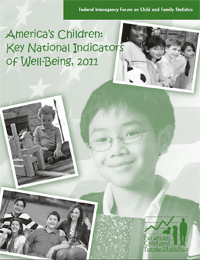 A new report released this week by the Federal Interagency Forum on Child and Family Statistics (a.k.a. ChildStats.gov) summarizes how American children are faring using 41 key indicators offered through federal data sources.
This annual report, America’s Children: Key National Indicators of Well-Being, 2011, aims to depict “both the promises and the challenges confronting our Nation’s young people.” The report includes measures of child well being in seven areas: family and social environment, economic circumstances, health care, physical environment and safety, behavior, education, and health.
Highlights include:
- Family structure data — married and single parents, and foreign-born parents (Also available on kidsdata.org)
- Adolescent birth rates (Also available on kidsdata.org)
- Child abuse rates (Also available on kidsdata.org)
- Children with working parents
- Health insurance coverage (Also available on kidsdata.org)
- Housing cost and adequacy (Also available on kidsdata.org)
- Adoption data
Posted by kidsdata.org
Tags: Data Projects, Data Sources
Asthma and Environmental Health: See Our Data Slideshow
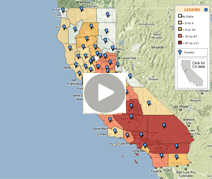 In recent weeks, we’ve updated data for asthma diagnoses and asthma hospitalization rates, and added an entirely new category — environmental health. Measures of environmental health include air quality, water quality, lead poisoning, and sex ratio at birth.
There are many ways to learn about these data:
- View a slideshow of highlights from these data >>
- Read our e-mail advisories about asthma and environmental health
- View, customize, download and share the asthma and environmental health data on kidsdata.org.
- Sign up to receive a customized e-mail alert when we update these data again >>
Posted by kidsdata.org
Post Comment
Just Updated: Data on Asthma Diagnoses and Hospitalizations
You can add this graph — or any other graph/map — to your website. Just click “embed” at the top right corner of any data page. |
How many California kids have asthma? Maybe more than you thought.
As the most common chronic condition among children in the U.S., asthma affects roughly 14% of California children ages 1 to 17 — about 1.3 million kids. These data, collected by the California Health Interview Survey, recently were updated on kidsdata.org and are available for most counties.
Also just updated, the rate of asthma hospitalizations among California children ages 0-17 increased slightly from 2008-2009, but is down overall since 1998. Thanks to the California Department of Public Health for these data.
Here are a few more highlights:
- Asthma hospitalization rates in 2009 were three times higher for California children ages 0-4 than for children ages 5-17. In 2009, more California children under age 5 were hospitalized for asthma (6,288) than all older children (those ages 5-17) combined.
- Among California counties with available data, the percentage of children diagnosed with asthma varied widely, from 8% to 31%.
- Among California counties with available data, Alameda, Fresno and Imperial had the highest childhood asthma hospitalization rates from ’06 to ’09.
Posted by kidsdata.org
Tags: New Data
Kidsdata Grant Recipient Featured for Program to Encourage Healthful Habits Among Kids/Families
 Earlier this year, the Lucile Packard Foundation for Children’s Health announced grants to organizations statewide to promote the use of data—including data from kidsdata.org—to foster improvements in children’s health and well being.
One grantee, KIXE-TV, which broadcasts to more than 500,000 people every week in ten Northern California counties, was awarded a grant to promote healthful habits among children and families and was recently featured in two publications, The Record Searchlight (scroll down) and A News Café. You also can see an announcement of KIXE-TV’s video contest, encouraging families to describe how they create healthful habits in eating, reading, parenting, or spending time together.
See all 14 grants we recently awarded to California organizations.
Posted by kidsdata.org
Post Comment
Kidsdata.org: Helping Reporters Find the Local Angle
 You may have seen recent news coverage of data analysis by the Food Research and Action Center noting that 1 in 4 California families can’t afford food for their kids.
Written by New America Media’s Paul Rodriguez, the article examines food hardships faced by communities across the state. To bolster that information, Rodriguez used local data from kidsdata.org to round out the story, by noting the number of students eligible for the Federal Free/Reduced Price School Meal Program and including demographic information about children in California.
We encourage reporters to use kidsdata.org to put a local face on a news story — and we’re available to help you find the facts you need. We often can provide a visual, such as a map or a trend graph to go along with your article.
Please contact us at (650) 724-5778 or [email protected]. Don’t forget to sign-up for an e-mail alert to learn when data of interest to you are updated.
Posted by kidsdata.org
Post Comment