


Archive for the ‘Kidsdata News’ Category
Despite Steady Increases Statewide, Fewer than Half of CA Third Graders Proficient at Reading
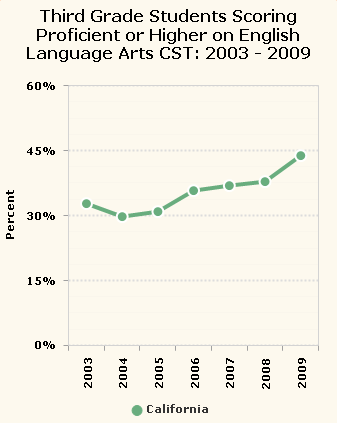 One of the leading indicators of students’ academic progress and likely school success is their level of reading at the end of third grade. In California, although steady increases in reading proficiency have been seen since 2005 across all ethnic and socioeconomic groups, fewer than half of California third graders score proficient or higher on the state’s English language standardized test.
Despite increases in reading proficiency across all groups, substantial disparities remain. For instance, fewer than one in four Latino third graders read at or above the 50th percentile, the lowest of any racial/ethnic group in CA. These gaps also exist between low-income and higher-income students.
The Annie E. Casey Foundation also recently released a report, Early Warning! Why Reading by the End of Third Grade Matters, which notes that California ranks 46th in the percentage of 4th-graders who are not proficient in reading.
Children need a variety of support beginning at an early age in order to read proficiently by third grade. They must be ready to learn when they enter school, which means having access to opportunities to help them build basic cognitive, social, emotional and physical skills. Children who do not have access to such opportunities may need extra support to catch up; otherwise, they tend to fall further behind over time.
Do you see these trends in your school or district? Has your school or district found effective measures to help close these proficiency gaps?
Posted by kidsdata.org
Tags: New Data, Statewide Expansion
Could You Live Off of California’s Minimum Wage?
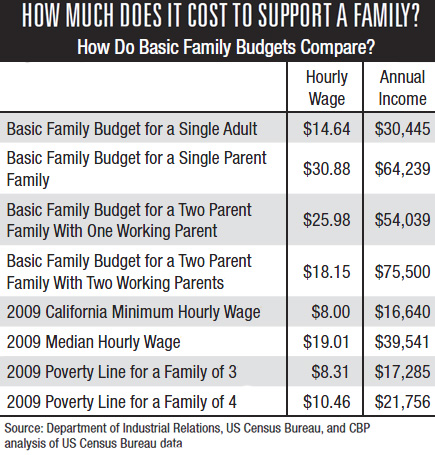 A new report from the California Budget Project brings to light an issue that has a profound effect on the health and well being of children — living off minimum wage in California may be next to impossible.
According to the report, a single parent family with two children needs an annual income of $64,239 – equivalent to an hourly wage of $30.88 for a 40-hour workweek – to provide the basics: child care, health coverage, food, rent, utilities, transportation, and other modest expenses.
Yet the minimum hourly wage of $8 per hour generates an annual income of $16,640 for a 40-hour workweek – less than half of what’s needed to get by, according to the report. The impact on child well being can be wide-ranging. Children living in poverty are more likely to go hungry, reside in overcrowded or unstable housing, be exposed to violence, and receive a poorer education. Poverty also exposes children to chronic stress, which can hinder their physical, social, and emotional development. Children in families with inadequate income may face more substantial health problems than those in families with enough to meet basic needs.
The report is worth a look. In addition to offering statewide numbers, it includes data for all counties in California.
Posted by kidsdata.org
Tags: Child Health Issues, Data Projects
New Feature: Add Graphs to Your Website That Update Automatically!
Just launched on kidsdata.org — a new way to share data.
You already were able to download data in to Excel, copy charts into Word or Powerpoint, and print a pdf summary of data. Now, you can add a graph to your website or blog. Simply find the data you’re interested in, customize the chart with your preferences, and click “embed” in the top right.

You can embed any map, table, or graph from kidsdata.org. The chart will update whenever data are added to kidsdata.org. Here’s an example:
Posted by Felicity Simmons
Tags: New Features, News About Kidsdata.org
Children’s Network of Solano County Uses Kidsdata.org in 2010 Report Card
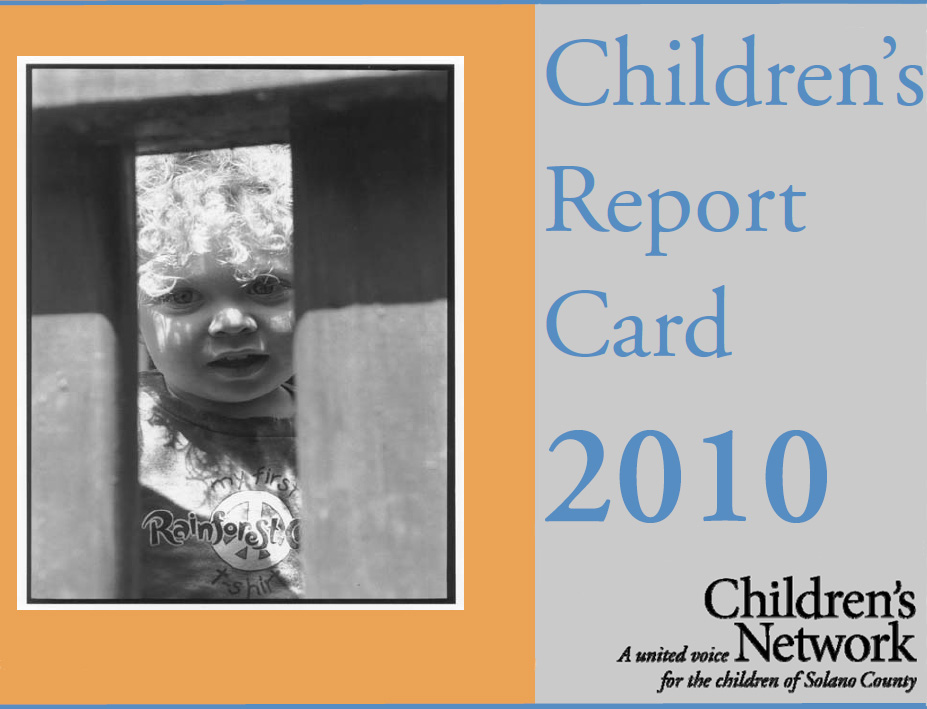
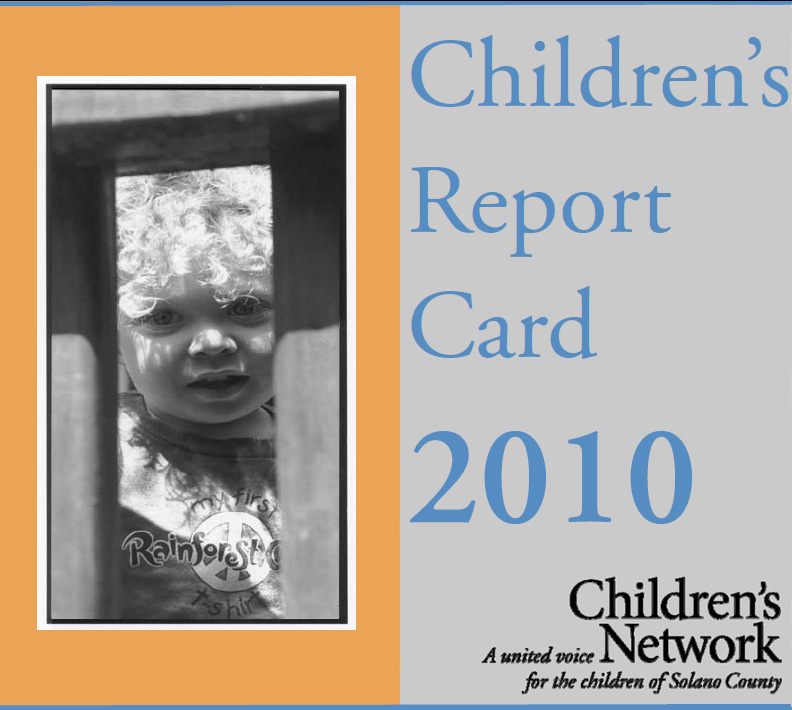 To help the Solano County Board of Supervisors understand and address the needs of the county’s 108,000 children, the Children’s Network of Solano County has published a Children’s Report Card regularly over the past decade.
The 2010 edition offers a number of recommendations based on data in the report – preserving the basic infrastructure of government services provided to kids; investing more in prevention and early intervention; and involving community-based organizations and advisory councils in planning.
The report also references facts and figures from kidsdata.org numerous times, including data ranging from family economics to emotional, behavioral and physical health.
Since the beginning of the recession, Solano County families have experienced economic hardships in the form of high unemployment, widespread home foreclosures, and dwindling budgets for social programs, as the report notes. A report card helps elected officials and policymakers understand the current impact of these developments and plan for the future.
Solano County’s 2010 Children’s Report Card is a terrific example of how people working on behalf of children can use kidsdata.org. We’d like to thank the Children’s Network of Solano County for using kidsdata.org, and encourage all organizations to reference kidsdata.org in their research, reports, and grants.
Posted by kidsdata.org
Tags: Data Projects, News About Kidsdata.org
Learn About LA’s Communities Using the LA Times New Neighborhood Map
Ever wanted to know more about your neighbors, but were afraid to ask?
Well, the LA Times has asked about your neighbors for you — and mapped out the answers with its neighborhood mapping project.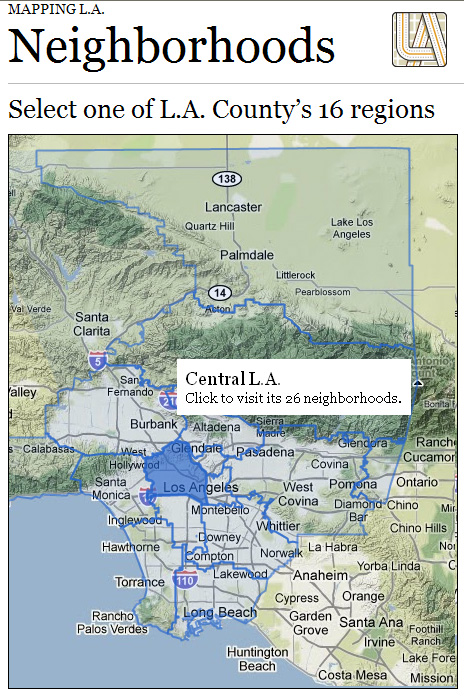
Through a joint effort, the Los Angeles Times and its readers have mapped L.A., providing individual maps and statistics for approximately 158 cities and 114 neighborhoods within the city.
The Times’ neighborhood maps offer information regarding income, education, schools, age, population, and ethnicity, along with up-to-date news from each selected area. You can click on a region to see the neighborhoods available, and then click on any one to view a more detailed map.
As an example, the maps show considerable differences among education levels. In the San Marino neighborhood of the San Gabriel Valley, 70 percent of residents age 25 and older have a four-year college degree, while in the nearby South El Monte neighborhood, that number is a drastically lower 3 percent.
This new mapping tool may well become a valuable resource for Los Angeles-area neighborhoods. Do you know of similar projects statewide where media organizations have mapped their community?
Posted by kidsdata.org
Tags: Data Projects
One in Three CA High School Graduates Ready for College
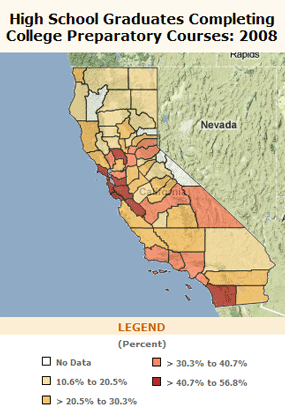
New college readiness data on kidsdata.org indicate that in 2008, about one in every three high school graduates was college ready – as measured by completion of college preparatory courses required for admission to the UC and CSU systems with a grade of “C” or better.
Looking specifically at counties and how they compare to the state average, the top five counties were all in the Bay Area.
Drilling down to specific parameters such as school districts and race/ethnicity, some wide disparities appear. At the school district level, college readiness ranges from two percent in some districts to more than 75 percent in others. Ethnically, 59 percent of Asian American students are ready for college, while African American and Hispanic students are both at 23 percent.
Are these numbers surprising to you? Without knowing the data, what percentage of high school graduates would you guess to be college ready?
Posted by kidsdata.org
Tags: New Data
Our Melting Pot: A California Perspective on the Generational Divide Over Immigration
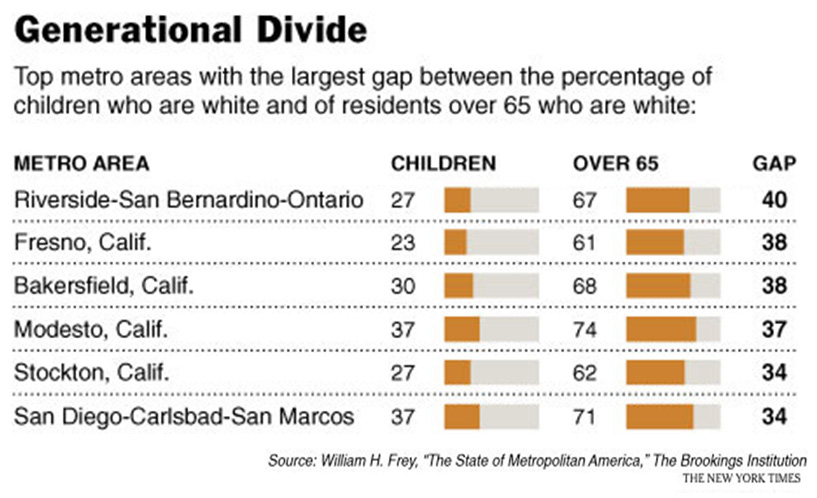 California, it turns out, is diverse even within its diversity, at least judging by newly available immigration data from the Census Bureau’s American Community Survey. In Shasta, Mendocino, Tuolumne, and many other counties, the percent of residents who are foreign born is a tiny fraction of the overall population, adults or kids. But in other counties – Los Angeles, San Francisco, San Mateo, and Santa Clara – nearly half (or more) of residents in some age groups are foreign born.
Another interesting demographic difference is the generational divide evident in a graphic from the New York Times. California is home to six of the 11 metropolitan areas nationwide that have the largest gap between the percentage of children who are white and of residents over 65 who are white: Riverside-Ontario-San Bernardino, Fresno, Bakersfield, Modesto, Stockton, and San Diego-Carlsbad-San Marcos.
These data are compelling, given survey results that show a generational difference on opinions regarding immigration. A recent New York Times article offers insights as to why younger and older generations differ about their feelings on immigration. The article notes that baby boomers and older Americans “came of age in one of the most homogeneous moments in the country’s history.” In 1970, for example, less than 5 percent of the country was foreign born. By contrast, 13 to 15 percent of the U.S. was foreign born from 1860 through 1920. That percentage – roughly three times the figure in 1970 – is actually quite similar to breakdowns today.
Posted by Andy Krackov
Tags: Data Projects
2008 CA High School Dropouts Could Fill Two Baseball Stadiums
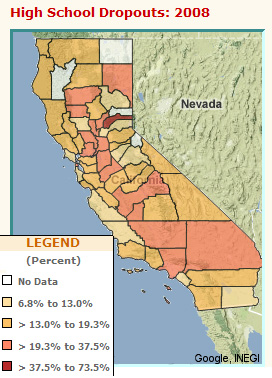 According to our recently released data on high school dropouts, in 2008 about one in five kids in California (19%) dropped out of high school during grades 9-12, a total of nearly 100,000. That’s down from 109,000 in 2007, but each year roughly 100,000 dropouts enter an already shaky California economy. To put those numbers into perspective, you could fill Anaheim’s Angel Stadium twice over with 2008 California dropouts, and still have nearly 10,000 more kids waiting outside.
Hispanics/Latinos, who represent 49% of California’s public school students, accounted for more than half of all dropouts (nearly 55,000). African American/Black students had the highest dropout percentage rate, with nearly one in three (32.9%) quitting school during grades 9-12. Asian Americans had the lowest rate, at 7.9 percent.
Educators nationwide share concern over dropouts, because they are more likely to use drugs and alcohol, get involved in criminal activity, and become teen parents.
What’s happening locally in your school district? Have you seen an increasing or decreasing trend in high school dropouts? What factors might be contributing to these trends in your community?
Posted by kidsdata.org
Tags: New Data, Statewide Expansion
Children’s Health — Read All About It
Recently, we polled kidsdata users — perhaps you participated — to ask how often you’d like to hear from us; and what information you’d like to receive. We learned that monthly newsletters are far too infrequent, according to our users, and those who took the survey also alerted us to their thirst for general news about children’s health issues.
Thus, the Kidsdata News Roundup was born. This occasional e-newsletter will note issues in the news, research findings about children’s health and well being, and related data from kidsdata.org. Take a look at our first issue, available here, and let us know what you think.
Don’t worry, we’ll still be sending out regular e-mail advisories to note new and updated data on kidsdata.org.
Want to receive the round-up, and all our e-mail notifications? Sign up here.
Posted by Felicity Simmons
Tags: News About Kidsdata.org
Millions of Facts – But Do We Have Yours?
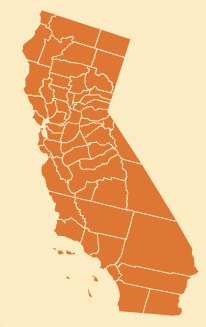 On kidsdata.org, we have millions of data points across hundreds of measures of child well being. So you’d think that we possess all the data that people in California ever could want. Yet whenever we’re in Los Angeles, we invariably get questions about data we don’t have. Preschool or afterschool enrollments, HIV among parents, media consumption among adolescents, art programs in schools, data for children 0-5 who have special health care needs, rates of 2nd teen births. The list literally goes on.
And at the opposite end of the state, in Redding, a similar craving for hard-to-find data emerged during some recent meetings. There in Shasta and neighboring counties, we heard about one of the more pressing issues affecting kids up there –drug abuse – and the resultant need for data on parental substance abuse and prenatal drug exposure, as well as fetal alcohol syndrome. People also expressed a desire for data on abuse of kids with special needs, child care waiting lists, maternal depression, and the numbers of children born to teen parents.
All of these, of course, are important issues affecting the physical and emotional health of kids. However, for some of these topics, we don’t know of sources that regularly collect quality data in a uniform way across California. Do you?
“We’ve got your numbers.” That’s what we say on the kidsdata home page. And in most cases when you visit kidsdata, you’ll find a measure that meets your needs. But when you don’t, we want to hear from you. Send us an e-mail through our feedback page. Better yet, broaden the conversation by asking us publicly through Twitter or Facebook, or by posting your query on this blog’s Data Questions page. More often than not, unfortunately, a quality data source simply may not exist for a desired issue. But even if it doesn’t, the more we communicate about the need for these data, the closer we’ll get to developing such sources. In some instances, of course, you may be able to point us to a source, in which case we can consider adding these data to kidsdata.
Let’s all start conversations about the data we need. We hope the links noted above can help serve as a catalyst for such discussions, which, in turn, can lead to the creation of a data agenda on children’s issues. Ten years from now, we just may have developed sources of data for at least some of the issues noted above. What a gift that would be to the nearly 10 million kids we collectively serve here in California.
Posted by kidsdata.org
Tags: Data Challenges