


Archive for the ‘Kidsdata News’ Category
Tough Economy May Threaten CA Child Care Supply
Imagine losing a trusted, licensed child care provider for your toddler because their home – their place of business – was foreclosed. Then imagine finding a new provider, only to be laid off from your job.
This is a true story highlighted in a press release by the California Child Care Resource & Referral Network. According to their 2009 California Child Care Portfolio, an already tight supply of quality, licensed child care in California is getting even harder to find due to the economic downturn.
Despite a roughly 20 percent increase between 2000 and 2008 of licensed child care facilities and the number of slots within those facilities, licensed child care in California was available for only 27 percent of children ages 0-13 with working parents.
Of course, not all working parents require licensed child care, but the potential demand for child care still far outweighs supply. In a time when foreclosures are high and jobs are hard to find, difficulty finding child care puts additional strain on working families.
Some other highlights from the newly available childcare data on kidsdata.org:
- From 2000 to 2008, the number of licensed child care facilities – and the number of slots within those facilities – increased by about 20 percent statewide. However, due to shortages of qualified staff and other issues, many child care providers do not fill all of their slots; therefore, the number of slots may overestimate the available care.
- In 2008, licensed child care in California was available for 27 percent of children ages 0-13 with working parents. As noted above, not all children with working parents need licensed care; some may be cared for by family members, nannies, or others.
- Almost 10 percent of parents statewide request child care during the evenings or weekends, according to the 2009 California Child Care Portfolio, and only 1-2 percent of licensed centers offer this type of care.
- While family child care homes are more likely to provide care during evenings or weekends, they represent only about a third of the licensed child care slots in the state.
On kidsdata.org, you can find child care data for counties statewide, as well as a “dashboard” of data highlights on child care in California. And please add a comment below to share your insights or experiences regarding child care issues in California.
Posted by kidsdata.org
Post Comment
New Blog Highlights California Health Issues
 Congrats to KQED on the launch of its new blog, Our State of Health, which explores health issues across California. To quote KQED’s outreach coordinator: “The blog was launched with the idea that the best way to learn about the health of our communities is to give voice to community members themselves.”
The blog highlights health issues affecting all Californians, including children, and already features posts about asthma and breastfeeding. Check it out at http://blogs.kqed.org/ourstateofhealth/.
Posted by Felicity Simmons
1 Comment
Study: Obesity Rates Fall for Asian American, White Children but Rise for Other Groups
According to a study from the University of California, San Francisco, obesity rates among Caucasian and Asian American children have fallen in recent years. The study also found that child obesity rates have leveled off among Latino children.
What is the reason for this good news? Here’s an excerpt from a recent San Francisco Chronicle article:
“For the first time in more than three decades, obesity rates for white and Asian children are falling in California, and they seem to have leveled off for Hispanic kids – all good signs that public health campaigns aimed at keeping young people away from unhealthful sweets and fatty foods are starting to work, according to a UCSF study.”
But, it’s not all good news. The same study noted that obesity rates among African American and American Indian girls are rising. Researchers say this indicates that public education campaigns need to be more widespread. Also from the article:
“We can attribute the plateaus to increasing awareness of pediatric obesity in families and communities. And there’s been a consistent effort by pediatricians to identify overweight and obese kids,” said Dr. Padmaja Padalkar, an assistant chief of pediatrics who specializes in working with overweight children at Kaiser Permanente San Jose Medical Center. “But this study also reminds us that we’re far from being out of the woods.”
Do you think your community is doing all it can to combat and prevent child obesity?
Here are some links to related measures of child health on kidsdata.org:
Posted by Felicity Simmons
Post Comment
Kidsdata.org’s Statewide Expansion Is Complete!
 Over the last year, kidsdata.org has been phasing in data for all counties, cities, and school districts in the state. This expansion is now complete, and more than 400 measures of child health and well being are available.
Watch this video to learn about kidsdata.org’s helpful features, and find tips to quickly locate the data you need. We’ll also continue to add new topics in the coming months, such as indicators related to environmental health.
Have any questions about kidsdata.org? Post them on our Data Questions page.
Posted by Felicity Simmons
Post Comment
Using Kidsdata.org to Make Your Case
You probably know that kidsdata.org can be a valuable resource for making your case on behalf of kids — whether you are working on a grant proposal, presentation, advocacy project, or other efforts. Here are some tips from our foundation on how kidsdata.org can help with grant proposals, in particular:
Making Your Case
Here’s a common way to organize making a  case for the need:
1) Who are the people in need?
2) What is the need?
3) Evidence to support the claim.
Proposals typically include facts about the population or community to be served and the issues to be addressed. When providing those facts, it’s important to provide context for the data. Context can mean different things – for example, it can mean putting your data in a larger geographic context by showing how your community compares to the county or state as a whole. Or, you can provide context by showing how a specific issue has changed over time; or by explaining why these data are important and what they mean.
Writing Your Proposal
In general, it’s important to spell out the key points you want to make, and explain assumptions. Make it easy for the funder to follow the train of thought and pick up your key points.
Funders want to see data as relevant as possible to the focus of the proposal. When the exact data you need are not available, it’s helpful to state that and then provide what is available. For example, if data aren’t available for the city you’re serving, school district or county-level data may be an acceptable replacement.
Use the best possible data, and explain the connection between the data you are including and what you are proposing to do. And always include the source. That will add credibility to your proposal.
Kidsdata.org Can Help
Kidsdata.org provides a wide range of specific facts about children and families, the particular issues they face, and about local communities – as well as the contextual information noted above.
Another type of data often necessary in proposals is data on program effectiveness; that is, citing research/data to demonstrate that your proposed program is likely to succeed. While providing info on program effectiveness is not the primary focus of kidsdata.org, the site has a Resources section with links to articles/research that may help you find evidence to support your program.
If you can’t find what you are looking for or if you have questions about the site, please post any questions on our Data Questions page.
Posted by JoAnna Caywood
Post Comment
Cancer, Health Care, Substance Use News Noted in August Kidsdata News Roundup
The latest Kidsdata News Roundup now is available — read it here.
A few key items:
Alcohol, Tobacco, and Other Drug Use
Anti-Smoking Efforts Compete Against Childhood Obesity for Attention and Funding
(NY Times, 7/27/10, by Wilson)
Health Care
Health Insurers Win Concession on Coverage for Children; Allowed to Set Limited ‘Open Enrollment’ Periods
(SF Chronicle, 7/28/10)
High School Dropouts
Teens with ADHD More Likely to Drop Out of High School, Study Shows
(CNN, 7/28/10)
Weight
Study: Obesity Drops Among Kids in School-Based Health Program
(NY Times, 7/12/10, by Rabin)
Know of news that we should include in our next edition of the Kidsdata News Roundup? Leave a comment.
Posted by Felicity Simmons
Post Comment
Latest County Report Shows Smoking, Teen Pregnancy Down but Obesity, Diabetes Up
 The Santa Clara County Public Health Department recently released its 2010 report on the overall health of adults and children in the county. Although there was a marked drop in smoking and teen pregnancy, obesity and diabetes in both adults and children are on the rise, and about 25 percent of students in middle and high school are overweight or obese.
County Health Officer Dr. Marty Fenstersheib notes that this kind of report can help create community action to improve health practices throughout the county. Tracking data over time is particularly important for the health of children. When issues are identified, the right intervention at the right time sometimes can prevent serious problems.
See more data for Santa Clara County at www.kidsdata.org/santaclara
Posted by kidsdata.org
Post Comment
California Ranks 19th in KidsCOUNT Data Book
The 2010 KidsCOUNT Data Book was released today by the Annie E. Casey Foundation. Using 10 key child health indicators, the Data Book ranks states according to how they’ve fared in those measures since 2000 — and also provides national comparisons.
This year, California ranks 19th — a slight improvement over the rank of 20 in the 2009 Data Book. Since 2000, our state has improved in nearly every area featured: infant mortality, child and teen death rates, teen birth rates, and others.
Some areas have seen significant improvements — such as a 40% decrease in the teen birth rate from 2000-2008; and a 20% decrease in the death rate for children ages 0-14.
However, there are two areas that do not show improvement — low birthweights and single-parent families. According to KidsCOUNT, nearly 7% of babies in California were born at a low birthweight — an increase since 2000, but lower than the national average of 8.2%. In 2008, 32% of California children lived in single-parent families, which is an increase of 7% since 2000, but in line with the national average. (According to kidsdata.org, family structure can be an important factor in a child’s physical health and mental health, educational attainment, and poverty status. Studies have shown that single-parent families are more likely than two-parent families to have lower incomes.)
Overall, children’s health in California is improving, according to the 2010 KidsCOUNT Data Book. Our Foundation’s Index of Child and Youth Well-Being also found that child well being improved from 1995 to 2006, but notes that the recent economic downturn threatens those gains.
- To see all the data available for California through the KidsCOUNT data center, visit http://datacenter.kidscount.org/ca.
- Visit kidsdata.org to see data for your community on low birthweight babies, and single-parent families.
Posted by Felicity Simmons
Tags: Data Projects, Data Sources
Short Term Gains, but Long Term Challenges for Federally Funded Children’s Programs
 Two reports released at the recent Children’s Budget Summit paint a less-than-hopeful picture of the future of federal spending for children’s programs. The reports were produced by First Focus, a bipartisan organization advocating for children and families.
The first report, the Children’s Budget 2010, offers a guide to federal spending on children. The budget notes that spending on kids programs has increased in 2009 and 2010, largely due to dollars from the American Recovery and Reinvestment Act. (a.k.a. the Federal Stimulus) Even with this additional funding, spending on kids programs (ranging from health and education to child welfare and juvenile justice) remains at less than 9% of the federal budget.
A second report, Kids’ Share 2010, noted that overall spending on children’s programs has declined by 25% since 1960, and 10-year projections show a continued decline.
Despite a temporary boost from the Stimulus, children’s programs across the country face an uphill battle. Unless Congress makes children a higher priority and this increase in funding is maintained, these programs will need to cut back to pre-2009 budget levels, according to First Focus President Bruce Lesley.
How has your organization been affected by the Federal Stimulus?
Posted by Felicity Simmons
Tags: Child Health Issues
Fewer Than One in Three Students Proficient in Algebra I
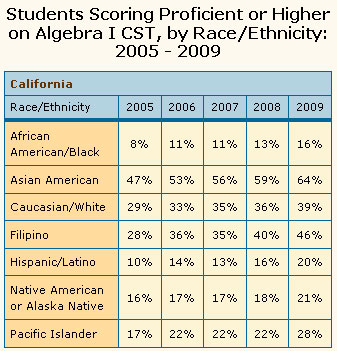 Over the past four years, California has seen Algebra I proficiency increase among students in grades 7-11, but the stubborn fact remains that fewer than one in three students is considered proficient.
Research has shown that competence in mathematics is crucial for functioning in everyday life, and mastering algebra is associated with readiness for the workplace and higher future earnings.
Disparities by race/ethnicity and socioceconomic status are pronounced. Statewide, Asians are four times more likely to be proficient in Algebra I than African Americans, and three times more likely to be proficient than Hispanics.
While such gaps between different socioeconomic and ethnic groups have long existed not only in California, but nationwide, a recent report indicates that some schools are having success reducing the math achievement gap.
What kinds of strategies does your school or district use?
Posted by kidsdata.org
Tags: New Data, Statewide Expansion