


Archive for the ‘Kidsdata News’ Category
‘Distress Index’ Measures Recession’s Impact on Local Families
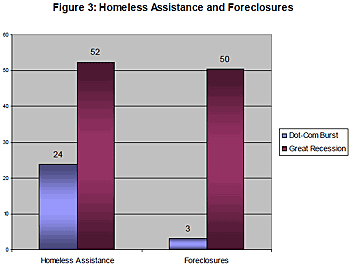 Just how bad is this recession — and how is it affecting families in high cost-of-living areas like the Bay Area? A new ‘Distress Index’ can shed some light.
The Stanford Center for the Study of Poverty and Inequality, in partnership with New America Media and the San Francisco Foundation, just released “Measuring Economic Distress in San Francisco,” an index that monitors 11 indicators of distress, including bankruptcies, CalWORKs enrollments, foreclosures, unemployment, food bank pantry visits, and other measures where data are updated more frequently than on an annual basis.
The index assesses San Francisco’s distress for the last 10 years — primarily comparing the dot-com bust to the recent recession. Although the index is limited to the city/county of San Francisco, researchers noted that they hope other communities will replicate the idea.
Overall, researchers found that the distress index in San Francisco has been increasing since 2000. It also notes that foreclosures, food stamps applications, and homeless assistance are all higher during this recession than they were during the dot-com bust. For all results, visit http://www.stanford.edu/group/scspi/_media/pdf/cpr_papers/San_Francisco_Distress_Index.pdf
Interested in data about family economics for your community? We have several indicators on kidsdata.org.
Posted by Felicity Simmons
Tags: Data Projects
Partnership with CHKS Provides Easy Access to Depression, Bullying and Other Key Datasets
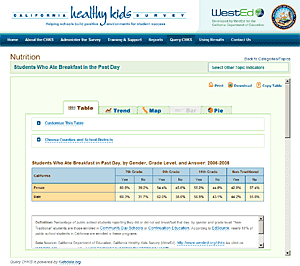 Finding timely measures of critical issues such as teenage depression, bullying, and drug use can be quite challenging. Fortunately, here in California, we have a rich database of self-reported information for these and other behavioral/emotional health topics through the California Healthy Kids Survey (CHKS). Thanks to a partnership with WestEd, which administers the survey, and the California Department of Education, kidsdata.org offers more than 80 indicators from CHKS – all available at the school district level. This month, we’re extending that partnership, with WestEd’s announcement of the launch of its new website, Query CHKS, which allows users to view and customize data from CHKS directly from WestEd’s own site.
Query CHKS combines the wealth of valuable data from the survey with the data display of kidsdata.org, allowing for easy access to the millions of data points available through CHKS. Many of the tools available on kidsdata.org now are available on Query CHKS, including the ability to view data as trend or bar graphs, maps, pie charts, and tables; as well as the options to download or copy those data.
And, as the data are updated on kidsdata.org, they will automatically be updated on QueryCHKS.
You can add a graph from kidsdata.org to your website, too. Simply find the data you’re interested in, customize the chart with your preferences, and click “embed” in the top right.

Posted by kidsdata.org
Tags: Data Projects, Data Sources, News About Kidsdata.org
Kidsdata.org Answers Your Data Questions: The Crosstab Quandary
Here at kidsdata.org, our staff has been traveling throughout California to introduce this resource to people who work on behalf of children. In all of these meetings, we get excellent questions about the availability and limitationsof the data on our site. We thought we’d share some of those questions — and our answers — with you in a series of blog posts. If you have a question, feel free to post it as a comment here, or on our Data Questions page.
Today’s Question: There are so many topics of data available on kidsdata.org. Can I put together two different indicators to learn more about the population of children I serve? For example, can I combine your data on children in poverty and your data on asthma diagnoses to learn about the relationship between poverty and asthma?
Answer: Alas, the short answer to this question is no.
You cannot use kidsdata to run crosstabs, as they’re called, when data come from different sources, because the data were collected from different sets of children. For example, the asthma diagnosis data on kidsdata.org come from the California Health Interview Survey, and data about children in poverty come from the American Community Survey. That means that we can’t use those two datasets to explore whether children living in poverty are more or less likely to be diagnosed with asthma. To do that, we’d need a single source that recorded a child’s family income level and whether or not the child had asthma.
However, within an individual source of data, we often offer multiple breakdowns for a given indicator. For example, on kidsdata.org we offer dozens of measures of child and youth well being health from the California Healthy Kids Survey. Because the same students answered all the questions on that survey, it’s acceptable to compare the responses for different topics. You can explore how different risk behaviors (like drinking alcohol) vary by students’ level of connection to school, or by gender and grade level. For any indicator, if there are other breakdowns that you think we should add, we certainly would like to know; add a comment below.
Soon on kidsdata.org, we’ll be offering the ability to compare multiple indicators for multiple regions, so that it’s easy to get a summary of how children are faring on a range of issues, across regions.
Posted by Sarah Marxer and Felicity Simmons
Tags: Data Challenges, Data Sources
Budget Agreement Has Significant Effects on Children — Increases in Education, Cuts to CalWORKS, Mental Health
 A society’s investment decisions reveal much about its priorities. On Oct. 8, the Governor signed the 2010-11 budget for California. As a Foundation that uses data to elevate the priority of children’s health in California, we should note that the new budget illustrates the value our society places on programs that serve children. The Governor made nearly $1 billion in line-item cuts, including key child care, special education, and welfare programs. On the other hand, the 2010-11 budget also increases spending on K-12 education, community colleges, and UC education over last year. The California Budget Project provides an analysis of the key provisions in the budget agreement.
Key provisions:
- A $256 million reduction that ends CalWORKS Stage 3 child care, effective Nov. 1
- Child Welfare Services program funding cut by $80 million
- $43.8 billion in K-12 education, a slight increase over the last fiscal year
- $133 million cut from mental health services for special education students
For the full analysis, visit http://www.cbp.org/pdfs/2010/100618_Budget_Comparision.pdf or see a recent article about the 2010-11 budget agreement at http://www.sfgate.com/cgi-bin/article.cgi?f=/c/a/2010/10/09/MNBR1FQDB7.DTL.
Posted by Jordan Handcox
1 Comment
Kids’ Admission to Specialty Care Hospitals Strongly Influenced by Non-Medical Factors
A recent study from Stanford University points out a troubling trend: Factors other than medical need appear to be influencing whether California children with chronic conditions are treated in hospitals with special expertise in caring for children.
On the positive side, the study provides evidence that the majority of chronically ill children who require hospitalization are admitted to these specialty care centers. More disturbing is the fact that the data suggest that factors other than medical need play a major role in influencing where children are hospitalized. Low-income children with public insurance generally are cared for in a children’s specialty care hospital. Surprisingly, though, children who are privately insured are significantly less likely to be treated at these pediatric centers of excellence.
In addition, other non-medical factors such as age, ethnicity, income level and living close to a specialty care hospital also influence where a child is treated, the study reports.
These findings are worrisome because a range of studies suggest that outcomes improve when children with serious or rare conditions have access to physicians and hospitals with special expertise.
The Stanford study analyzed pediatric hospitalizations for children ages 0 to 18 years at the time of admission in California between 1999 and 2007, using data from the Office of Statewide Health Planning and Development (OSHPD).
The authors recommend greater scrutiny of clinical practices and child health policies that shape patterns of hospitalization of children with serious chronic disease. Through our work regarding children with special health care needs, our Foundation is advocating for a system in which all children are able to receive the highest-quality health care when and where they need it.
Posted by David Alexander, MD
Post Comment
Health 2.0 Honors Data Visionaries
 Last week, San Francisco was home to the Fall 2010 Health 2.0 Conference, which showcases cutting-edge technologies in health care.
Headlining this fall’s event were a session and luncheon honoring the winners of the federal Health and Human Services Department’s Health 2.0 Developer Challenge. The project challenged organizations nationwide to develop applications to support the Community Health Data Initiative (CHDI). The CHDI is an HHS program aimed at helping Americans understand health issues locally, and take action to improve health in their communities.
The winners are shining examples of the power of data and how, if data are made accessible, they can change lives.
The challenge winners included:
- County Health Rankings, a project of the Robert Wood Johnson Foundation and the University of Wisconsin, that ranks health indicators for all counties in all states. Developers were challenged with creating apps or widgets that would make that information easily accessible on the technological platforms (iPads, smart phones, etc) that people already use to make informed decisions.
The winning app was developed by Acys Healthcare and displays health rankings based on the GPS location of the user, and the county they are in.
- Catch and Hope Labs challenged developers to develop an app that encourages users to get up and moving, and then tracks that movement. Winner Happy Feet from Stanford University proposed an app that allows users to track activities and earn achievements, as well as be social via Facebook to see how friends using the app are doing.
In addition to these ingenious ideas, there were four other winners.
Posted by Felicity Simmons
Post Comment
Children Now Scorecard Offers ‘Fingerprint’ of Child Health Across California
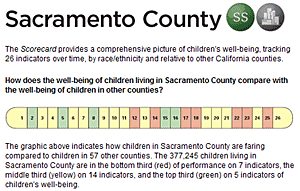 |
The scorecard offers a unique fingerprint of how children are faring in each county in California. |
Noting that no two counties are alike in California with regard to children’s health, Children Now recently released its 2010 California County Scorecard of Children’s Well-Being.
The scorecard offers a “fingerprint” for each county in California, showing each county’s performance in a range of areas of child well being, relative to other counties’ performance. Counties are organized according to rural or urban status and, within that, high- or low-income. The 26 measures in the scorecard include education, safety, substance use, connectedness to school, and many others. Data about breastfeeding and prenatal care are cited from kidsdata.org. Check out all the indicators here: http://www.childrennow.org/subsites/publications/invest/scorecard10/scorecard10_home.htm.
And, view each county’s fingerprint at http://www.childrennow.org/subsites/publications/invest/scorecard10/scorecard10_comparison.htm
Posted by Felicity Simmons
Tags: Child Health Initiatives, Data Projects, Data Sources
National Child Health Day
Today is National Child Health Day!
Here at kidsdata.org and the Lucile Packard Foundation for Children’s Health, we tip our hats to organizations nationwide that are working to improve the mental, emotional, behavioral, and physical health of children.
Here are some facts about kids in California that you might be interested to know:
- There are nearly 10 million children in California.
- Of those, 14.5% have special health care needs, according to 2007 data.
- Mental health problems accounted for nearly as many hospitalizations of kids 0-17 as asthma in 2007.
- In 2008, 18.5% of California children lived in poverty.
- California’s youth suicide rate in ’05-’07 was one-third lower than it was 10 years earlier.
If you’re interested in learning more about children’s health at the national level, the Child and Adolescent Health Measurement Initiative offers a useful web resource for nationwide data.
Does your organization work on behalf of kids? Tell us how!
Posted by Felicity Simmons
Post Comment
California Governor Signs Several Bills Affecting Children into Law
 Governor Schwarzenegger signed many bills into law this past week before the Sept. 30 constitutional deadline, including several bills affecting children’s health and well being in California. A few highlights:
- SB 1381: Kindergarten: Age of Admission. This bill, introduced by Senators Simitian and Steinberg, will require kids to be 5 years old when they begin kindergarten http://www.paloaltoonline.com/news/show_story.php?id=18454
- AB 12: California Fostering Connections to Success Act. This bill, introduced by Assembly Members Beall and Bass, extends benefits to foster care children up to age 21 http://blogs.sacbee.com/capitolalertlatest/2010/09/governor-signs-bill-to-extend.html
- AB 2244: Health Care Coverage. This bill, introduced by Assembly Member Feuer, prohibits insurers from denying coverage to children because of pre-existing conditions by implementing federal health care law http://californianewswire.com/2010/10/01/CNW8045_204133.php
Posted by Jordan Handcox
Post Comment
Strength in Numbers: Data Insights from Rural California
For those of us who live in California’s urban centers, it can be easy to forget that our state, in some ways, can be characterized as rural. About one-third of California’s counties have a child population of fewer than 10,000 kids each. In some of these counties, like Inyo and Alpine, the overall population density is roughly 1 person per square mile, compared to Orange County, where the density is 3,815 people per square mile.
It stands to reason that the data needs for California’s rural regions are different than in our suburban and urban cores. A few weeks ago, I traveled to Calaveras County and heard from folks there and in nearby Tuolumne, Amador, and Alpine counties about how kidsdata.org can meet their data needs. As one person noted, they know their counties without needing data to tell them what’s going on. Still, they made clear how critical it is for them to be able to accurately measure child well being – in part, to tell others what’s going on locally.
They suggested some great ideas – offering the capacity for users to create their own customized regions of data; ensuring we offer numbers in addition to rates/percentages for as many indicators as possible; and, when viewing data, creating the ability to sort, or separate out, California’s rural counties from other counties.
We’ll consider all of those ideas, as well as others that we heard in a trip up to Shasta County a few months ago. But we want to open up this discussion to others, too. If you have insights about how kidsdata.org can serve the unique needs of rural California, we’d love to know. Just enter a comment below, or on our Facebook page.
Posted by Andy Krackov
Post Comment