


Archive for the ‘Kidsdata News’ Category
Now Available on Kidsdata: More Data About Kids with Special Needs
 |
| View a slideshow of data highlights from Children with Special Health Care Needs: A Profile of Key Issues in California |
Kidsdata.org has just added wide-ranging data — dozens of measures in all — on the approximately 1.4 million children in California who have a special health care need.
These new indicators are drawn in part from a just released study which found that California ranks at or near the bottom compared to other states on multiple measures of how well these children are faring. The report, Children with Special Health Care Needs: A Profile of Key Issues in California, was commissioned by our foundation and prepared by the Child and Adolescent Health Measurement Initiative.
On kidsdata.org, we now offer more than 80 measures of the health and well being of children with special health care needs at the state level with a U.S. comparison. These data include:
And some data related to children with special needs are available at a local level:
In an effort to bring together those working on issues affecting children with special health care needs, the foundation is establishing the California Collaborative for Children with Special Health Care Needs. The goal of the collaborative is to create a shared agenda and advocate for meaningful and lasting system change — including improving over the long-term measures of how these children are faring. Sign up to be a part of this work >>
Posted by kidsdata.org
Tags: Data Projects, Data Sources, New Data
Children with Special Health Care Needs:
A Call to Action
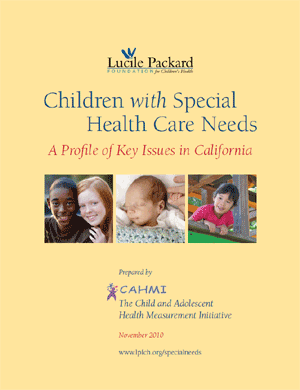 Approximately one in seven children in California has a special health care need — that’s 1.4 million children. Yet our state ranks last in the nation on a minimum quality of care index that assesses adequacy of insurance, provision of basic preventive care, and meeting minimal criteria for care that is ongoing, comprehensive, coordinated, and family-centered.
This striking finding comes from a just-released study, Children with Special Health Care Needs: A Profile of Key Issues in California, commissioned by our Foundation and prepared by Dr. Christina Bethell and her colleagues at the Child and Adolescent Health Measurement Initiative (CAHMI).
The researchers also found that California ranks at or near the bottom nationally on numerous other measures, including transition to adult health care, stress among parents, and receipt of needed mental health services.
Such troubling findings will come as no surprise to California families who are caring for a child with special needs, or to the thousands of individuals throughout the state who work with, and on behalf of, these children and their families. The roadblocks that prevent development of a high-quality system of care are longstanding, complex, and difficult to overcome.
Here at the Foundation, we believe these findings signal that the time has come to join forces in a new way to bring about broad and lasting change. For the past two years we have been focusing our efforts on improving California’s system of care. We have convened experts — both providers and consumers — to develop a model for a higher quality care system.
Now, we are launching the California Collaborative for Children with Special Health Care Needs to create a shared agenda and to advocate for changes that bring the system closer to this model.
A key goal of this ongoing, statewide Collaborative will be to look beyond specific organizational issues and speak with one voice to decision-makers about the need for a more effective and efficient system for all children with special needs. The Collaborative will not replicate the many valuable efforts under way throughout the state, but will offer a unique opportunity for a cross-system partnership that can assemble the critical mass necessary to bring about significant change.
Collaborative members will include patients, families and caregivers, providers, insurers, disease-specific advocacy organizations, educators, researchers, and public and private agencies. Members will share information and will address issues that matter to all of these constituencies, such as adequacy of insurance, better access to medical specialists, education primary care providers on special needs, ethnic and income disparities; enhancing support for families, and smoothing the transition to adult health care.
The Foundation is committed to working with others on a long-term basis to bring these issues to public attention and to achieve results. We are committing staff and resources. I hope you will sign up now to receive information about the Collaborative as it develops.
Posted by David Alexander, MD
Post Comment
California’s Data Wish List
 |
| Want to learn more about what kidsdata.org has to offer? Watch This Video
|
Recently, we announced the data we’re planning to add to kidsdata.org in 2011 — obesity, truancy, preterm births, and more. (See the full list.) These additions are the result of conversations we’ve had with individuals across the state. We also asked kidsdata.org users to suggest topics they’d like to see on the site. We thought others would be interested in seeing the suggestions we received, which included:
- Sex education programs in schools
- Special education enrollment for preschool-age children
- Undocumented youth not attending school and not working
- Children who qualify for dental care with Medi-Cal, but don’t know how to access services
- Pregnant women diagnosed with gestational diabetes
- Children whose parents are incarcerated
- Comparisons of California to national data
Here at kidsdata, we’ll certainly consider these suggestions by adding them to our data wish list. Of course, sometimes there is no source that collects data in a uniform way for some of these topics.
Do you know of data sources for the suggestions above? Do you have other topics to add to this list? Please keep the suggestions coming; we’re listening.
Posted by Jordan Handcox
Tags: New Data
Data Questions: Data for Rural Communities
 This week, we’ll be showing kidsdata.org at the California Rural Health Conference in Sacramento.
When visiting rural communities, we often get questions about why so little data are available. In this installment of Data Questions, we’ll address this issue:
“I live in a rural county — why does kidsdata sometimes show LNE instead of data for my region?”
LNE stands for Low Number Event. LNE is defined differently depending on the data source, but is shown when the numbers are too small to report. Showing LNEs helps us maintain statistical integrity and, in some cases, it helps ensure the anonymity of the children reporting the data. Whenever you see an LNE in a graph or chart, its definition is explained in the “footnote” below the data. On maps, regions with LNEs appear as white.
We know that in many cases, rural communities with small populations of children need to gather the same data as urban communities, but are burdened with a smaller pool of data available. We try to address that need in several ways. In some cases, we aggregate data across several years. In other cases, we offer data for regions made up of several counties with small populations. When possible, we aim to offer numbers alongside rates and percentages, so that even if there are not enough English Learners in a school district to report a reliable percentage, we can offer the number of English Learners.
A quick way to find out what data are available for your region is to go to the Data by Region page, select your region, and then click “View all data” at the top of the page.
Posted by Sarah Marxer and Felicity Simmons
Post Comment
Questions From Mendocino That May Help You, Too
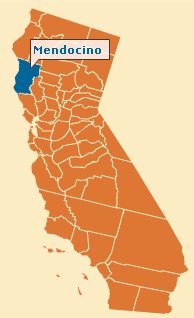 Recently, we traveled up to Ukiah, CA, to provide an introduction to kidsdata.org for a group of key people working on behalf of children’s health in Mendocino County. The group participants asked several good questions about kidsdata.org and the data available on the site. Their questions, and our answers, are below.
Question: When viewing survey data, is there a way to find out the sample size?
Answer: In most cases, you will need to go to our data source, (a link to the source is found in the Data Source field below every table or graph) to learn the sample size of the survey. For example, you can find the number of students taking the California Healthy Kids Survey by selecting one of the reports on this page: http://chks.wested.org/reports/search. You can find information on the California Health Interview Survey sample sizes here: http://www.chis.ucla.edu/who-chis.html. The American Community Survey gives information about sample sizes here: http://www.census.gov/acs/www/methodology/sample_size_and_data_quality/ In general, we don’t report out small numbers from surveys. Those are reported as a Low Number Event, or LNE, in the graph.
Question: If the same data come from two different sources, how do you decide which to include on the site?
Answer: Our criteria include data quality, the consistent availability of data over time and across counties, and ease of accessing the data. We welcome feedback about our choices.
Question: Is it possible to compare multiple topics at once for your county, or compare your county to other counties, to see where there are outliers?
Answer: In early 2011 , we are aiming to launch a tool that will allow users to compare multiple regions and multiple topics in one table view. We’re adding it for the exact reason you mention — to offer the ability to quickly view outliers.
Question: Can you group similar counties together — by size, for example — without already knowing which counties are similar?
Answer: When displaying data results, we are exploring the possibility of grouping counties regionally, so that counties physically near each other are grouped together. We also could consider grouping according to population or economic make-up. We welcome your suggestions on groupings that would be useful for you.
Posted by kidsdata.org
Post Comment
Get Out and Vote — for Kids
 You already know that Tuesday, Nov. 2 is election day.
But what you may not know is that there are a number of issues on the ballot this year affecting kids. Issues such as funding for community colleges and school districts, health insurance for low-income kids, and public safety are on the ballot. The people we elect at all levels of government, from senator to governor to state superintendent of schools to local council members, will decide on wide-ranging policies affecting kids.
Whatever your politics, please keep kids in mind when you go to the polls on Tuesday.
Need some data on issues affecting kids? Visit kidsdata.org for data on child safety, education, health care, and many other issues.
Posted by kidsdata.org
2 Comments
Sac Bee Editorial Says Kids Not on Candidates’ Radar Screen
An editorial in today’s Sacramento Bee laments that the two candidates for governor are not talking more about issues affecting kids in California. “Neither [candidate] has anything resembling an agenda for children, and what they do have to say is vastly unsatisfying,” says the editorial, also noting our foundation’s interest in encouraging a dialogue on issues related to children’s health and well being.
The editorial enumerates a range of issues that the candidates could comment on, citing data. For those interested in how children are faring on the measures highlighted by the Sacramento Bee’s editorial, here are links to currently available data:
Posted by Andy Krackov
Tags: Child Health Issues
Domestic Violence is a Child Health Issue
October marks Domestic Violence Awareness Month, an issue affecting children and families nationwide.
Although domestic violence often occurs between adults, it concerns children because in 30% to 60% of families that experience domestic violence, children also are abused. In addition, children who witness domestic violence — even if they are not targets of the violence — tend to exhibit the same emotional, behavioral, and academic problems as abused children.
In California, rates of domestic violence calls for assistance decreased by nearly one third from 1998 to 2008. In one county – Merced – severity has gone up even as rates were stable.
View a customizable map of domestic violence rates by county >>
On kidsdata.org, we also offer an important related measure of violence – dating violence among adolescents. These data come to us from the California Healthy Kids Survey, which is administered in schools statewide by WestEd for the California Department of Education. According to the ’06-’08 survey, 6.6% of 11th-grade girls and 7.5% of boys reported they had experienced dating violence, defined as being hit, slapped, punched, or otherwise hurt by a boyfriend/girlfriend in the past year.
Across all grades in California, boys are more likely than girls to report dating violence, except in non-traditional school settings. And the percentage of 11th-grade boys reporting dating violence has increased in recent years. Students who report high levels of connectedness to school are less likely to report dating violence.
Posted by kidsdata.org
Tags: Health Observances
What Data Would You Like to See on Kidsdata.org?
 |
| Want to know when data of interest to you are updated? Sign up for e-alerts to get data updates tailored to your interests that are sent weekly or monthly. |
Just a year ago, kidsdata.org expanded from the Bay Area to include wide-ranging data on children’s health and well being for every city, school district, and county in California.
We’re continually updating the hundreds of measures that are available through kidsdata.org (see an A to Z list of available data), and enhancing the site to make it even easier to find, interpret, and share data.
Over the next year, we’ll be adding data on these topics, among others:
- Poverty
- Preterm Births
- Obesity
- Environmental Health (air and water quality, lead poisoning, etc.)
- Truancies, Suspensions, and Expulsions
- Youth Not Working and Not in School
See the Full List of New Indicators We’re Adding to Kidsdata.org >>
In addition to what we’re adding and what’s now available, what other measures would you like us to consider offering through kidsdata.org? If you know of data sources for what you’re suggesting, that would help too.
Posted by kidsdata.org
Tags: News About Kidsdata.org
California Data Sheds Light on Bullying of Gay Youth
October is National Bullying Prevention Month, and a recent bullying-related suicide by a New Jersey college student is a tragic reminder of how devastating bullying can be.
Several recent bullying victims making national headlines were children and young adults bullied due to their sexual orientation. In fact, there has been so much outcry that a YouTube campaign has started to support the victims.
Kidsdata.org offers data on this subject.
Kidsdata.org has student-reported data from the California Healthy Kids Survey noting how many times students in 7th, 9th and 11th grades, and in non-traditional programs, report being bullied due to their sexual orientation. These data are available for counties and school districts across California, and also are broken out by race/ethnicity and level of connectedness to school.
According to the 06-08 data, more than 5 percent of 7th-grade boys in California reported being bullied four times or more in the past year because they were gay or because someone thought they were gay; 2.5 percent of 7th-grade girls said the same. Overall, 10 percent of 7th-grade girls and 12 percent of boys report being bullied at least once in the past year due to sexual orientation.
We also offer data about bullying reports for other reasons. Bullying and Harassment due to:
Posted by Felicity Simmons
Tags: Child Health Issues