


Archive for the ‘Kidsdata News’ Category
Child Welfare in California: A Snapshot of Legislation
April is Child Abuse Prevention Month, and we’ve just updated child abuse and foster care data on kidsdata.org — seems like the perfect time to check in on recently passed and upcoming child welfare legislation.
We’ve noted a few key bills below, and you can find more child welfare legislation passed into law in this report from the County Welfare Directors Association. And, if you know of other bills, please note them here.
Child Welfare Legislation Passed in 2010:
- AB 12, introduced by Assemblymember Jim Beall (D-San Jose), is the California Fostering Connections to Success Act, which extends foster care to age 21 if the youth is working or enrolled in school full time.
- AB 743, authored by Assemblymember Anthony Portantino (D-La Canada Flintridge), strengthens state policy to keep siblings together in the foster care system.
- AB 1933 from Assemblymember Julia Brownley (D-Santa Monica) allows foster children to remain in their school of origin, even if placed with a family in a different area.
- AB 2322, authored by Assemblymember Mike Feuer (D-Los Angeles), helps county employees better identify instances of child abuse and neglect, helps social workers fashion plans of action for potentially abused children, and provides strict protection for the privacy of children and their families.
Proposed Child Welfare Legislation for 2011:
- AB 73, from Assemblymember Feuer, would provide for public access to dependency court proceedings.
- AB 181, authored by Assemblymember Portantino, would create a mental health bill of rights for foster youth.
- AB 194, from Assemblymember Beall, would offer priority enrollment for foster youth in post-secondary education.
Posted by kidsdata.org
Tags: Child Health Issues, New Data
Federal Data Resources In Jeopardy
 As the Federal government struggles to vote on a budget that affects many programs for children, we note some valuable data resources that may be in jeopardy.
According to the Sunlight Foundation, Federal data transparency tools such as data.gov, usaspending.gov, and the IT Dashboard are at risk of having most of their budgets cut. The cuts are so drastic that they might mean the elimination of these programs altogether.
Websites such as these have been used by journalists to shed light on government spending, and offer context to health issues.
Here at kidsdata.org, we value these trusted public data sources and hope they can be retained. On its website, the Sunlight Foundation offers may ways you can voice your opinion on these proposed cuts.
Posted by kidsdata.org
Tags: Data Challenges
Physical Fitness Data Released: 1/3 of CA Kids Score “Healthy”
As you may have seen in the news, the California Department of Education last week released ’09-’10 physical fitness data for school districts statewide. These data show that roughly one-third of public school students in California meet all six fitness standards. A summary of these data are available on the California Department of Education website. In the coming weeks, we’ll update our fitness and weight indicators on kidsdata.org to include the ’09-’10 data, so that you can customize for your region, and view the data as trend graphs, bar charts, or maps. In the meantime, you can view historical data on kidsdata.org.
Here’s a summary of local coverage of fitness test results from around the state:
Contra Costa Times: Only One-Third of County Students Could Pass Physical Fitness Test
Inland Empire News: 2 of 3 Students Fail Fitness Test
KFMB-AM: San Diego Students Score Slightly Better in Fitness Tests Compared to State
LA Times: Only 1 in 3 California Students Make the Grade in Physical Fitness Test
Monterey County Herald: County Lags State in Youth Fitness
North County Times: Local Kids Beat State Averages for Fitness Tests
Redding Record-Searchlight: North State Students Slip in State Health Test
San Francisco Chronicle: Couch or Calisthenics?
Santa Cruz Sentinel: State Fitness Test Results Reveal Stubborn Plateau
SJ Mercury News: California Students Continue to Score Poorly on Fitness Tests
Have you seen other local coverage? Post it here.
Posted by kidsdata.org
Tags: New Data
March News Roundup Features Articles About Hungry Students, Bullying, Child Abuse, and More.
The March issue of the Kidsdata News Roundup now is available – you can read it here.
A few highlights:
Child Abuse
Head Trauma Study Suggests Many Child Abuse Cases Go Undetected
(MSNBC, 3/7/11, by Brownstein)
Health Care
Experts Give Advice on Caring for Ill Children with No Health Insurance
(San Diego Union Tribune, 3/7/11, by Dell, Whitehead, and Day)
Hunger
Report: Majority of Teachers Nationwide Have Hungry Students in Their Classrooms
(San Jose Mercury News, 2/22/11, by Gonzales)
School Meals
Opinion: Schools Still Serve Meals Far Too High in Sugar
(LA Times, 3/2/11, by Ventura and Goran)
Students’ Negative Reactions to More Healthful Lunches Highlight Challenges for Schools
(LA Times, 2/20/11, by Eng)
Posted by Jordan Handcox
Post Comment
Make Your Case with Compelling Facts
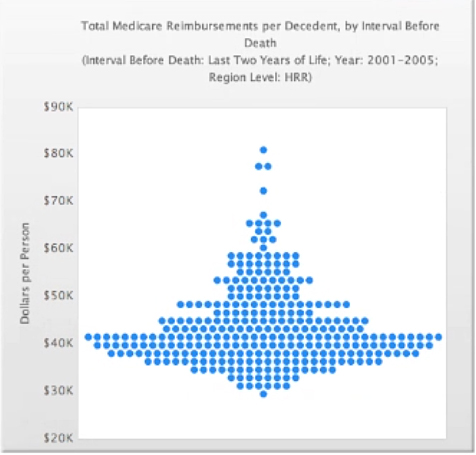 |
This “turnip” or “space invader” graph was one of the data visualizations highlighted in the session. |
Recently, I had the pleasure of moderating a session about data at the Nonprofit Technology Conference in Washington, D.C. This annual conference explores trends in technology that affect nonprofit work, and this session focused on making your case with compelling facts.
Given that the audience for this conference is exclusively nonprofits, we knew that every attendee needs data — whether they want it or not. All kinds of nonprofit work — advocacy, grantseeking, and even reporting to a board of directors — require data. But, that doesn’t have to mean run-of-the-mill excel graphs or, even worse, text-heavy pdfs. There are so many intriguing and, in some cases, inexpensive, ways to tell your story through data. Here are some that we featured in the session:
Two of our expert panelists came from Velir Studios, the web firm behind kidsdata.org and many other data sites, such as KidsCount, Kaiser State Health Facts, and the Dartmouth Atlas of Health Care. See the video of their presentation, which includes mapping examples and many other data visualizations.
Perhaps the biggest question of the day was: how can I do this for free/on-the-cheap? Several Google tools were mentioned as low-cost and easy-to-understand data displays. Google Chart Tools offers a wizard for creating several types of dynamic data displays, and Google’s Public Data Explorer allows you to upload your own data, create your own visualizations, and then share what you’ve done with the masses.
Other free, inexpensive, or at least easy-to-use tools that were noted included Tableau Public (there’s also a server edition for more sophisticated developers); Socrata, which can help you offer your data publicly; and mapping tools such as GeoCommons, and IndieMapper. Additional resources are included in this handout from the session.
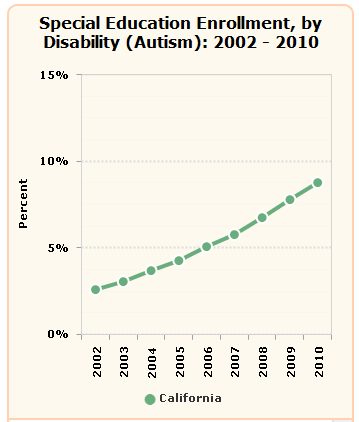 And, of course, no data session would be complete without some display examples from kidsdata.org. Andy Krackov, our Assistant Vice President of Programs & Partnerships, pointed out some tips for communicating data, noting that kidsdata.org makes it easy to monitor trends, like the graph on the left, and identify disparities.
In addition to these data visualization examples, the session included in-depth discussions about several related topics:
- How data and personal stories can come together to make your case even more compelling. See a blog post on this topic by session panelist Kurt Voelker from Forum One Communications.
- How to find data within your organization that others may be interested in (it can be anywhere — grant reports, web analytics, etc.) and, once you’ve found it, whether or not you should release it. (You should err on the side of releasing it.)
- If you have a mountain of data, how you can decipher what’s important. (Focus on your mission.)
- How to use data in your story, but still keep your story interesting
The discussion continues on Twitter via the hashtag #11ntcdata. Feel free to post questions there or here. And, if you know of other compelling data visualizations not listed here, or other free tools and resources, please let us know.
Posted by Felicity Simmons
Tags: Data Challenges, Data Projects
Governor Brown Signs Budget Bill That Cuts Programs Affecting Children and Families
 Governor Jerry Brown signed legislation Thursday afternoon enacting several reductions to California programs. Over $8.2 billion in state services were cut. Following are some of the program cuts that affect children and families in California:
- An increase in premiums and co-pays and elimination of vision care for the Healthy Families program
- A broad cut to services for the developmentally disabled, including to regional centers
- Almost $1 billion in cuts from First 5 Commissions (early child development programs). The money will be shifted to the general fund for Medi-Cal expenses.
- An 8 percent cut in welfare grants for families
- A reduction in state child care contracts, including for pre-school, by 15 percent
Find a detailed list of all the cuts here.
Posted by Jordan Handcox
Post Comment
Health Care Reform: One Year Later
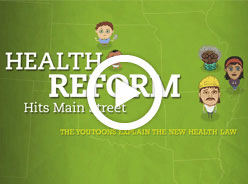 |
This video about health reform was created by the Kaiser Family Foundation. |
This week marks the one-year anniversary of the signing of the federal Affordable Care Act. While some key provisions are not yet in place, children and families already have been affected by the new law, especially children with special health care needs.
In California, 8% of children with special needs are uninsured, and among those who are insured, 35% of have inadequate coverage, according to 2007 data. These children may be uninsured because they are denied coverage on the open market – health insurers tend to reject children with pre-existing conditions, such as asthma, diabetes, and autism, due to higher costs of care for these children. However, since the signing of the Affordable Care Act, approximately 576,500 California children with pre-existing conditions are now protected, according to Families USA; under the new law, insurers no longer can deny health coverage to these children.
Some other health reform provisions affecting children and families already have been implemented as well, including:
- Parents now can keep children on their health insurance policies until age 26. This helps reduce the rate of uninsurance among older teens and young adults.
- Insurers cannot charge co-payments, deductibles, or co-insurance for certain preventive care, thereby reducing families’ out-of-pocket expenses.
- Insurance companies cannot drop coverage for people who are sick.
- There are no longer lifetime limits on coverage.
See what other changes lie ahead under the Affordable Care Act with this timeline.
Posted by Jordan Handcox
Tags: Child Health Issues
March Awareness Campaigns: Breakfast, Diabetes, Inhalants
 Several important children’s health observances take place this month. Following are highlights, along with related data from kidsdata.org.
National School Breakfast Week was March 7 – 11. In California, 2006-’08 data show that students in 7th grade are more likely than 9th and 11th graders to say they ate breakfast that morning. Among 7th and 9th graders, boys are more likely than girls to say that they ate breakfast that morning. These data also show that Asian American and Caucasian/White students were most likely to say they ate breakfast (66% and 65%, respectively), while African American (53%) and Latino students (55%) were least likely to report having eaten breakfast.
The American Diabetes Alert Day which took place March 22, challenges all Americans to explore their risk for developing type 2 diabetes by taking the proper preventive health tests. According to 2005-06 data, 1% of California children with special care needs have diabetes.
Inhalants Prevention Week is this week (March 20-26) and aims to increase understanding about the use and risks of inhalants. Although most 7th, 9th, and 11th graders in California in 2006-08 said they had never used an inhalant, 5.8% of 9th-grade girls and 4.9% of 9th-grade boys reported using an inhalant 4 or more times. Students who report feeling less connected to their school also have higher levels of inhalant use.
Posted by kidsdata.org
Tags: Health Observances
East Bay Studies Reveal Health Disparities
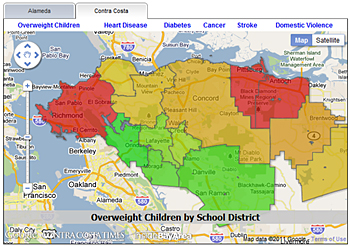
Data released this month from local East Bay studies show wide disparities in several areas of health — and a subsequent impact on life expectancy.
A few key findings, from a series in the Contra Costa Times on these studies:
- In Alameda County, the life expectancy for an Asian American girl is 20 years longer than that of an African American boy.
- In Contra Costa County, children born into low-income communities have a life expectancy of 75 years, compared to 82 years in higher-income areas.
The studies, which considered both adult and child health, also looked at specific health issues such as obesity, asthma, and cancer. Detailed maps show obesity rates — as high as 41% in one school district in Alameda County — and rates of childhood asthma, available by city. These data showed significant disparities between cities in hospitalization rates for childhood asthma, from 800.7 per 100, 000 children in Oakland, to 118.4 per 100,000 in Pleasanton.
The studies were funded by the Hospital Council of Northern and Central California, and aim to help hospitals analyze and address local health needs. County officials say they’ll also use the data to focus their attention and resources on key issues and demographic groups.
If you don’t live in the East Bay – or even if you do – kidsdata.org offers data on cancer rates, asthma hospitalizations, weight, and many other issues for your community.
Kudos to the hospital council and Contra Costa and Alameda counties for generating and using such a rich data set. Such local data are invaluable for raising the visibility of serious child health issues in our communities.
Posted by kidsdata.org
Tags: Child Health Initiatives, Data Projects
Poverty Linked to Wide Array of Child Health Issues, Parent Survey Shows
 Newly updated data reveal that the percentage of California public school students eligible for free/reduced price meals rose from 51% in ’08 to 56% in ’10 — an increase of more than 281,000 children statewide. Eligibility for this program is widely viewed as a proxy measure for poverty.
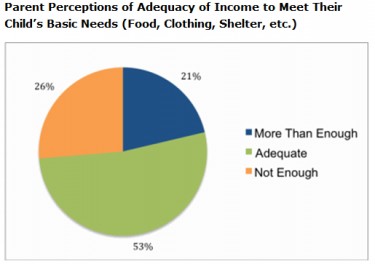
As increasing numbers of children fall below the income level required to qualify for the program, it’s instructive to note data from our foundation’s 2010 California Parent Survey. The survey asked parents of 1,685 children how their child was faring across dozens of measures that address the whole terrain of childhood, from physical, emotional and behavioral health to school-related issues and family and societal influences. Parents’ responses highlight the many ways that poverty is connected to child health.
The parents of one-quarter of children said their family’s income was not adequate to meet their child’s basic needs, such as food, clothing, and shelter. The survey also showed that lower-income children have poorer health; lower quality health care; poorer emotional health; higher rates of depression; neighborhoods that are less safe; lower-quality schools, and less satisfactory child care arrangements (differences were statistically significant.)
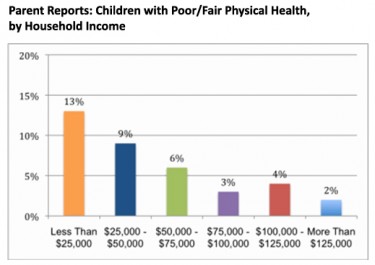 These results conform with a substantial body of research that links poverty with long-term negative consequences for children. According to a 2009 Child Trends analysis of 10 studies, poor children are more likely than children from more affluent families to have low academic achievement, to drop out of school, and to have health, behavioral, and emotional problems. As the Child Trends report notes, “these linkages are particularly strong for children whose families experience deep poverty, who are poor during early childhood, and who are trapped in poverty for a long time.”
For policy implications related to child poverty, see the Child Trends report.
Posted by kidsdata.org
Tags: Data Projects, New Data