Mental Health Awareness month is a time to note that the emotional health of children is an integral part of overall health, as physical and mental health are intricately linked. Mental disorders affect as many as 1 in 5 U.S. children each year and are some of the most costly conditions to treat – mental health problems among young people under age 24 cost the U.S. an estimated $247 billion annually. Unfortunately, the majority of young people who need mental health treatment do not receive it, and mental health problems in childhood often have negative effects in adulthood.
The California Legislature has proposed several bills that address children’s mental health, from increased training and peer supports to early prevention and funding parity. Three current bills worth noting:
SB 906: Medi-Cal: mental health services: peer support specialist certification
This bill establishes a statewide peer support specialist certification program for health providers. The peer support specialist would have the experience and the formal training to promote mind-body recovery for adults or transition-age youth.
SB 1019: Youth mental health and substance use disorder services
This bill creates financial parity for children’s mental health and adult mental health funding. It requires at least half of all funds allocated to the Mental Health Services Oversight & Accountability Commission under the Investment in Mental Health Wellness Act of 2013 be used to expand mental health services for minors.
AB 2686: Early identification of pupil mental health issues: in-service training for certificated employees and classified staff
This bill requires each school district, county office of education, and charter school to provide in-service training to certificated employees and classified staff who provide instruction to or have regular personal contact with pupils in K-12th grades on the early identification of pupil mental health issues.
Kidsdata is a source for policy options that could promote children’s emotional health.
Learn more »
Posted by kidsdata.org
Post Comment
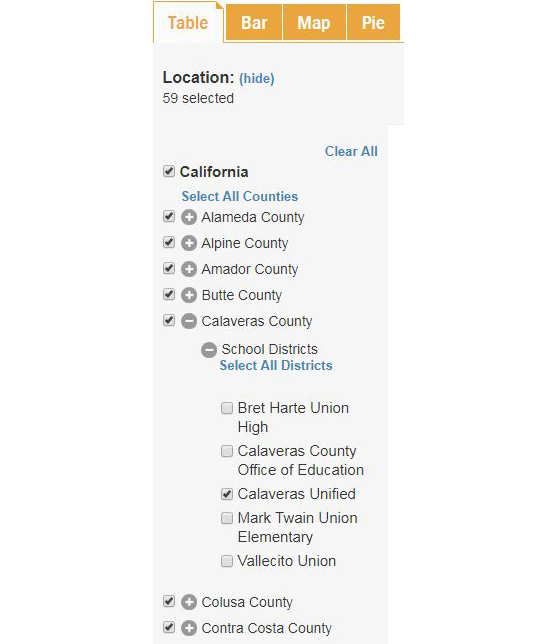
Curious to know how children’s health differs by school district? Data such as emotional health, school attendance and discipline, and drug use are available at the school district level. It’s just three easy steps from the left side of the visualization:
1. Click the “+” sign next to your county of choice
2. Click the “+” sign next to “School Districts” and all available school districts will appear
3. Select your district of interest
The Kidsdata team will be at the California School-Based Health Conference on Friday, May 18, in Sacramento, CA. The event brings together providers, educators, advocates, and other leaders in the school-based health care movement across the state. Be sure to stop by our booth to say hello!
Posted by kidsdata.org
Post Comment
Depression-Related Feelings Among Gay, Lesbian, Bisexual Youth, 2013-2015
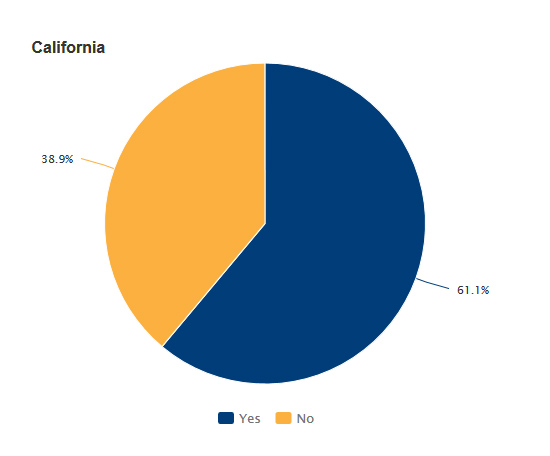
An alarming 61% of youth who identify as gay, lesbian or bisexual have felt depressed in the previous year in contrast to 29% of their peers who identify as straight. These students, who are in grades 7th, 9th, or 11th grade or are in non-traditional programs, felt so sad or hopeless almost every day for two weeks or more that they stopped doing their usual activities.
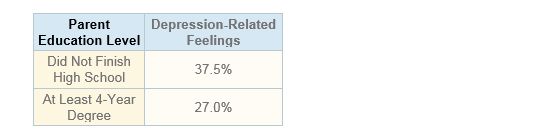
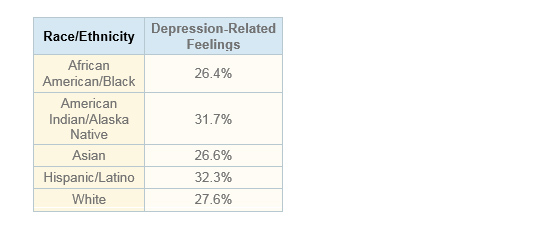
Disparities among youth who experience depression-related feelings vary widely across student groups. Students with particularly high percentages of depression-related feelings include those in non-traditional schools, those with low levels of school connectedness, those whose parents did not graduate from high school, and American Indian/Alaskan Native or Hispanic students.
The tables below call attention to disparities among groups of students in California. Use the links to see additional data by county and school district.
Depression-Related Feelings Among Student Groups, 2013-2015
By grade level »
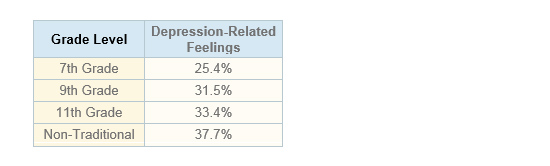
By level of school connectedness »
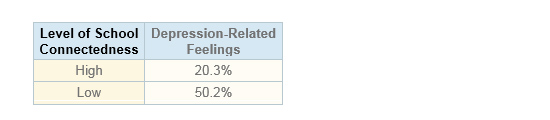
By parent education level »
By race/ethnicity »
This data release about emotional health is a part of Kidsdata’s Youth in Schools series. In partnership with WestEd, we are featuring data from the California Department of Education’s California Healthy Kids Survey.
The Stanford Center for Youth Mental Health and Wellbeing featured how to overcome cultural barriers to mental health care access at its Adolescent Mental Wellness conference.
The Kidsdata team will present on chronic stress and emotional health among California’s youth at the California Mental Health Advocates for Children and Youth Conference.
We are continuously updating our data. Click the links below to see the latest:
Youth Suicide and Self-Inflicted Injury
Suicidal Ideation (Student Reported), by Grade Level
Number of Youth Suicides, by Age
Youth Suicide Rate
Posted by kidsdata.org
Post Comment
Homeless Public School Students, 2015-2016
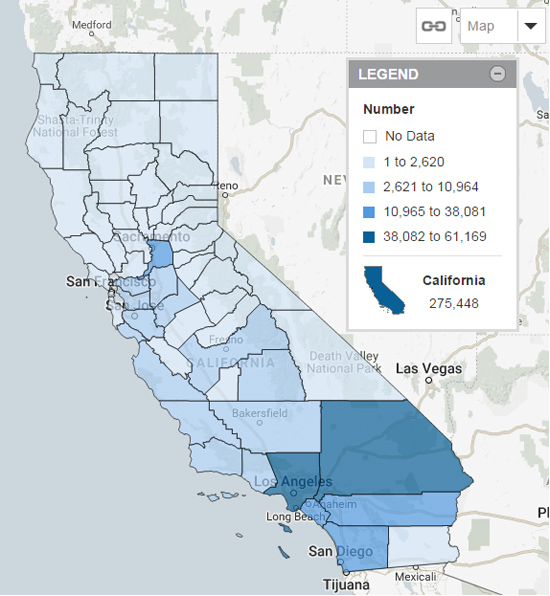
Data on homeless children and youth in California are now available on Kidsdata. Over a quarter million, or 4.4% of public school students, were recorded as homeless at some point during the 2015-2016 school year. Most homeless students stayed with friends or relatives because of loss of housing (85%), and the remainder were in a temporary shelter, motel, or were unsheltered.
Unaccompanied Homeless Youth (Point-in-Time Count), Ages 0-17: 2017
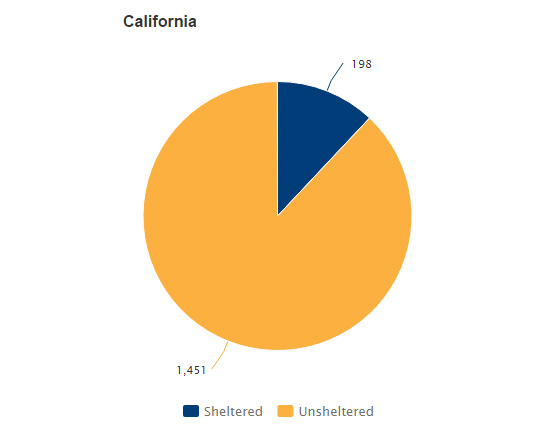
Recording homeless students during the school year is one way to measure homelessness. A second way to measure homelessness is with a point-in-time (PIT) count which is held nationwide on one night in January each year. In 2017, 1,649 youth who were under age 18 were found homeless without a parent or guardian. Most were unsheltered, meaning that they were found in a place not ordinarily used for sleeping.
Federal agencies, researchers, and advocates agree that the homeless youth population remains largely hidden. Current methods to measure homelessness are presumed undercounts. However, the data that are available suggest this is a statewide issue.
Earlier this month we released data on childhood poverty. Homelessness can be one of the tragic consequences of poverty. Data revealing homelessness among youth and research about the impact of homelessness can help raise awareness and drive solutions to ending homelessness among youth.
Learn about addressing youth homelessness »
Kidsdata shared how to access and use homeless data by legislative district at the Youth Empowerment Summit hosted by the California Coalition for Youth in Sacramento on April 16. The next day, participants met with state legislators in support of SB 918, the Homeless Youth Act of 2018. Estimates of homeless students, based on data from the California Department of Education’s Coordinated School Health and Safety Office, are available for your legislative district here.
The California Homeless Youth Project uses data to enhance their “voices from the street” series.
Homeless Public School Students
Unaccompanied Homeless Youth (Point-in-Time Count), by Age Group and Shelter Status
Posted by kidsdata.org
Post Comment
Kidsdata and Public Policy Institute of California (PPIC) have partnered to bring you the latest data on poverty among California’s children. Poverty and inequitable distribution of resources are fundamental impediments to healthy and well children. Addressing poverty among all children must be a key part of programs and policies that aim to maximize health and well being.
Guest author, Caroline Danielson, who is a senior fellow at the Public Policy Institute of California, shares important findings about poverty in California:
Measuring Poverty
Poverty is high in California, and it has not improved as much as the growing economy might suggest it should. In fact, California’s poverty rate and child poverty rate are both the highest in the country, according to Census Bureau estimates from the Supplemental Poverty Measure (SPM). The California Poverty Measure (CPM), an ongoing collaboration between the Public Policy Institute of California and the Stanford Center on Poverty and Inequality, is a state-specific, updated measure of the adequacy of the resources families have on hand to meet their basic needs. The CPM improves on official poverty statistics by accounting for sharply differing housing costs across counties and by incorporating major social safety net programs like the federal and state Earned Income Tax Credits (EITC), CalFresh food assistance, and CalWORKs cash assistance for low-income families with children.
Poverty in California
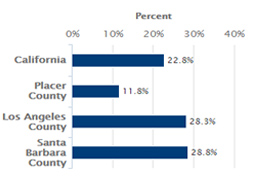
According to the CPM, 19.5% of Californians were poor as of 2015—that means 7.5 million people living below a basic needs threshold (on average less than $30,000 in total resources for a family of four). The poverty rate is higher for children at 22.8%, or over 2 million children in 2013-2015. Among counties with data, CPM poverty rates ranged from 11.8% in Placer County to over 28% in Los Angeles and Santa Barbara counties.
Learn more »
Poverty Increase without Safety Net
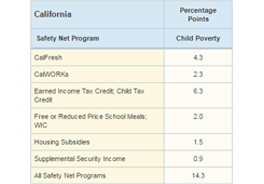
Without resources from the social safety net, we estimate that an additional 1.3 million children, or 14.3%, would live in poverty based on data from 2013-2015. This translates into over one-third of children in poverty (37.1%). In other words, social safety net programs are doing critical work to mitigate poverty in the state.
Learn more »
Deep Poverty
For children living in deep poverty (with family resources less than half of the poverty threshold), social safety net programs are even more consequential. We estimate 5.1% of children lived in deep poverty in 2013-2015, but that nearly three and one-half times that share would live in deep poverty absent resources from the social safety net (17.4%). Nonetheless, the vast majority of children in poverty live in families where at least one adult works (82.3%), and this share is high even for children in deep poverty (68.2%).
Learn more »
Addressing Poverty
Taken together, these data suggest that solutions to child poverty in the state must take account the ways in which family employment and social safety net programs dovetail and the ways that they could be jointly improved. These data also drive home the need to address poverty as we take action for the well-being of the state’s children.
Learn more about addressing poverty »
Caroline Danielson is a senior fellow at the Public Policy Institute of California. Her research focuses on multiple dimensions of the social safety net, including its role in mitigating poverty, program access and enrollment, and the integration and governance of programs. The Public Policy Institute of California is a nonprofit, nonpartisan think tank dedicated to informing and improving public policy in California through independent, objective, nonpartisan research.
Kidsdata in Action
First 5’s 2018 Child Health, Education, and Care Summit, April 11-12.
Along with several of our partners, we will discuss the relationship between poverty and adversity. Also, we will share new data on adversity and introduce county-level dashboards on adversity over the life course. We hope to see you there!
We are continuously updating data. Click the links below to see the latest:
Family Income and Poverty
Children with Two or More Adverse Experiences (Parent Reported)
Children Who Are Resilient (Parent Reported)
Prevalence of Childhood Hardships (Maternal Retrospective)
Posted by kidsdata.org
Post Comment
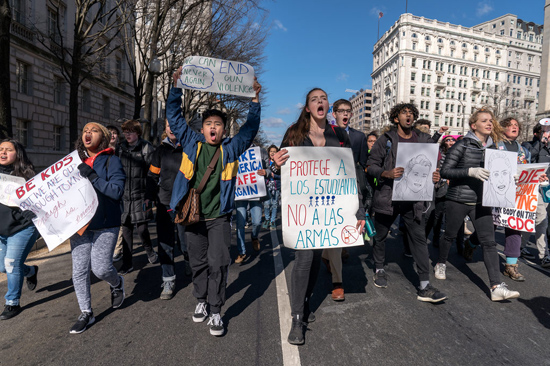
Some of the best advocates for children’s health are engaged and empowered youth. Creating a positive cycle of health, from optimal physical and mental health to positive social behaviors and supportive relationships requires all of us, adults and youth alike, to be engaged citizens.
Adolescence is the stage in human development when individuals begin to clarify and articulate their own values and operationalize their roles in the larger world. Their uncertainty motivates them to question those around them. Thus, it is natural for youth to challenge the status quo, identify hypocrisy, and encourage all of us to improve and hold society to a high standard.
This past month we have seen youth across the country take ownership of their own safety. They are speaking up because they implicitly understand that health and well being can only be achieved when their communities are safe and when they have ready access to physical and emotional supports. We are inspired to watch this generation of advocates work to improve society and protect their health.
Kidsdata is a powerful tool for demanding action, it provides comprehensive data on how children and youth are faring and information on how we can contribute to improving their health and well being. As our youth raise their voices to make a better world, we should take time to listen and support them. They too, are demanding action.
Photo by Lorie Shaull/CC BY-SA 2.0
We are continuously updating data. Click the links below to see the latest:
School Attendance and Discipline
Children’s Emotional Health
Posted by kidsdata.org
Post Comment
Visualizing data by legislative district helps identify areas of need and strengthens communication with your legislator. Kidsdata offers easy access to data for specific legislative districts on various topics. For all other topics where data are not broken down by districts, our legislative boundary overlay tool is a great option. Users can customize a map overlay by Assembly District, State Senate District, and U.S. Congressional District for a visual representation of district borders. Follow these three easy steps to take your map data to the next level!
1. Choose your data map of interest:
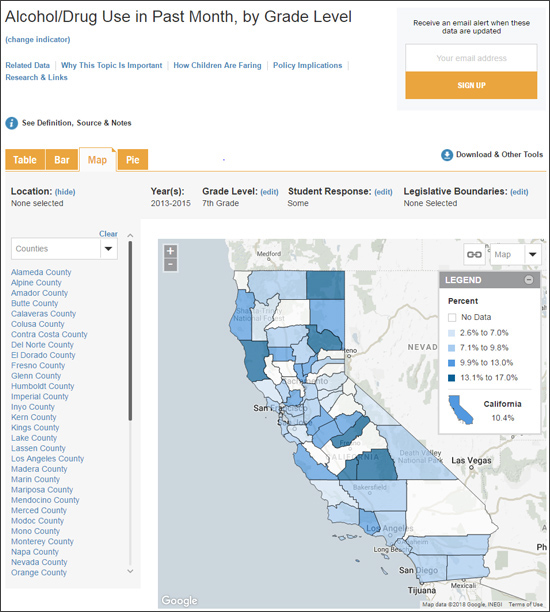
2. Click Legislative Boundaries. Select the type of district. If you’re not sure about your district, click “What’s my district?” for more information.

3. Customize the districts you would like to see on the map. You can select as many as you want, or, click “Check All” to view all districts.
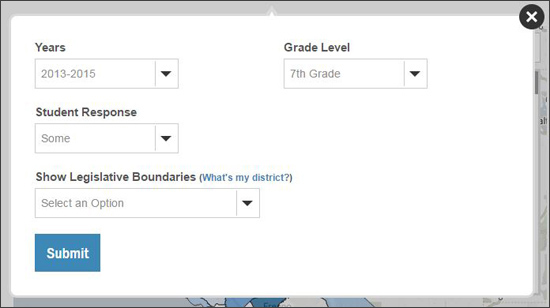
Share your map with legislators, stakeholders, and advocates!
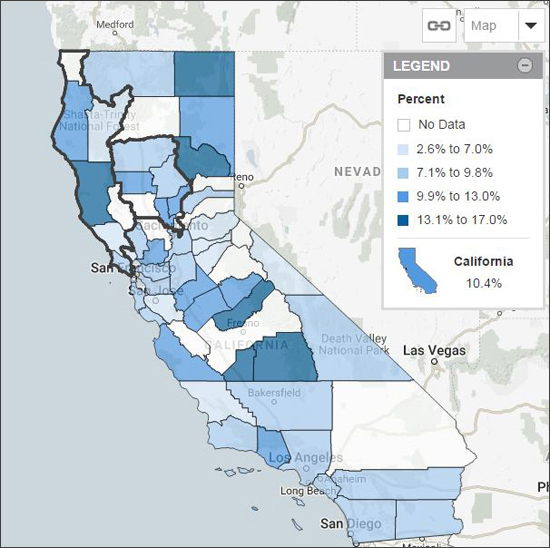
7th Grade Alcohol/Drug Use in Past Month, 2013-2015, in California State Assembly Districts Two and Four
Check out more helpful tips »
Posted by kidsdata.org
Post Comment
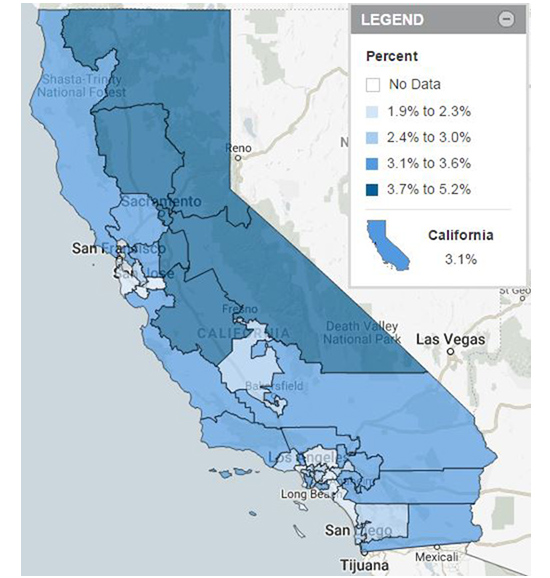
Children with Major Disabilities, by State Senate District, 2011-2015
Updated information on children with special health care needs, those who have a chronic physical, developmental, behavioral or emotional condition that requires more than routine health and related services, is now on Kidsdata. Discover the latest data on children with major disabilities by legislative district and by county, city and school district. Also, find special education enrollment by disability and race/ethnicity, the number of active California Children’s Services (CCS) enrollees by age group, and the percentage of insured and uninsured children who have major disabilities.
In California, nearly one in four families has a child with a special health care need, totaling over one million children. Additionally, over 280,000 children ages 0-17 years old had at least one major disability in 2011-2015. For state legislative districts around the Shasta/Cascade, High Sierra, and Gold Country regions, between 3.7% and 5.2% of children had major disabilities compared with under 3.7% in other districts during this period.
Children with special health care needs and their families face many challenges. For example, health care and other necessary support services generally are provided in an uncoordinated manner, and families are left to navigate the fragmented system on their own. For children of color, low-income families, and families living in rural areas, challenges are greater. Programs like CCS are crucial to helping children with special health care needs. Learn how the Lucile Packard Foundation for Children’s Health is improving the system of care for California children: lpfch.org/cshcn.
Posted by kidsdata.org
Post Comment
Using E-Cigarettes At Least Seven Times in Lifetime, by Level of School Connectedness, 2013-2015
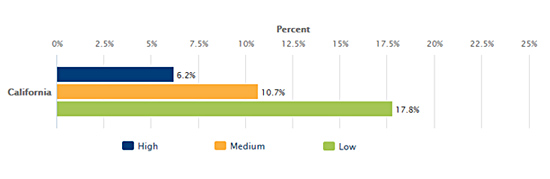
California youth with low levels of connectedness to their schools have higher rates of e-cigarette use than their more connected peers. Reporting in 2013-2015, 18% of students with low levels of school connectedness in grades 7, 9, 11, and non-traditional programs had used e-cigarettes at least seven times—almost three times the estimate for youth with high levels of school connectedness (6%).
A new report from the National Academies of Sciences, Engineering, and Medicine found substantial evidence that e-cigarette use among youth increases the risk of transitioning to smoking conventional cigarettes. Data available on kidsdata.org show that e-cigarette use is more common than smoking: 14% of 11th graders in California had used e-cigarettes at least seven times compared to 7% who had smoked cigarettes. This pattern held across levels of school connectedness, grade levels, genders, race/ethnicities, and sexual orientation. Tobacco use or smoking in any form is highly addictive and unsafe, and the long term health risks require intervention at an early age to prevent uptake and escalation.
Efforts across the state are working to address this growing issue. The Tobacco Prevention Toolkit from Stanford School of Medicine is a resource for anyone who works with youth. It contains a set of modules focused on e-cigarettes and vapes, messages on nicotine addiction, information and resources concerning positive youth development, and school policies that provide information about school tobacco policies and tobacco control efforts. Also noteworthy, the California Department of Public Health continues to run a Still Blowing Smoke campaign with special attention to youth and e-cigarettes.
Kidsdata.org’s new indicators about e-cigarette use are among 75 updated indicators on alcohol, tobacco, and other drug use from the California Department of Education’s Healthy Kids Survey. In partnership with WestEd, we are working to feature data on the health and well-being of youth in schools.
We are always updating our data. Click the links below to see the latest:
Characteristics of Children with Special Needs
Active California Children’s Services (CCS) Enrollees, by Age Group
Children with Major Disabilities
Insured/Uninsured Children Who Have Major Disabilities
Special Education Enrollment
Deaths
all indicators
Youth Alcohol, Tobacco, and Other Drug Use
all indicators
Posted by kidsdata.org
Post Comment
Firearm Death Rate for Children and Young Adults Ages 24 and Under: 2013-2015
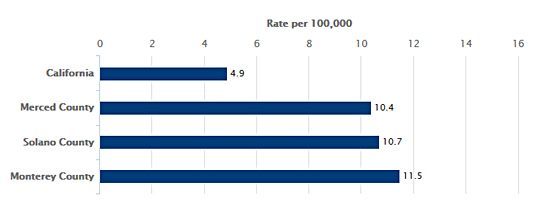
Firearm-related injuries claimed the lives of 1,918 California children and young adults between 2013 and 2015. Homicide is the leading cause of firearm death among young people ages 24 and under, followed by suicide. Of the 19 counties with data in 2013-2015, three recorded firearm death rates that were more than double the state average of 4.9 per 100,000: Merced, Monterey, and Solano. These counties’ rates have been consistently higher than the statewide rate since 2008-2010.
The death of any young person is a tragedy. The tragedy is amplified when the death is preventable. Public policies aimed at prevention, education, and support of youth and families can address preventable death. For example, routine and accessible mental health screening and services for youth can address suicide and harmful behavior to others. Also, school policies that foster a safe and positive school climate can reduce violence.
Kidsdata.org has newly added data on the number and rate of both fatal and non-fatal firearms injuries, by cause, age, gender, and race/ethnicity. Customize and share these data to help prevent youth firearm injury and death in California. If you need assistance navigating our site to get the data you need, please contact us at [email protected].
Posted by kidsdata.org
Post Comment