


Archive for September, 2011
Revamped Research & Links Section Helps Put Data into Context
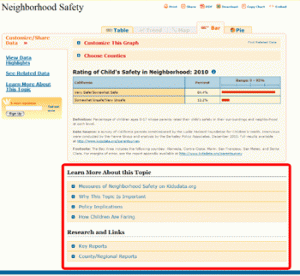 Earlier this week, our foundation announced a new section of kidsdata.org that can help provide context to the data.
The new Research & Links section of kidsdata.org allows users to get seminal research, policy, and program information related to each topic on the website. By compiling key websites, research articles, reports on policies and best practices, and county/regional reports for each topic, this section provides a gateway for users who want to learn more about the issues presented on the site.
The Research & Links section offers additional context for the data on kidsdata.org, such as explanations of what’s behind the numbers and what can be done to bring about improvements. The section also highlights key issues that are not apparent from the data, such as information about emerging concerns or specific subgroups of the population for which little data exist.
Kidsdata’s Research & Links section contains wide-ranging resources to help researchers, policymakers, practitioners, and others to better understand and address important issues in children’s health. This information is available below any chart or graph on kidsdata (see an example) or in the main Research & Links section.
If you have suggestions for additions to our Research & Links section – regional or county-level reports, other key websites, research articles, etc., please contact us at [email protected].
Posted by kidsdata.org
Tags: New Features
New Report Details Increase in Poverty for Hispanic Children Nationwide
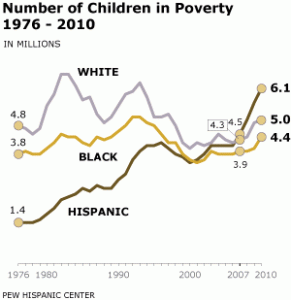
A report released this week by the Pew Hispanic Center reveals that Hispanic children comprise the largest number of children living in poverty in America, according to data from 2010. Hispanic children now surpass all other racial and ethnic groups in terms of population living in poverty, at 6.1 million, compared to 5 million Caucasian children and 4.4 million African American children.
The Pew Hispanic Center report suggests that the increase is the result of the economic recession, which drove up the percentages of unemployment and food insecurity to above average rates for Hispanics, while driving down the value of household wealth for the Hispanic population.
Among California children, the most recent data on kidsdata.org show a rise in the percentage of Hispanic children living in poverty each year from 2007 to 2009.
From 2007 to 2009, Native American, Hispanic, and African American children faced similar rates of poverty, at 26.7%, 27.5%, 28.6%, respectively.
Find more data about California children living in poverty.
Posted by kidsdata.org
Post Comment
Coming Soon to Kidsdata.org: Preterm Birth Data
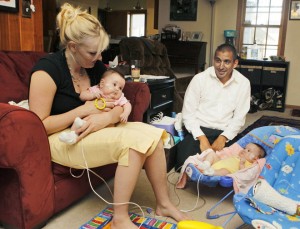 |
Photo courtesy of Rick Wood of the
|
A recent article in the Milwaukee-Wisconsin Journal Sentinel chronicled the financial and emotional costs a family faces when a child is born prematurely. Infants born prematurely have a higher risk of developing immediate, severe health problems and lifelong disabilities compared to babies carried to full-term, and research also shows that preterm (vs. full-term) babies have higher death rates in young adulthood.
Given the importance of this issue, as well as its connection to children with special health care needs, which is a focus area for our foundation, we will soon add a new Preterm Birth indicator to kidsdata.org. We also will update the following related indicators:
Stay tuned for these data in the coming months.
Posted by kidsdata.org
Post Comment
Roundup of Recent News Stories: Poverty, Fitness, ADHD, and More
 Following are some recent news highlights about children and families, along with related data from kidsdata.org:
Education (see related data)
- Obama to Waive Central Provisions of ‘No Child Left Behind’
(NY Times, 9/22/11, by Dillon)
Physical Fitness (see related data)
- New Approach to Physical Education Encourages Healthy Habits, Improves Youth Fitness Results
(WSJ, 9/13/11, by Shellenbarger)
Poverty (see related data)
- Census Report Finds Increase of 950,000 Children Living in Poverty from 2009 to 2010
(LA Times, 9/13/11, by Semuels and Helfand)
School Meals (see related data)
- Public Schools Face Rising Costs of More Healthful School Lunches
(NY Times, 9/19/11, by Santos)
Smoking/Risky Behaviors (see related data)
- Tobacco Sales Down for California Minors, Survey Finds
(Bay Citizen, 9/22/1, by Mcintosh) - Eating Meals as a Family Linked to Less Risky Behaviors in Teens, Study Says
(ABC News, 9/22/11, by Francis)
Special Health Care Needs (see related data)
- Premature Babies Face Higher Risk of Death in Early Adulthood, Stanford Researchers Say
(Time, 9/21/11, by Rochman) - Study: ADHD Doubles the Risk of Injury Among School-Age Children
(Consumer Reports, 9/14/11)
Posted by Jordan Handcox
Post Comment
Encouraging News and Data Related to Teen Smoking
Teen smoking has been in the news lately. And, from what we can see, the news is encouraging.
According to this Bay Citizen article, fewer California retailers are selling cigarettes to minors than ever before. To collect these data, the California Department of Public Health conducts an annual sting operation — sending 700 underage youth to try to buy cigarettes. Results showed that 8% of stores sold cigarettes to minors in 2010, and only 6% did in 2011.
For those teens who do smoke, a new study found that adding physical activity to a cessation routine increases the likelihood that teens will stop smoking. According to the International Business Times, teens who combined counseling with fitness education were more likely to quit than those who didn’t. Evidently the rates for quitting were even more pronounced among teen boys.
On kidsdata.org, we offer data about youth cigarette use for counties and school districts across California. Statewide, the percentage of 11th grade boys and girls reporting they’ve never smoked remained relatively steady from 2003-2008. Find data for your region>>
Posted by Felicity Simmons
Post Comment
New Census Data Show Local Poverty Rates, Income Levels for 2010
 Median family incomes for counties across California decreased from 2009 to 2010, according to data released today by the Census Bureau. This set of data, from the American Community Survey, also includes local data for educational attainment, health insurance coverage, and several demographic measures.
On kidsdata.org, we include many measures of child well being from the American Community Survey, including the aforementioned median family income. 2010 data from this Census release will be added soon.
Given today’s news about family income data, the impact of the recession on California communities is becoming more evident. For more perspective on these data, here are some news articles from across the state:
- Modesto Bee: As Incomes Fall, More Stanislaus County Families Need Assistance
- San Jose Mercury News: Census Reveals Lower Bay Area Incomes, Rising Poverty
- Los Angeles Times: LA County Poverty Rate Jumps for Third Straight Year to 17.5%
Posted by kidsdata.org
Tags: Child Health Issues, Data Sources
Going to a Meeting? Don’t Forget to Bring Data
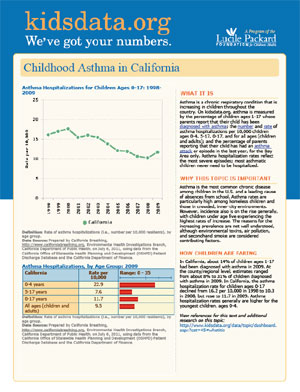 Now you can take relevant, updated data from kidsdata.org with you anywhere — to meetings, presentations, events, or any other place you want to share child health information.
New, one-page (front and back) fact sheets offer up-to-date summaries for each of our 60+ topics, 1,800 regions (every county, city, school district, and legislative district in California), and 10 demographic groups (see all available fact sheets). These easy-to-print pdf data summaries are valuable for a variety of uses:
- Quick, up-to-date handouts about the status of children for meetings or advocacy work
- Inexpensive brochures for events and presentations
- Offline reference material about children’s health in your community
Access these fact sheets by clicking on the PDF link at the top right corner of every data page.
By printing a fact sheet and taking kidsdata.org with you to a meeting or event, you can put reliable data in the hands of those who support programs for children in California.
Posted by kidsdata.org
Tags: New Features
Kidsdata.org Staff Are Coming to a City Near You
 At the Lucile Packard Foundation for Children’s Health, our mission is to elevate the priority of child health issues across California. In the coming months, staff from kidsdata.org will be traveling throughout the state for meetings, events, and other opportunities to help us meet our mission. Here’s a synopsis of where we’ll be, and when. If you’re in the area, please do reach out if you’d like to learn more about the foundation or kidsdata.org. We’d like to meet you, too, and learn about your work on behalf of children in California.
- Next week, we’ll be in Los Angeles and Orange counties. On Sept. 30, we’re partnering with UCLA’s Health Data team for a day-long workshop about child health data.
- In mid-October (date TBD) we’ll host a second data workshop with UCLA, this time in the Inland Empire. Stay tuned to Data Points for details.
- In late October or early November, we’ll be in San Diego meeting with some key child health organizations.
- Also in early November, we’ll be in San Jose with New America Media for another media briefing on poverty.
We also have trips planned for the Sacramento area, and more in the Bay Area. For more information, please reach out to Felicity Simmons at 650-724-5778, or [email protected].
Posted by kidsdata.org
Tags: News About Kidsdata.org
Recap and Video: Growing Up Poor in the Bay Area
Earlier this week, the kidsdata team participated in a forum for the media, “Growing Up Poor in the Bay Area.” The San Francisco forum, hosted by New America Media, began with a presentation from our foundation’s Andy Krackov, who covered data on childhood poverty in California and the Bay Area. The data tell a compelling story of the rising levels of poverty and decreases in median family income in the Bay Area, all alongside increases in the cost of rent for housing.
After the data presentation, New America Media showcased a number of youth-created videos that took an in-depth look at the face of childhood poverty in the Bay Area. One video chronicles a family’s fight to survive after the primary bread-winners are deported. Another video chronicles an East Palo Alto mother’s struggle to feed her family healthful meals on a tight budget. The video below documents a day in the life of a young baby in San Francisco’s Hunters Point neighborhood, whose family struggles daily to make ends meet.
Tying data together with personal stories like these helps bring a human face to the numbers. Our foundation will be part of another “Growing Up Poor in the Bay Area” session with New America Media, this time in San Jose. Details will be posted on this blog.
Posted by Jordan Handcox
1 Comment
Orange County Workshop: Using Children’s Health Data in Your Work
 Attention everyone in Southern California who need children’s data for their work!
On Friday, Sept. 30, in Anaheim, we’re partnering with the UCLA Center for Health Policy Research and their HealthDATA team for a day-long workshop about finding and using data.
At this FREE workshop, you’ll learn how to formulate data questions, interpret results, export data for analysis, and use your findings in reports, presentations, proposals, and policy/program planning. Working directly with kidsdata.org, attendees will learn simple tips for obtaining health information for every city, legislative district, county, and school district in the state.
For more details, and to register, visit http://www.kidsdata.org/content/ucla-orange/Default.aspx
Posted by kidsdata.org
Tags: Data Projects, News About Kidsdata.org