


Archive for the ‘Kidsdata News’ Category
Positive Indicators: It’s Important to Look At Strengths, Too
Several recent publications have discussed the importance of “positive indicators.” What are positive indicators and why are they important? These indicators measure aspects of positive well being, such as the percentage of students who report that an adult at school cares about them, rather than measuring problems, such as juvenile arrests. In the last couple of decades, there has been an increasing focus on understanding how to support children’s positive development – the skills, attitudes, health, and opportunities that young people need to succeed. This is a major shift from the historical focus on understanding and reducing negative behaviors and problems.
While it is important for policymakers to continue monitoring and addressing the problems facing children, it also is critical for leaders to understand the extent to which children are developing in positive ways, so we can develop strategies to promote and sustain those benefits. This is particularly true when governments are faced with tough budget decisions.
A recent UNICEF report discussed the concern that positive indicators may not attract as much attention as negative indicators and suggested that “it is often not the tenor of the indicator, but whether the trend is good or bad, that attracts this attention.” For example, the good news about California’s declining teen birth rate and the not-so-good news about few students reporting meaningful opportunities to participate in school both are worthy of public attention. In the U.S., it certainly is true that programs and policies promoting the positive development of children and youth have received increased attention in recent years, and support seems to be growing for the notion that “problem free is not fully prepared.”
However, there also is wide agreement on the need for additional and improved measures of positive well being, particularly in the area of social and emotional health. The following reports discuss these needs in depth and offer recommendations to improve positive indicators:
Lippman, Laura, H., Kristin Anderson Moore and Hugh McIntosh (2009), “Positive Indicators of Child Well-Being: A Conceptual Framework, Measures and Methodological Issues.” Innocenti Working Paper No. 2009-21. Florence, UNICEF Innocenti Research Centre.
Dukakis, K., London, R.A., McLaughlin, M., Williamson, D. (Oct. 2009). “Positive Youth Development: Individual, Setting and System Level Indicators.” John W. Gardner Center for Youth and Their Communities.
Posted by JoAnna Caywood
Tags: Data Challenges
Just Updated on Kidsdata.org: Juvenile Felony Arrest Rates
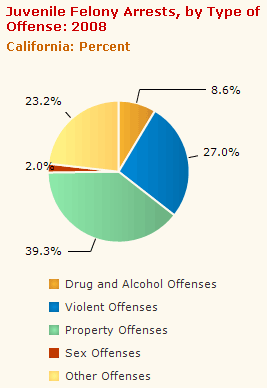 The kidsdata.org statewide expansion continues with new data for juvenile felony arrest rates and total felony arrests for all counties in California. These data are provided by the California Department of Justice, and are further broken down by age, gender, race and type of offense. Insights from these data include:
- California’s juvenile felony arrests have declined over the last 10 years, to 14 per 1,000 youth ages 10-17 in 2008.
- CA juvenile males are at least 4 times more likely than females to be arrested for a felony.
- African American juveniles are arrested at higher rates than their peers in other ethnic groups.
- Property offenses are the most frequent felony offense for CA youth, at about 40% of all offenses. Sex offenses were the lowest, at 2%.
View all data on juvenile arrests>>
Sign up to receive an e-mail alert when these data are updated>>
Posted by kidsdata.org
Tags: New Data, Statewide Expansion
National Awareness Campaigns for Kids in April
Following is a rundown of some important children’s health observances that take place this month, along with links to related data from kidsdata.org:
National Autism Awareness Month
- 8% of public school students enrolled in special education in California are diagnosed with autism.
- The number of special education students that were diagnosed with autism in California more than tripled from 2001 to 2009.
See our foundation’s May 2008 issue brief on autism diagnoses for more on this topic.
- According to data from the 2006-’08 California Healthy Kids Survey, more than 40% of 7th grade girls in California said they have ridden in a car driven by someone who had been drinking
- In this same survey, 29% of 11th-grade California boys, and 27% of 11th-grade girls, said they drink alcohol either “enough to feel it a lot” or “until I get really drunk.”
See all measures of alcohol, tobacco, and other drug use on kidsdata.org.
National Child Abuse Prevention Month/Month of the Young Child
- Substantiated cases of child abuse in California declined from 1998 to 2008.
- Neglect is the most common type of child abuse, representing nearly 50% of substantiated cases of child abuse in California.
See all child abuse data on kidsdata.org.
National Minority Health Awareness Month
Health-related data on kidsdata.org are available for a number of racial/ethnic groups in California, including:
- African American
- Asian/Asian American
- Filipino
- Latino/Hispanic
- Native American/American Indian
- Pacific Islander
Posted by Andy Krackov
Tags: Health Observances
How Can We Better Measure California’s Child Diversity?
A few weeks ago in LA, my colleague, Felicity Ayles, and I held a discussion with ethnic media about children’s data issues (video). In February, I participated in a similar session in Fresno (video). Both events were sponsored by New America Media.
The key question on ethnic journalists’ minds? How are kids of different racial/ethnic groups faring locally?
Unfortunately, our answers often were necessarily incomplete. As diverse as California’s child population is, we actually don’t have tools even to easily measure that diversity at a local level, let alone determine the status of how some groups are doing on wide-ranging measures. That’s because state and federal data sources often don’t report local data at the needed level of specificity.
California’s Department of Finance, for example, breaks out the statewide child population this way: Hispanic/Latino (49.3%), Caucasian/White (30.6%), African American/Black (5.8%), Native American (0.5%), Multiracial (3.7%), then one overall basket for Asian/Pacific Islander (10.2%). The state’s Department of Education is a bit more specific, breaking out Pacific Islander (0.6%) and Filipino students (2.7%) separately from Asian Americans (8.4%) in state and local public school enrollment figures.
But what about the Hmong population in Fresno? Or the Arab-American population in Southern California? Or the important breakdowns within the Hispanic/Latino community? The short answer is that we can’t pinpoint demographic trends locally, or sometimes statewide, for these and other groups.
As Steve Thao of the Hmong Tribune in Fresno points out in the video noted above, “The Asian-American community is very diverse and very splintered – different languages, different history, different cultures – and I think that’s something that kidsdata.org has to address.”
We agree. We crave better racial/ethnic breakdowns – not just for demographic data but for the hundreds of indicators on kidsdata.org that measure the status of child well-being, from prenatal care to poverty to child abuse – all of which are offered by race/ethnicity, but not by very fine breakdowns. Addressing this issue is clearly a multi-year endeavor that will require coordination with state and federal agencies. But we can start. At kidsdata.org, we’ll investigate whether more specific breakdowns are available from our data sources. And if you know of local or statewide efforts to provide better racial/ethnic data for children, please let us know by posting a comment below.
At the very least, we can catalog what’s going on in California to provide more distinct racial/ethnic groupings. From that, we all may learn how we can better measure California’s diversity.
Posted by Andy Krackov
Tags: Child Diversity, Kidsdata.org In The News
Is Your Kid Eating Pizza for Breakfast?
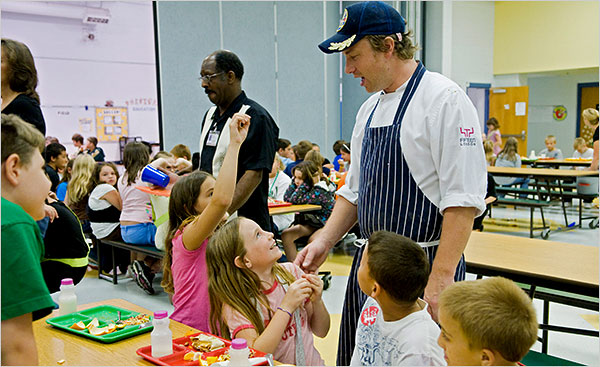 |
This photo from the New York Times notes the new series Jamie Oliver’s Food Revolution, which addresses nutrition in school lunches. |
If you watched ABC a few Sundays ago, you may have seen the premiere of a new show titled Jamie
Oliver’s Food Revolution. The show follows Jamie Oliver, a British chef known the world over for his healthful cooking, and more notably, for transforming the school lunch program in England into a healthful and budget-conscious success.
His new American reality show took him to Huntington, West Virginia, which, according to data from the Center for Disease Control and Prevention, earned it the moniker by the Associated Press as “Unhealthiest City in America” for 2008. Having no shortage of ambition, Oliver decided to observe and attempt to improve the city’s school lunch program, which served pizza for breakfast each day.
Seeing the state of a school lunch program in the unhealthiest city in America – where more than half of the adult population is considered obese – makes every parent think about what their children eat – and maybe, too, how there own community is faring regarding kids’ weight.
While California cities can’t claim to be the unhealthiest in America, there are disparities with the healthy weight of California children. For example, a smaller percentage of Latino and Pacific Islander children are at a healthy weight compared to their peers in other racial/ethnic groups. Get our most recent data on California students with healthy weight to see how kids in your community compare.
Posted by kidsdata.org
Tags: Child Health Initiatives
Finding Local Data on Substance Use Now Is Easier than Ever
In addition to the compelling drinking and driving data noted in the post below, numerous other substance use indicators also were added to kidsdata.org recently. These data also originated from the California Healthy Kids Survey (CHKS), which was developed and is administered by WestEd for the California Department of Education. Below are a few highlights for the state of California for the 2006-2008 reporting period. See all topics to view these student self-report data for your county or school district.
- 24% of 11th-grade boys and 21% of 11th-grade girls reported binge drinking in the past month before they took the survey.
- More than one-third of 11th-graders in the state report smoking marijuana at least once
- More than one in eight 11th-graders smoked cigarettes at least once in the past month before taking the survey.
- California students in 7th, 9th, and 11th grades are more likely to use alcohol than tobacco or other drugs.
- Students who report feeling less connected to their schools report higher levels of alcohol, tobacco, and other drug use.
For school districts and counties across California, these data are broken down by grade, gender, and students’ feelings of connectedness to their school, making CHKS an essential tool to researchers, policy makers, and those who work directly with kids in assessing how California’s adolescents are faring.
To be notified when these or any other data on kidsdata.org are updated, sign up for e-mail alerts.
Posted by Felicity Simmons
Tags: New Data, Statewide Expansion
How Prevalent Is Drinking and Driving Among Kids in CA? Local Data Provide Clues
Kidsdata.org just added 27 new indicators related to alcohol, tobacco, and other drugs. They all come from the California Healthy Kids Survey (CHKS), through a partnership with WestEd, which developed and administers CHKS for the California Department of Education.
This set of data includes 7th-grade students’ reports of riding in a car with a driver who had been drinking, and reports by 9th and 11th graders of drinking and driving or riding in a car driven by a friend who had been drinking. Here are some state-level findings for 2006-08:
- More than 40% of 7th graders said that they’d ridden in a car with a driver who had been drinking.
- Among 11th graders, girls were slightly more likely than boys to say that they had driven after drinking, or ridden in a car driven by a friend who had been drinking.
- Students with low levels of connection to school were most likely to say they had driven after drinking or ridden with a drinking driver – 14% said they had done so 7 times or more, compared to 6% of students with high levels of connectedness. (School connectedness is a summary measure that includes being treated fairly, feeling close to people, feeling happy, feeling part of school, and feeling safe at school.)
- Asian American students were most likely to report that they had never ridden in a car with a drinking driver or driven after drinking.
Find data for your county or school district:
Reports of Drinking and Driving or Riding with a Driver Who Had Been Drinking, by Grade and Gender
By Level of Connectedness to School
Posted by Sarah Marxer
Tags: New Data, Statewide Expansion
Putting CA’s High Unemployment Rates in a National Perspective
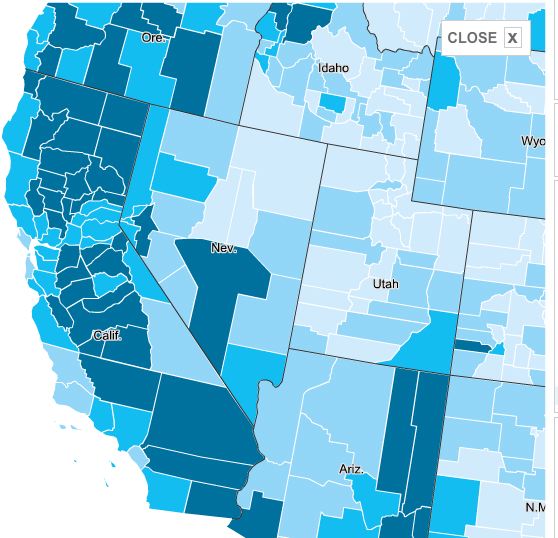 The Washington Post offers an informative map of unemployment rates, by county, across the United States. On the Post’s map, take note, too, of the “autoplay changes” feature, a helpful visual tool that shows how the recession took hold across America from Jan. 2007 to Nov. 2009.
When you focus on California, you see some troubling signs. From Imperial County through the Inland Empire to the Central Valley and on up to the Oregon border, California’s middle is experiencing among the highest levels of unemployment in the United States. In Imperial County, in fact, the unemployment rate in January 2010 was a shocking 27%, which appears to be among the highest, if not the highest, percentages in the country. The connection between unemployment rates and kids’ well being is perhaps obvious, but this brief paragraph from kidsdata.org makes the point clear:
Not only can unemployment be a barrier to a family’s economic security, it also can place families under stress, affecting children’s emotional health and other aspects of their well being, such as access to health insurance. Children from low-income families are more likely to go hungry; reside in overcrowded or unstable housing; live in unsafe neighborhoods; and receive a poorer education. They also tend to have less access to health care, child care, and other community resources, such as quality after-school programs, sports, and extracurricular opportunities.
Posted by Andy Krackov
Tags: Data Projects
“Underinsurance” Hinders Care for Many Children with Special Needs
The good news is that most of California’s children with special health care needs have health insurance. Unfortunately, that’s only part of the story. For nearly 40 percent of these children, their insurance coverage is inadequate to meet their needs, and low reimbursement policies make it extremely difficult for their families to find physicians and other care providers. As one parent of a special needs child said in a recent article from New America Media (NAM), “I called every therapist from Oakland to San Leandro, but none of them is willing to accept him.”
The NAM article, by Vivian Po, recounts the experiences of several Bay Area families, whose children have diagnoses that include cerebral palsy, Down syndrome, autism, Asperger’s syndrome, and epilepsy. The story highlights how program cuts brought about by California’s staggering budget deficit are worsening the underinsurance problem and taking a toll on families.
The issue is, of course, not limited to California. A national study published online March 8 in the journal Pediatrics notes that adequacy of insurance is strongly related to where a child lives, and that disparities exist within and among states. The authors conclude that legislation guaranteeing insurance for all children is important, but not sufficient. “If policymakers are interested in ensuring equitable treatment in the health care system for children with special health care needs, then policy initiatives aimed at reducing underinsurance and increasing uniformity of coverage across states are also needed,” they write.
A focus area for our foundation is improving the systems of care for kids with special needs, and adequate insurance must be a top priority. See our website at http://www.lpfch.org/informed/cshcn/.
Posted by David Alexander, MD
Tags: CSHCN
Stay Up to Date on Just the Facts That Matter to You
 Kidsdata.org offers a lot of data – likely millions of individual facts about kids in California. But maybe you’re only interested in a few of those facts. A specific ethnic group? A certain city? A couple of different topics?
Now, you can get an e-mail alert when data you care about are updated.
Just launched on kidsdata.org, our free e-alerts notify you whenever data are updated on the topics, regions, and demographic groups you select. These e-mail updates (similar to Google Alerts) can be delivered weekly or monthly and tailored for any combination of data available on kidsdata.org. Learn more>>
Try it out at http://ealerts.lpfch.org.
Posted by Felicity Simmons
Tags: New Features