


Archive for the ‘Kidsdata News’ Category
How Connected Are CA Kids to their Schools?
As adults, we know that the health and success of a company depend, in part, on a positive working environment. When employees feel that their managers care, hold high expectations, and give meaning to their work, productivity increases.
This dynamic is similar in schools. Students want to feel valued, challenged, and encouraged to participate, and when they do, research has shown that these and other factors associated with school connectedness play a critical role in fostering resilience in kids. Resilience, in turn, has been associated with healthy development and the avoidance of risky behaviors.
But how do we measure a student’s connectedness to school? Over the past several years, the California Healthy Kids Survey (CHKS) – developed and administered by WestEd and the California Department of Education – has established a number of measures of school connectedness, and these data – broken out by gender and race/ethnicity – now are available on kidsdata.org for school districts for across California.
Among the highlights, these data from 2006-08 show that:
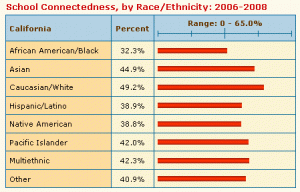 Less than half of 7th, 9th, and 11th-grade students in California typically report high levels of connection to their school. This summary measure includes student reports of being treated fairly, feeling close to people, feeling happy, feeling a part of, and feeling safe at, school.
- Students’ connectedness to school varies
by race/ethnicity. Caucasian/White and Asian American students consistently are most likely to report high levels of connectedness, while African American/Black students are least likely to report such high levels. - About one half of 7th, 9th, and 11th grade students in California in 2006-08 reported high expectations from teachers and others at school. Across all racial/ethnic groups, students were more likely to say in 2006-08 that teachers had high expectations of them than in 2003-’05.
- About 15% of 7th, 9th, and 11th-grade students in California report high levels of meaningful participation in school. This is a summary measure of student reports of whether at school they do interesting activities, help make decisions, and “do things that make a difference.” A higher percentage of students – roughly one-third – report low levels of meaningful participation in school.
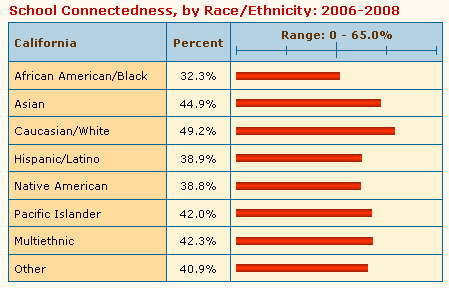
These school connectedness data provide important insights on the emotional health of students, and now that they are on kidsdata.org, we hope they can help policy makers and school districts statewide craft ways to ensure that all students, regardless of gender and ethnicity, feel connected to their schools.
Posted by kidsdata.org
Tags: New Data, Statewide Expansion
School Nurses: What a Difference Just One Can Make
 Today is National School Nurse Day. School nurses provide a link for all school children to available health resources and, in many cases, offer much-needed basic health care and screenings.
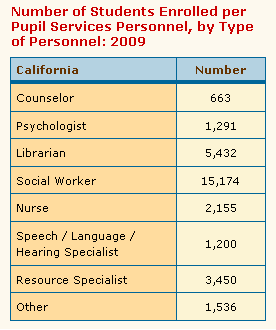
Yet despite their valuable contributions, there continues to be a long-standing nursing shortage in most school districts in California. Statewide, there were 2,155 students for every school nurse during the 2008-09 school year. Many school districts must share a single nurse with several other districts.
The decision not to fund school nurses has a significant impact on all children, but particularly on children with special health care needs. Many students now come to school requiring daily care, such as insulin injections, asthma medication, or care for medical equipment. Frequently, no school staff member has the skills to provide this care. Yet, the state’s current economic climate could mean even fewer nurses at school.
One encouraging sign is proposed federal legislation, sponsored by Senator Charles Schumer and Rep. Carolyn McCarthy, that aims to make grants to states for the purpose of reducing the student-to-nurse ratio in high schools, elementary schools, and kindergartens.
On a more local level, our Foundation, along with Lucile Packard Children’s Hospital, made a 5-year grant in 2007 to the San Jose Unified School District with the goal of increasing the number of school nurses available to the children in schools with a high percentage of students from low-income families. Early evaluation results from this grant, which added four nurses in the district, already have shown improved outcomes for children with hearing, vision, asthma, or dental problems, due to the availability of a school nurse. Since the implementation of this grant, more than 70% of teachers surveyed have said that school nurses helps them teach more effectively.
We will continue to report on the results of this effort to restore nursing to our schools. What is happening in your district?
Posted by Jordan Handcox
Tags: Child Health Initiatives
National Awareness Campaigns for Kids in May
Several important children’s health observances occur in May. Here’s a partial list, with related data from kidsdata.org noted alongside:
National Foster Care Awareness Month
- The rate of CA first entries into foster care have declined steadily over a 10-year period.
National Teen Pregnancy Prevention Month
- The teen birth rate dropped significantly from 1995 to 2007, the latest year for which data are available. Hispanics/Latinas had the highest teen birth rate in CA for 2007, 35% higher than the next highest racial/ethnic group, African-Americans.
National Physical Fitness and Sports Month
- The percent of California’s 7th-grade students meeting all fitness standards increased from 23% in 1999 to 33% in 2008.
National Asthma and Allergy Awareness Month
- Between 2000-2008, the CA asthma hospitalization rate for infants 0-4 years old decreased by 38 percent.
Asian American and Pacific Islander Heritage Month
- Over a 5-year period from 2004 to 2009, Pacific Islander students have steadily improved their Algebra I CST proficiency scores.
- Among racial/ethnic groups for which data are available, Asian Americans in 9th grade fare the best on the measure of students with healthy weight. See data for all racial/ethnic groups, including Pacific Islanders.
Some Weekly Observances in May:
Children’s Mental Health Awareness Week – 5/2 – 5/8
Food Allergy Awareness Week – 5/9 – 5/15
Alcohol and Other Drug-Related Birth Defects Awareness Week – 5/9 – 5/15
Posted by kidsdata.org
Tags: Health Observances
Insights from Newly Available Data on
Depression-Related Feelings Among Adolescents
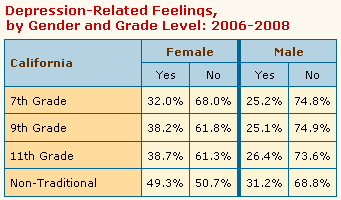 As noted in our recent youth suicide data release, boys are four to five times more likely to commit suicide than girls. One factor associated with youth suicide is depression – a measure of which was recently added to kidsdata.org, as part of its continuing statewide expansion. These data, which measure depression-related feelings, not clinical depression, come from the California Healthy Kids Survey (CHKS), a statewide survey of students that was developed and is administered by WestEd for the California Department of Education. The survey asked students whether they “had felt so sad and hopeless every day for two weeks or more that you stopped doing some usual activities.”
A few highlights:
- According to 2006-2008 data, about more than 1 in 4 California youth in grades 7, 9, and 11 expressed feelings of depression, with girls more likely than boys to report such feelings.
- Students with weak levels of school connectedness were nearly twice as likely as those with strong levels to report feelings of depression.
- Across all racial/ethnic groups, Pacific Islanders and Native American students were most likely to report feelings of depression while other Asian Americans and Caucasians were least likely.
One difference that’s worth noting when comparing depression and suicide data: Although boys are four to five times more likely to commit suicide, boys’ reported feelings of depression are lower than girls across grades 7, 9, and 11.
What are the implications of this difference? What is your organization doing to address this?
Posted by kidsdata.org
Tags: New Data, Statewide Expansion
Just Updated on Kidsdata.org: Youth Suicide & Self-Inflicted Injury Data
 All throughout May, which is Mental Health Month, kidsdata.org will be releasing data related to children’s emotional well being. This week kidsdata.org’s statewide expansion continues by adding a key measure of emotional well being – youth suicide and self-inflicted injury data for counties across California. These data are provided by the California Department of Health Services, and are broken down by age, gender and race/ethnicity.
Insights from these data include:
- From 1995-97 to 2005-07, California’s youth suicide rate declined by 27 percent.
- Males are much more likely than females to commit suicide. Among California youth ages 15-24, between 1995 and 2007, four-to-five times as many males committed suicide each year than females.
- California’s rate of hospitalizations for self-inflicted injuries among youth ages 5-20 decreased nearly every year from 2001-06.
- Over a ten-year period, from 1998-2007, nearly 4,000 (3,836) California children and youth ages 5-24 committed suicide.
View all data on youth suicide and self-inflicted injury>>
Sign up to receive an e-mail alert when these data are updated>>
Posted by kidsdata.org
1 Comment
Kidsdata.org Partners with New Public Policy Site, HealthyCal.org
 Kidsdata.org is pleased to announce a partnership with the recently launched HealthyCal.org — a site that tracks health policy at the state and community level to highlight issues affecting Californians. The site features updates on legislation, and posts on issues from key state leaders and advocates. And — full disclosure — a weekly data posting from kidsdata.org that focuses on an important issue affecting children’s health in California.
Veteran journalist Daniel Weintraub, formerly the public affairs columnist for the editorial pages of the Sacramento Bee, is editor-in-chief of HealthyCal.org, which has received initial funding from The California Endowment. Kudos to Dan for this pioneering effort in the world of healthy policy blogging — we’re glad to be a part of it. Take a look: www.healthycal.org
Posted by Felicity Simmons
Tags: Child Health Initiatives, Data Projects
At Packard Hospital Forum, Experts Detail Why Kids Need Health Reform
“Kids can’t wait” was the theme of the day at the Child Health Forum on March 25, a gathering of doctors, nurses, nonprofit staff, teachers and others to discuss the future of health care for kids in California. The event, sponsored by Lucile Packard Children’s Hospital and the Children’s Health Fund, fortuitously coincided with the passage of massive health care reform legislation that Congress has been debating for more than a year.
However, the speakers emphasized that health care for kids goes far beyond simply having an insurance card. Other major factors, such as access to care, affordability, and parental health, will determine whether the health care reform efforts have a real impact on our state’s children and youth.
Ted Lempert, president of Children Now, lauded the passage of health reform efforts, but cautioned that other issues are not resolved under the new health care reform laws. He noted that a key issue for California is undocumented kids, who are not covered under reform, and asserted that it is in the financial interest of the state to cover these children through health insurance. Along with others, he cited the current shortage of pediatric specialists, another growing concern that is not fully addressed by health care reform.
From a parental point of view, Lisa Wise, mother of a young son with Crouzon Syndrome, discussed how having a chronically ill child leads some parents to shape their career decisions based on which employer has the best health insurance benefits. For parents like Lisa, health reform holds the promise of eventuallying providing more insurance options that are affordable and family friendly.
Dr. Paul Wise, the Richard E. Behrman Professor of Child Health and Society at Stanford University School of Medicine, stressed the importance of taking care of parents as we focus on improving the health of kids. Children are poor because their parents are poor, he said, and insuring and nurturing mothers can lead to better health outcomes for kids. This reminds us all that as we seek to address the needs of children in California, we cannot neglect the needs of the parents who tend to these children every day.
Posted by Jordan Handcox
Tags: Child Health Initiatives
Kidsdata.org On the Road
 As we strive to let people know how kidsdata.org can be valuable in their work, and to learn about how kids are faring in communities across the state, we’ll be on the road quite a bit in the coming weeks. Here’s a sampling of our planned travels. If
you’ll be in the area – stop by and say hello!
- Today we’re in Sacramento, presenting kidsdata.org to First 5 executive directors from across California.
- Tomorrow, we’ll be exhibiting at the California School Health Centers Association conference in Oakland. If you’ll be there, please do stop by our table.
- Tuesday, May 4th, we’ll be presenting kidsdata.org in Merced County – Southwest Merced/East Merced County is one of The California Endowment’s 14 Healthy Communities.
- The following Monday, May 10th, we’ll be up in Redding for a 10-county Child Abuse Prevention Council meeting; and to meet with some champions of child health in Shasta County.
- On Wednesday, May 19, kidsdata.org will be the subject of a presentation to organizations associated with Community Partners, in Los Angeles; and on May 24 we’ll be back in LA participating in the demographic conference, “What Is the Future for Children in California?”
If you don’t see your region on this list, don’t worry. We hope to be in your neighborhood soon!
Posted by Felicity Simmons
Tags: News About Kidsdata.org, Statewide Expansion
Healthy City Tool Tracks Local Census Response
We’ve talked before about the need to see every person counted in the 2010 Census, and we’ve noted California’s particular challenge to that end (10 of the 50 hardest-to-count counties are right here in our state). Today we applaud our colleagues at Healthy City for offering Census2010.HealthyCity.org. The site presents current Census participation rates, hard-to-count scores from the last Census for communities statewide, and a weekly analysis of low-response areas — key information that will inform outreach strategy as it’s happening.
Remember: Today is the last day to mail back your census form!
Posted by kidsdata.org
Tags: Data Projects
Fun with Data Mashing
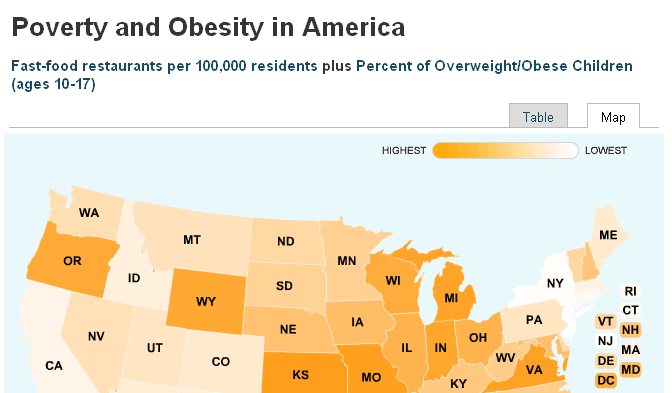 |
From datamasher.org, this is an example of a data mash-up of fast food restaurants and child obesity rates. |
Kidsdata.org has a wealth of data related specifically to children in California, but what if you want to compare California against other states and different indicators? You might want to try Datamasher.org, a website that allows users to get creative by comparing indicators from different states against each other. Users can view others’ mash-ups, then vote on them to help determine how useful they are.
Take, for instance, the mash-up titled Money Spent per Student and SAT Scores. This mash-up combines reading and mathematics SAT scores with expenditure per pupil at public schools. California students had an average combined SAT score of 1,015, with the state spending $7,905 per student, which puts California about the middle (29th) on the list for most SAT points per dollar spent. The worst state was New Jersey, where the average SAT was 1,005, but state spending per student was $14,117 – nearly double the expense of California. Utah ranked the best, with an average score of 1,114 and $5,216 spent per student.
When it comes to Most Reproductive States, California ranks 9th with 562,440 births divided by the state’s 2008 population of nearly 37 million. The West and Southwest has some of the most reproductive states, with Utah again ranking 1st, while the Northeast has some of the least reproductive states, with Maine ranking 50th.
Have you created a mashup on kids’ health? Add it here!
Posted by kidsdata.org
Tags: Data Projects