


Archive for the ‘Kidsdata News’ Category
What Our New Truancy, Suspensions and Expulsions Data Don’t Tell Us
The truancy, suspensions, and expulsions data we just added to kidsdata.org offer perspective on an important topic related to children’s well being. Research has shown, for example, that truancy, which is defined as missing more than 30 minutes of instruction without an excuse three or more times during a school year, is linked to academic failure, dropping out, substance abuse, gang involvement, and criminal activity (more info). In addition, there are high costs associated with truancy. Not only does truancy diminish revenue for schools due to lower daily attendance, it also contributes to costs related to delinquent behavior.
Likewise, our understanding of the effects of expulsions and suspensions is key. Excluding students from school by relying too heavily on suspensions or expulsions as a disciplinary strategy can exacerbate problems such as poor academic achievement, high dropout rates, and students’ involvement in the juvenile justice system.
On kidsdata.org, we offer the data that are publicly available from the California Department of Education – the number and percent/rate of expulsions, suspensions, and truancies for school districts and counties statewide. It’s a wealth of data, yet we need more data – in particular, better breakdowns. Some examples:
- There is growing concern about truancy in elementary schools, but data are not available by grade level or age, making it difficult to understand the extent of the problem in California. Related to this, data on chronic absences, which may or may not be excused, would help us further clarify our understanding about this issue.
- Similarly, other demographic breakdowns (e.g. socio-economic status, race/ethnicity) are not publicly available, so it’s challenging for officials to accurately identify students that need additional support.
- There is debate now on using suspensions and expulsions as part of a strategy to combat bullying. However, we don’t have data that give us detailed reasons students are expelled or suspended. Are more California students today being suspended or expelled because of bullying? We simply don’t know.
These are critical data gaps that we hope can be addressed in the coming years, but they shouldn’t prevent us from using what’s available now. At kidsdata.org, our hope is that policymakers and others will begin to acquaint themselves with these just-published indicators, and use these data in their work by bringing attention to these issues, stimulating discussions, deepening our understanding of what’s going on and overall helping to inform decisions that are made. By using these data, we’ll all better understand, too, the limitations of what’s available, thus putting us in an even better position to advocate for improved data on these important issues.
Posted by kidsdata.org
Tags: Data Challenges, New Data
Are Some Children’s Data Too Old to Be Useful? Thoughts from a Guest Blogger
This guest post comes to us from Rob Shotwell, chair of the Yuba County Children’s Council. If you have a data question or issue you’d like to express through a guest post on Data Points, e-mail us at [email protected].
We did a Children’s Report Card in 2007 for the first time. It reflected what many other county report cards have reflected, and in most of the categories that kidsdata.org uses. The frustrating thing that we experienced then was the age of the data. In 2007, we were forced to use data that was 2 to 4 years old. Some data were current (previous year), but most were not.
This diminishes the usefulness for documents such as county Report Cards or this website. The data are interesting two or three years later, but not as useful for planning a timely response in areas where the data indicate a clear problem. A local response to such a problem, of course, depends upon state and federal resources, but counties and school districts have less leverage when the data available are not current.
Obviously, the data are collected/recorded locally, and are compiled on a state and national level. This system is ponderous and inefficient; however, I admit I don’t know the solution to the data dilemma. Current data would have more of a punch when we approach our local Boards of Supervisors, county executive management, Offices of Education, county Superintendants of Education, city councils and even the state legislature.
It’s difficult to present this data, then explain why some of it is older and why current data was not available, THEN reach a conclusion or recommendation.
Our efforts on behalf of child health and safety I’m sure are comparable to what other counties are doing, given the current economy and state budget in California. While kidsdata.org continues to be helpful in some of the areas because the data are current, some is interesting but less impactful because of its age. Nonetheless, I and I’m sure my colleagues will continue to use Kids Data as a primary source of annual information for Yuba County.
Editor’s Comment: If you’ve experienced similar issues with the age of data you’re using, or if you know of a solution, please note it here.
Posted by Guest
Tags: Data Challenges
2010 Children Now Report Card Sets Agenda
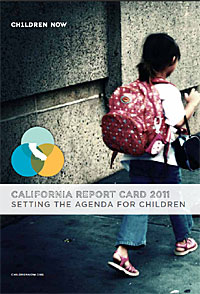 Every year, Children Now offers a Report Card to grade key areas of child well being in California. This year, the advocacy organization has taken this tool a step further by offering a children’s health agenda to incoming lawmakers.
The agenda addresses and recommends action on several key issues, including:
- Strengthening California’s afterschool infrastructure
- Establishing a comprehensive, longitudinal data system to track educational outcomes
- Coordinating and streamlining the state’s delivery of children’s services
- Providing quality health coverage and improving access to care
Overall, the state received an average grade of C- in the report card, with grades ranging from a D for oral health services and K-12 education, to a B+ for afterschool programming. The report cites disproportional budget cuts to children’s programs as the reason for consistently low grades.
Posted by kidsdata.org
Tags: Data Projects
Find Kidsdata.org Across California
Kidsdata.org has been statewide for a year now, and while our traveling for 2010 may be winding down, you can find us at several upcoming conferences:
- Kidsdata.org will have a presence at the California Working Families Policy Summit in Sacramento on Jan. 12. This annual conference is presented by the California Center for Research on Women and Families. For more information, visit http://www.ccrwf.org/.
- We’ll be sponsoring the 25th Annual San Diego International Conference on Child and Family Maltreatment, presented by Rady Children’s Hospital and the Chadwick Center for Children and Families, which will be held Jan. 23-28. More information is available at http://www.sandiegoconference.org/
- Also in late January, we’ll be sponsoring and presenting at the Friends for Youth Mentoring Conference, on Jan. 27 and 28. The conference brings together mentoring professionals from around the world for learning, collaboration and networking. http://www.friendsforyouth.org/MI-Conference.html
Posted by kidsdata.org
Tags: News About Kidsdata.org
Survey Highlights Key Issues in Health, Well Being of California’s Children
 This week our Foundation released data from the 2010 California Parent Survey, a new study that provides a wealth of current data on how California parents say their children are faring across a broad spectrum of physical and emotional health issues. While many of the overall results are positive, the findings highlight serious issues that affect significant percentages of the state’s children and demand our attention. For example:
- Family Income: About 2.6 million California children live in households where the parents report that their income is not adequate to meet basic needs such as food, clothing and shelter.
- Child Care: Approximately 16 percent of children do not have access to affordable child care options, according to their parents.
- Parental Depression: 26 percent of children live with parents who say they needed help with depression since becoming a parent. Research shows that children with depressed parents are at a higher risk of substance abuse, depression and aggression.
- Special Health Care Needs: About one-third of children with special health care needs are in very poor, poor, or fair overall emotional health, compared to 7 percent of other children, according to the survey.
- Neighborhood Safety: 20 percent of children with household incomes below $25,000 have parents who consider them unsafe in their neighborhood or surroundings.
The California Parent Survey queried 1,685 parents across income and racial/ethnic groups about their child’s physical, emotional and behavioral health, school-related issues, family activities, and societal influences. The study was conducted by Berkeley Policy Associates and the Henne Group in spring 2010, in English, Spanish, Mandarin, Cantonese or Vietnamese, depending on the respondents’ preference. The study includes a representative sample of children in California.
Full survey results can be viewed at www.kidsdata.org/parentsurvey
Posted by kidsdata.org
Post Comment
2010 California Parent Survey: A Parent’s Perspective
Happiness and health. When it comes down to it, that’s perhaps all that most parents want for our children. It’s a simple enough goal. But we’re passionate in our efforts to guide – in some cases steer – our kids down a path leading there. Along the way, we’re bombarded with advice about how to be the perfect parent – from fellow parents, the media, parenting “experts”, teachers, our own parents, and, of course, our kids, who usually have no shortage of opinions on what we should do. And we’re often not quite sure that we’re making the right decisions.
So it’s heartening to see that responses from the 2010 California Parent Survey indicate that parents, by and large, seem to be doing fairly well by their kids. We talk with teachers about our children’s academic progress (91%) and volunteer at school (58% of kids have parents who volunteered in the last six months). We make sure our kids have health insurance (94%) and visit the doctor at least annually (79%). We try to have family dinners together at least five times a week (parents say this happens for 76% of children) and read with our kids (about two-thirds of parents of 0-5 year-olds read at least 5-6 times a week with their families, parents say).
Some of us accomplish all of this under heavy burdens that go well beyond the simple yet commendable accomplishment of just getting our kids dressed in the morning and off to school on time. Parents of about a quarter of California children (26%) say they’ve needed help with depression since becoming a parent, and the same percentage of parents say their income is not sufficient to meet their children’s essential needs – food, clothing, and shelter.
Certainly, there are areas for improvement. According to the survey, not all of us talk with our kids about sexual activity (these conversations have occurred for just 43%) or alcohol consumption (64%). Parents also indicate that roughly 15% of children live in households with at least one person who smokes, and about one in ten youth ages 14-17 may be suffering from depression (11 percent).
But as California parents strive to do their best, it’s important, too, that we remember a central message from this report: “On the whole, the survey’s findings are encouraging, with the majority of California’s children experiencing positive health and well-being within nurturing family environments.”
Posted by Andy Krackov
1 Comment
CORRECTION: Self-Sufficiency Standard
Accuracy means everything to us at kidsdata.org, so we want to draw your attention to a correction in one indicator. We offer the 2008 Self-Sufficiency Standard for the three most common types of families with children. The Self-Sufficiency Standard measures how much income is needed for a family of a certain composition living in a particular county to adequately meet its minimal basic needs, and takes into account the costs of housing, child care, health care, transportation, food, and other necessary expenses.
The annual figures are per family, rather than per adult, and this revision to the data has been posted on the live site. Many thanks to a meticulous kidsdata user from Food Share in Ventura County for contacting us with a question about this.
We take feedback from our users very seriously. If you have a question, suggestion, or comment about kidsdata.org, please use our feedback form, post it on our Data Questions page or as a comment here, or e-mail us at [email protected].
Posted by Sarah Marxer
Post Comment
New Data About Very Low Birthweight Added to Kidsdata.org
Data about prenatal care and low birthweight were updated on kidsdata.org this week, and a new measure of infant health — infants born at very low birthweight — was added.
Very low birthweight infants are those born at less than 1,500 grams; or about 3.3 pounds. Placer, Santa Cruz, and Sonoma are among the counties with the lowest percentages of infants born at very low birthweight. Overall in California, 1.2% of infants were born at very low birthweight in 2009.
Low birthweight babies account for a higher percentage of infants — those born at less than 2,500 grams, or 5 pounds, 5 ounces. In most counties, the percentage of babies born at a low birthweight in 2009 was lower than the state average of 7%. However, in Los Angeles County, as well as some other populous counties, the rate was slightly higher than in California as a whole. Low birthweight babies face six to 10 times the risk of infant mortality, and are at increased risk of long-term disabilities.
The data about prenatal care refer to the percentage of infants whose mothers received prenatal care in the first trimester of pregnancy, and kidsdata.org offers 15 years of data, making it easy to pinpoint trends over time. In 2009, the percentage of mothers receiving prenatal care inched up slightly to 81%, after four years of decline.
Posted by Felicity Simmons
Tags: New Data
New Poverty Data Highlights Current Realities Facing CA Children and Families
During this holiday season, data just added to kidsdata.org remind us that many California children and families struggle to make ends meet. Poverty data for 2009 indicate that one in five children in California lives in a family with household income below the federal poverty level of $21,756 for a family of four.
Overall, the percentage of children in poverty in the state had declined from 2003 to 2007, but rose in 2008 — and again in 2009. Children of certain ethnicities/races are more apt to experience poverty than others; in 2009, about 30% of African American, Native American, and Latino children lived in poverty, compared to about 10% of Asian American and Caucasian children.
The highest rates of poverty in 2009 occurred in Tulare, Kern, and Fresno counties, all of which are in the Central Valley. Nearly one in three children in these counties lives in a family earning below the federal poverty line.
Other poverty related indicators on kidsdata.org include:
- Median Family Income
- Enrollment in the Free/Reduced Cost School Meal Program
- Homeless Public School Students
- See all poverty data>>
Posted by Jordan Handcox
Post Comment
December News Roundup Features Articles About Poverty, Demographics, Obesity, and More
The December issue of the kidsdata news roundup now is available – you can read it here.
A few highlights:
Demographic Trends
Latino Students Now a Majority in California Schools
(SF Chronicle, 11/13/10, by Kane)
Depression
Depression Returns in About Half of Treated Teens, Study Finds
(Time, 11/1/10, by Park)
Poverty
Report: Even Short Term Poverty Can Have Lasting Health Implications for Children
(CNN, 11/15/10, by Henry)
Special Needs
Families Fight to Care for Disabled Children at Home
(NPR, 11/8/10, by Shapiro)
Kids Make Up Largest Group with Traumatic Brain Injuries, CDC Says
(LA Times, 11/8/10, by Cohn)
Weight
Report: 84% of Parents Fed Their Kid Fast Food in Past Week
(WSJ, 11/8/10, by Hobson)
Study: Obese Teens Likely to Become Severely Obese Adults
(HealthDay News, 11/10/10, by Gordon)
Posted by Jordan Handcox
Post Comment