


Archive for the ‘Kidsdata News’ Category
Public Data’s New-Found Freedom
 The author of the emancipation proclamation for health data.
That’s what Matt Miller, host of NPR’s “Left, Right & Center,” dubbed Todd Park at a national Health Data Initiative Forum in Bethesda, MD on June 9.
Park, chief technology officer for the U.S. Department of Health and Human Services (HHS), was instrumental in making HHS’s wide-ranging data offerings much more accessible, and is a pivotal figure in the federal government’s open data initiative.
Miller’s emancipation theme was pervasive at this one-day, Institute of Medicine forum. Speakers noted that at last year’s inaugural conference, technologists, communicators, and policymakers were trying to make sense of what to do with public data’s new-found freedom.
 In just one year, Miller noted, numerous mature apps have emerged that utilize health data from the federal government in innovative and important ways. Many of these were featured at the forum, including Ozioma, which makes cancer-related data available to media; the Foodborne Disease Outbreak Investigation System, a public-private collaboration to investigate disease outbreaks; and Asthmapolis, which provides real-time data on asthma by tracking when – and where – people use their inhalers.
But while there are reasons for optimism, there were some pointed reminders, too, about the need to focus even more on how best to use all the data the federal government is releasing. For example, Harvey Fineberg, president of the Institute of Medicine, quoted Samuel Coleridge’s famous quote, “Water, water every where, nor any drop to drink.” Noting that “we’re “afloat in a sea of data,” Goldstein said that “information shall set you free, but only if you can use it.”
HHS Secretary Kathleen Sebelius pointed out that 30 years ago, “You often had little data; you made policy by anecdote.” Today, the situation is the same, she said, urging attendees to use data to help improve both health care costs and outcomes.
To help organize the burgeoning national interest in health data, HHS, the Institute of Medicine and the Robert Wood Johnson Foundation announced the formation of a national Health Data Consortium to help the country understand the power of health data and harness these data to make the U.S. a healthier nation. In addition to the organizations above, some of the other 15 founding members of the Health Data Consortium include our foundation, the California Health Care Foundation, Consumer Reports, Grantmakers in Health, and the National Association of Counties.
Posted by Andy Krackov
Tags: Data Challenges, Data Projects
New Test for Down Syndrome Raises Ethical Concerns
A recent AP article, “Comfort or Conflict: Earlier Down Syndrome Test,” explores the ethical challenges posed by a new type of DNA test for Down syndrome. In the near future, DNA tests for Down syndrome may be available as a simple blood draw, and the new tests could give parents accurate results earlier in the pregnancy than with amniocentesis or chorionic villus sampling (CVS).
The article notes that this new test raises complex ethical concerns, because a Down syndrome diagnosis before birth can “pose a difficult challenge for couples as they decide whether to continue the pregnancy,” according to Dr. Mary Norton, director of Perinatal Research at Lucile Packard Children’s Hospital.
A recent study concluded that advances in testing (and, thus, more options for would-be parents during pregnancy) have contributed to an 11 percent decline in Down syndrome births in the U.S. between 1989 and 2006, a time during which rates were expected to rise 42 percent.
In California, about 1% of all children with special health care needs have Down syndrome, according to 2005-06 survey data, the most recent time period for which data are available.
Posted by Jordan Handcox
Tags: Child Health Issues, CSHCN
Racial/Ethnic Disparities in Children’s Weight Persist
Given public attention to weight issues among children, some might assume that there are fewer kids these days at a healthy weight than 10 years ago. When examining California data for 5th, 7th and 9th graders in public schools, however, it’s striking that most of the trend lines are fairly flat. In 1999, for example, 67% of California 5th graders were at a healthy weight. Roughly 10 years later, in 2010, that percentage was similar, at about 69%.
While the data indicate that weight trends among public school kids in these grades may not be getting worse, at least as measured by this indicator, neither have they gotten discernibly better over the last 10 years.
What also hasn’t budged much are racial/ethnic disparities in children’s weight. Across 5th, 7th, and 9th grade in 1999, there was roughly a 20 percentage point difference between the racial/ethnic groups in California that had the lowest and highest percentage of students at a healthy weight. In 2010, that percentage point spread was at about 23, slightly greater than in ‘99.
That there are racial/ethnic disparities in children’s weight is not surprising. The data reveal just how intractable these disparities have proven to be over the past decade. In 1999, for example, 74% of Caucasian/White 9th graders were at a healthy weight, compared to 59% of Pacific Islander 9th graders. In 2010, that gap had widened – about 80% of Caucasian/White 9th graders in California at a healthy weight, compared to 59% of Pacific Islander youth in this grade.
One key step in addressing these disparities is continuing to monitor the data and raise awareness about the issues. Understanding what works, especially in this tough budget climate, is another essential step. Numerous organizations and individuals have been working hard for many years to address these disparities and improve children’s weight, overall. For more information about key organizations, research on this topic, and strategies to address these complex issues, see kidsdata’s Research & Links section and a summary of policy implications.
If you have insights to share on this subject, please post a comment here.
Posted by kidsdata.org
Tags: New Data
New Measure of Children’s Weight – and More Related Data on the Way
Kidsdata.org recently added a new indicator of children’s health: Rate of Overweight/Obese Children in Low-Income Public Health Programs.
These data are collected from participants in the Child Health and Disability Prevention Program, which serves Medi-Cal recipients and children/youth with family incomes up to 200% of the federal poverty level. The data represent approximately 22% of low-income children in California.
Because the population captured is so specific, it is important that users do not over-generalize their conclusions. When looking at this particular population of kids, however, results indicate that in 2009, among California children served by low-income public health programs, about 42% 5-to-19 year-olds, and 33% of 2-to-4 year-olds, were overweight or obese. Although these rates were similar to those in previous years, they indicate persistently high levels of weight-related health risk. Specifically, children who are overweight or obese are at risk of developing high blood pressure, high cholesterol, asthma, and type 2 diabetes, among other serious physical problems. Type 2 diabetes is of particular concern, as it now is being found in children at increasing rates. Overweight and obese children also are more likely to have weight problems in adulthood.
On kidsdata.org, measures of weight also include the percentage of public school students in grades 5, 7, and 9 at a healthy weight (that is, students who are neither overweight nor underweight); these indicators are offered at a school district level by grade, race/ethnicity, and gender. Kidsdata.org also has related data on physical fitness, including percentages of students meeting all fitness and aerobic endurance standards.
Later this year, we should have more data on children’s weight through a partnership with the California Center for Public Health Advocacy, which is analyzing California child overweight rates by city and county.
As we bolster our offerings of data related to children’s weight, we also are interested in other sources of reliable weight/obesity data. If you know of any, please contact us at [email protected].
Posted by kidsdata.org
Post Comment
Can YOU Create a State Budget that Puts Kids First?
Tomorrow marks the June 15th deadline to pass the California state budget. Try your hand at balancing the state budget, using the newly updated California Budget Challenge
Created by the nonpartisan organization Next 10, the Challenge is an online game that allows users to build a state budget based on individual “values and vision.” It also serves to educate voters about the numerous policy choices our legislators must make. For each major budget decision (prison cuts, increases in per pupil spending, gas taxes, etc.), the Challenge offers background information, as well as the arguments for and against each cut or expenditure. After each decision you make, you also can see how fellow Californians chose from the many budget options.
Are you hoping California will allocate more funding for kids and families? More money for schools, parks, or health programs? See data from kidsdata.org on health care, education, poverty and more for California children to help inform and support your funding decisions — then leave a comment to share your thoughts and budget results with us and our readers!
To access the California Budget Challenge and other resources, visit their website at http://www.next10.org/next10/programs/budget_challenge.html#
Posted by kidsdata.org
Post Comment
What Issue is a Top Priority for Children’s Health?
The Association of Maternal and Child Health Programs recently polled its readership, asking “What is a top child health priority in your state?”
The top response, perhaps not surprisingly, was obesity/overweight, which was identified by 24% of the nearly 600 respondents. The second most popular response was dental care, followed by access to care, health insurance coverage, unintentional injuries, and several others. See the full list of responses>>
This was a national survey, so we thought we’d ask our readers the same question: What is a top child health priority in California?
On kidsdata.org, some of our most visited topics are homelessness, reading proficiency, child abuse, asthma, autism, and teen sexual health. While visits to an indicator don’t necessarily align with concern, we’re curious to hear what you think of that list – and what you might add. Take our unofficial, unscientific poll below and let us know a top child health priority in California:
[polldaddy poll=”5139140″]
Posted by Felicity Simmons
Tags: Child Health Issues
Obama Targets Bullying of Gay Youth with June Proclamation
Earlier this month, President Obama again proclaimed June to be National Lesbian, Gay, Bisexual and Transgender Pride Month. In the announcement, Obama called out initiatives set forth to prevent bullying of gay youth:
My Administration is actively engaged with educators and community leaders across America to reduce violence and discrimination in schools. To help dispel the myth that bullying is a harmless or inevitable part of growing up, the First Lady and I hosted the first White House Conference on Bullying Prevention in March. Many senior Administration officials have also joined me in reaching out to LGBT youth who have been bullied by recording “It Gets Better” video messages to assure them they are not alone.
In California schools, more than 1 in 10 7th and 9th grade boys reported being bullied due to their sexual orientation, according to ’06-’08 data. Among girls, 10% of 7th-graders and 9% of 9th graders said the same. Find data for your school district>>
For more insights into these and other bullying data, read our October blog post to mark National Bullying Prevention Month. The president’s “It Gets Better” video is available on YouTube.
Posted by kidsdata.org
Tags: Child Health Initiatives, Child Health Issues, Health Observances
School’s out! Now what?
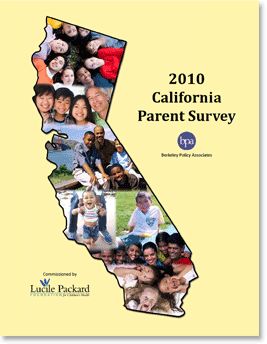 In many districts across California, school’s out and summer has begun. For some kids, this means a lot of free time, and we thought we’d highlight a few related data points — from a parent’s perspective.
According to our foundation’s 2010 survey of parents across the state, about half of California children have the right amount of free time, and about 15% do not have “quite enough” or “nearly enough” free time (findings are for children in general, not specific to summer). The same survey found that 18% of children do not have enough family time, according to their parents.
Also among the results of this survey, about 16% of California children have parents who say they do not have affordable arrangements for child care. And parents say more than half of children (59%) regularly participate in extracurricular activities or after-school programs.
We welcome your comments on these findings.
Posted by kidsdata.org
Tags: Child Health Issues
What data do you wish for?
Do you ever wish for something you can’t have?
In the data world, we have a lot of unfulfilled wishes because the data we need – or at the granularity that we need it – often just aren’t available, at least not yet. So, to address our goal of providing users with the most helpful data, we regularly seek suggestions for our data “wish list” for kidsdata.org. We’ve already added a variety of indicators that users have suggested, such as data on depression, school connectedness, and family structure. Ideas for new data arise from comments on this blog, and from conversations we have with users around the state, from Shasta to San Diego.
Leave a comment telling us what data you’d like to see.
Posted by kidsdata.org
2 Comments
Don’t Miss Our Upcoming Webinar on Fitness and Weight Data
If you follow this blog, or received our recent advisory, you probably know we just updated physical fitness data on kidsdata.org. Related updates to weight data are coming very soon.
You can be among the first to learn about how you can use these updated data — and get a personal tour of kidsdata.org’s features — by joining our upcoming webinar, “How to Incorporate the Latest Fitness and Weight Data from Kidsdata.org into Your Work.” The webinar takes place on Thursday, June 16 at 11 a.m.
In this webinar, we will show you how to use kidsdata.org to find fitness and weight data by region, gender, grade, and racial/ethnic group. We will demonstrate how you can view these data as maps and tables and bar and trend graphs and then import what you built into a Powerpoint presentation or Word document. You also will learn how to embed graphs onto your website.
Can’t join this webinar? No problem — just contact us at 650-724-5778 or [email protected] and we’d be happy to schedule one just for your organization.
Register for the webinar>>
Posted by kidsdata.org
Post Comment