


Archive for the ‘Kidsdata News’ Category
Help Shape Kidsdata’s Future
We meet with people all over California, introducing them to kidsdata.org. In nearly all of those meetings, we hear this common question: WHO uses kidsdata?
Because we can all use kidsdata.org anonymously, that is a difficult question to answer. So, we’ve decided to ask you, the users. We’re not out to gather any personal information — we’d just like to know two quick things: your primary affiliation, and how you plan to use the information you find on kidsdata.
Your response will be extremely valuable, and will help us shape the future content and enhancements on kidsdata.org.
Take the poll>>
Posted by Felicity Simmons
Post Comment
Turning Data Into Action
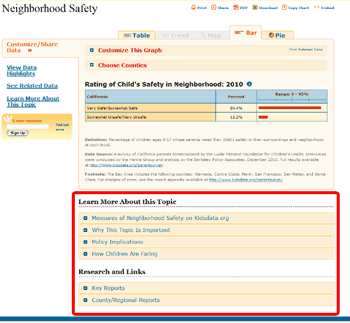 Back in May, we told you about an upcoming feature on kidsdata.org that aims to help policymakers tackle the important issues revealed in the data — a new Policy Implications section.
Now, this section is available for topics across kidsdata.org. (See an example) These narratives describe promising and research-based policy and program ideas, conveying the message that problems shown in the data can be addressed.
You can find the new Policy Implications section below tables, graphs or maps on kidsdata.org, or by clicking on “Learn More About This Topic” after finding your topic here. For more information, read our recent e-mail advisory about this new feature>>
We also recently revamped kidsdata.org’s Research & Links section, which offers key websites, additional research, and reports related to each topic. Learn more>>
Posted by Felicity Simmons
Tags: New Features
What Does It Cost to Meet Basic Needs?
At a time when unemployment is high and poverty is a pressing issue, new data show that the cost of making ends meet has increased.
New self-sufficiency data, released today by the Insight Center for Economic Development and available now on kidsdata.org, show how much income is required to meet basic needs. On kidsdata.org, we show the self-sufficiency standard for three family types: two adults and an infant, two adults and a school-aged child, and two adults and a teenager. The standard assumes that both adults work full time, and shows what they need to make in order to cover costs for housing, food, child care, out-of-pocket medical expenses, transportation, and other necessary spending.
In many California counties, the cost of meeting basic needs increased from 2008 to 2011. The Insight Center reports the reason for this increase is a combination of the rising cost of health care, child care, and taxes. See the center’s data on all family types.
For households with two adults and one infant in Alameda County, the cost of living increased by more than $8,000 between 2008 and 2011. In other Bay Area counties the increase was even greater — Santa Clara County saw an increase of nearly $14,000. In Southern California, Los Angeles County households of this type saw an increase of more than $9,000 between 2008 and 2011. Other Southern California counties such as Orange, Riverside, and San Bernardino saw more modest increases.
Among households with two adults and one school-aged child, every county had an increase in the cost of living — especially Santa Clara County, which had an increase of nearly $10,000. For households with two adults and a teenager, most counties experienced an increase in the cost of living between 2008 and 2011, but for 12 counties (i.e., Colusa, Glenn, Imperial, Kings, Madera, Merced, San Bernardino, Santa Barbara, Tehama, Tulare, Yolo, and Yuba), the cost of living decreased.
Find the cost of living in your county>>
Note: The Self-Sufficiency Standard data come from the Insight Center for Community Economic Development and Dr. Diana Pearce, Center for Women’s Welfare, School of Social Work, University of Washington. For more information, see http://www.selfsufficiencystandard.org/pubs.html.
Posted by Felicity Simmons
Tags: New Data
Today is National Child Health Day
 Monday, October 3rd, 2011, marks the 83rd annual National Child Health Day, an observance of child and maternal health sponsored by the Department of Health and Human Services.
Last year, President Barack Obama acknowledged the observance with this proclamation:
The health and well being of a child is one of our most challenging, yet important, responsibilities, and we have an obligation to ensure that all our children can live, learn, and play in safe and healthy environments. On Child Health Day, we reaffirm the critical importance of the quality health care, nutritious foods, clean air and water, and safe communities our kids need to grow into strong and active adults.
Read the full proclamation>>
Kidsdata.org offers data and information on many topics related to this observance and President Obama’s proclamation:
See all topics on kidsdata.org>>
Posted by kidsdata.org
Tags: Health Observances
Revamped Research & Links Section Helps Put Data into Context
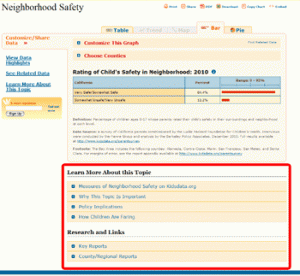 Earlier this week, our foundation announced a new section of kidsdata.org that can help provide context to the data.
The new Research & Links section of kidsdata.org allows users to get seminal research, policy, and program information related to each topic on the website. By compiling key websites, research articles, reports on policies and best practices, and county/regional reports for each topic, this section provides a gateway for users who want to learn more about the issues presented on the site.
The Research & Links section offers additional context for the data on kidsdata.org, such as explanations of what’s behind the numbers and what can be done to bring about improvements. The section also highlights key issues that are not apparent from the data, such as information about emerging concerns or specific subgroups of the population for which little data exist.
Kidsdata’s Research & Links section contains wide-ranging resources to help researchers, policymakers, practitioners, and others to better understand and address important issues in children’s health. This information is available below any chart or graph on kidsdata (see an example) or in the main Research & Links section.
If you have suggestions for additions to our Research & Links section – regional or county-level reports, other key websites, research articles, etc., please contact us at [email protected].
Posted by kidsdata.org
Tags: New Features
New Report Details Increase in Poverty for Hispanic Children Nationwide
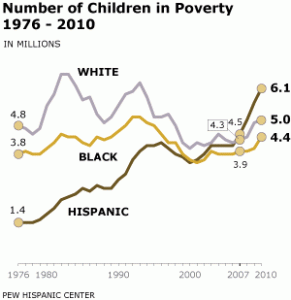
A report released this week by the Pew Hispanic Center reveals that Hispanic children comprise the largest number of children living in poverty in America, according to data from 2010. Hispanic children now surpass all other racial and ethnic groups in terms of population living in poverty, at 6.1 million, compared to 5 million Caucasian children and 4.4 million African American children.
The Pew Hispanic Center report suggests that the increase is the result of the economic recession, which drove up the percentages of unemployment and food insecurity to above average rates for Hispanics, while driving down the value of household wealth for the Hispanic population.
Among California children, the most recent data on kidsdata.org show a rise in the percentage of Hispanic children living in poverty each year from 2007 to 2009.
From 2007 to 2009, Native American, Hispanic, and African American children faced similar rates of poverty, at 26.7%, 27.5%, 28.6%, respectively.
Find more data about California children living in poverty.
Posted by kidsdata.org
Post Comment
Coming Soon to Kidsdata.org: Preterm Birth Data
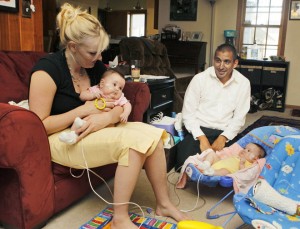 |
Photo courtesy of Rick Wood of the
|
A recent article in the Milwaukee-Wisconsin Journal Sentinel chronicled the financial and emotional costs a family faces when a child is born prematurely. Infants born prematurely have a higher risk of developing immediate, severe health problems and lifelong disabilities compared to babies carried to full-term, and research also shows that preterm (vs. full-term) babies have higher death rates in young adulthood.
Given the importance of this issue, as well as its connection to children with special health care needs, which is a focus area for our foundation, we will soon add a new Preterm Birth indicator to kidsdata.org. We also will update the following related indicators:
Stay tuned for these data in the coming months.
Posted by kidsdata.org
Post Comment
Roundup of Recent News Stories: Poverty, Fitness, ADHD, and More
 Following are some recent news highlights about children and families, along with related data from kidsdata.org:
Education (see related data)
- Obama to Waive Central Provisions of ‘No Child Left Behind’
(NY Times, 9/22/11, by Dillon)
Physical Fitness (see related data)
- New Approach to Physical Education Encourages Healthy Habits, Improves Youth Fitness Results
(WSJ, 9/13/11, by Shellenbarger)
Poverty (see related data)
- Census Report Finds Increase of 950,000 Children Living in Poverty from 2009 to 2010
(LA Times, 9/13/11, by Semuels and Helfand)
School Meals (see related data)
- Public Schools Face Rising Costs of More Healthful School Lunches
(NY Times, 9/19/11, by Santos)
Smoking/Risky Behaviors (see related data)
- Tobacco Sales Down for California Minors, Survey Finds
(Bay Citizen, 9/22/1, by Mcintosh) - Eating Meals as a Family Linked to Less Risky Behaviors in Teens, Study Says
(ABC News, 9/22/11, by Francis)
Special Health Care Needs (see related data)
- Premature Babies Face Higher Risk of Death in Early Adulthood, Stanford Researchers Say
(Time, 9/21/11, by Rochman) - Study: ADHD Doubles the Risk of Injury Among School-Age Children
(Consumer Reports, 9/14/11)
Posted by Jordan Handcox
Post Comment
Encouraging News and Data Related to Teen Smoking
Teen smoking has been in the news lately. And, from what we can see, the news is encouraging.
According to this Bay Citizen article, fewer California retailers are selling cigarettes to minors than ever before. To collect these data, the California Department of Public Health conducts an annual sting operation — sending 700 underage youth to try to buy cigarettes. Results showed that 8% of stores sold cigarettes to minors in 2010, and only 6% did in 2011.
For those teens who do smoke, a new study found that adding physical activity to a cessation routine increases the likelihood that teens will stop smoking. According to the International Business Times, teens who combined counseling with fitness education were more likely to quit than those who didn’t. Evidently the rates for quitting were even more pronounced among teen boys.
On kidsdata.org, we offer data about youth cigarette use for counties and school districts across California. Statewide, the percentage of 11th grade boys and girls reporting they’ve never smoked remained relatively steady from 2003-2008. Find data for your region>>
Posted by Felicity Simmons
Post Comment
New Census Data Show Local Poverty Rates, Income Levels for 2010
 Median family incomes for counties across California decreased from 2009 to 2010, according to data released today by the Census Bureau. This set of data, from the American Community Survey, also includes local data for educational attainment, health insurance coverage, and several demographic measures.
On kidsdata.org, we include many measures of child well being from the American Community Survey, including the aforementioned median family income. 2010 data from this Census release will be added soon.
Given today’s news about family income data, the impact of the recession on California communities is becoming more evident. For more perspective on these data, here are some news articles from across the state:
- Modesto Bee: As Incomes Fall, More Stanislaus County Families Need Assistance
- San Jose Mercury News: Census Reveals Lower Bay Area Incomes, Rising Poverty
- Los Angeles Times: LA County Poverty Rate Jumps for Third Straight Year to 17.5%
Posted by kidsdata.org
Tags: Child Health Issues, Data Sources