


Archive for July, 2021
Discrimination Against Caregivers Increased During Pandemic
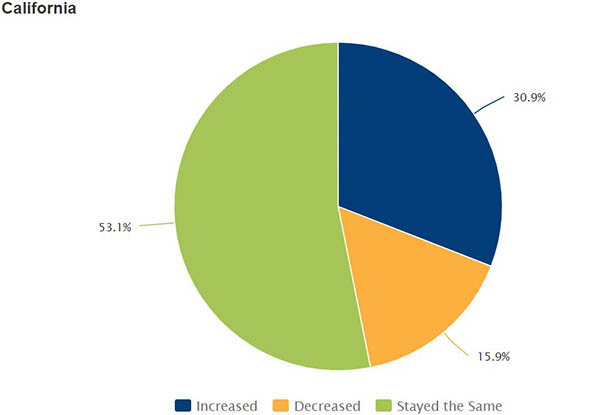
Change in Race/Ethnicity Discrimination Against Caregivers During the COVID-19 Pandemic, March 2021
Increased racism has been widely reported in the media during the COVID-19 pandemic, and the latest data support those reports. Children may experience racism directly or witness it against their caregivers. Direct and indirect racism impact health, blunt well-being, and undercut health equity—addressing them is fundamental to improving children’s health and well-being.
Caregivers who responded to the questionnaire, Family Experiences During the COVID-19 Pandemic, compared their experiences of racism before and during the pandemic. In March 2021, nearly one in three caregivers in California who had ever experienced race/ethnicity discrimination reported experiencing increased racism since the pandemic began, while just over half reported no change, and about one in six reported a decrease. Asian caregivers more often reported experiencing an increase in racism during the pandemic compared with all other race/ethnicities (44% compared with 31%).
On the questionnaire from November 2020, a caregiver shared, “Social challenges are the greatest challenge I have faced since [the pandemic began] and I don’t want my child to face racism or discrimination.”
Children’s Health Equity Resources
“The Impact of Racism on Child and Adolescent Health,” a policy statement from the American Academy of Pediatrics, offers guidance in clinical practice, workforce development, community engagement, and public policy settings to address the effects of racism on children.
The National Institute for Children’s Health Quality compiled resources that address maternal and child health equity.
Do No Harm Guide: Applying Equity Awareness in Data Visualization, a research report from the Urban Institute, provides in-depth guidance on centering equity in data-work and communications.
Recently Released Data
We recently released data about family structure and immigrants. See links to the latest here.
Posted by kidsdata.org
Post Comment
Childhood Cancer Survival Rates Vary by Race/Ethnicity
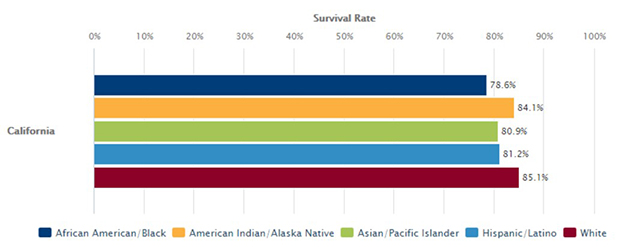
Five-Year Cancer Survival Rate Among California Children Ages 0 to 19 by Race/Ethnicity, 2006-2016
Treatment of childhood cancer, including leukemia and lymphoma, has improved markedly in recent decades, though survivors often need continued specialized care and may have a higher risk of developing other chronic health conditions. Because of the substantial burden of their disease, children battling cancer may also face psychological challenges, low educational attainment, and long-term quality of life issues. Cancer outcomes differ by race/ethnicity as well as other factors such as socioeconomic status and geographic location. Public policy and practices can help ensure equitable access to high-quality care during treatment and beyond.
In California, 83% of children ages 0 to 19 who were diagnosed between 2006 and 2016 were expected to survive cancer for at least five years. However, five-year survival rates varied by race/ethnicity, ranging from 79% for African American/Black children to 85% for White children. Eighty-one percent of Asian/Pacific Islander and Hispanic/Latino children and 84% of American Indian/Alaska Native children battling cancer survived the disease for at least five years.
Learn more about childhood cancer in California.
Children’s Health Resource
The 2021 Kids Count Data Book by the Annie E. Casey Foundation features state rankings on the overall well-being of children and on specific areas such as education and health.
Posted by kidsdata.org
Post Comment
New Data on Family Experiences During Pandemic
Today, KidsData released the latest data from the Family Experiences During the COVID-19 Pandemic questionnaire. These data are the second wave of findings from the multi-wave questionnaire.
As the COVID-19 pandemic passed the one-year mark, caregivers in households with children reflected on their experiences in:
- Education, Health Care, and Social Activities
- Economic Security
- Supportive Services
- Emotional and Behavioral Health
- Child and Caregiver Safety
- Adverse Childhood Experiences
- Positive Childhood Experiences
- Caring for Children With Special Health Care Needs (CSHCN)
The second wave of the questionnaire covers the period from March 22, 2021, to April 12, 2021. These data join the first wave of findings from Nov. 9, 2020, to Dec. 11, 2020.
Key findings from the latest data:
Education, Health Care, and Social Activities
About the same percentage of caregivers in both waves reported disruptions since the pandemic began, including closed child care centers (16% in wave 1, 17% in wave 2), canceled medical and dental appointments (29% in both waves), and canceled sports and after-school activities (36% in wave 1, 33% in wave 2).
Child and Caregiver Safety
Almost one-quarter (23%) of caregivers reported spanking, slapping, or hitting their child at least once in the last seven days. One-third (33%) of caregivers reported physical or emotional intimate partner violence during the pandemic.
Positive Childhood Experiences
A higher percentage of African American/Black caregivers reported that their child had a caring adult outside the home (94%) than White (82%) and Hispanic/Latino (79%) caregivers.
About the Data
In the Family Experiences During the COVID-19 Pandemic questionnaire, caregivers were asked to reflect on life disruptions and the emotional and behavioral consequences of the COVID-19 pandemic. The data cover California and seven regions within California. At the state level, findings are broken down by family income level, race/ethnicity, and the presence of a child with special health care needs in the household. We expect to share a third wave of findings in the coming months.
Learn more about the questionnaire and its collaborators who made it possible in About the Data Source.
Using the Data in Your Work
We hope these data are useful in your work with children and youth to address the effects of the COVID-19 pandemic. If you would like to share how you are using these data, please reach out to us at [email protected].
Additional Resource on the COVID-19 Pandemic
For a national perspective on the Family Experiences During the COVID-19 Pandemic questionnaire, see Family Snapshots: Life During the Pandemic from the American Academy of Pediatrics, in partnership with the Centers for Disease Control and Prevention (CDC), Prevent Child Abuse America, and Tufts Medical Center. They recently released two new snapshots on child discipline and intimate partner violence during the pandemic.
Children’s Health Resources
“Creating Safe, Stable, Nurturing Relationships and Environments for Children” is a new resource from the California Essentials for Childhood Initiative that elevates prevention strategies and highlights findings from the CDC’s Awareness, Commitment, and Norms Survey.
Physical Punishment: Attitudes, Behaviors, and Norms Associated with Its Use Across the US is a new report from Prevent Child Abuse America that shares findings from a survey given to U.S. adults about physical punishment and offers new insights for policy, intervention, and social norms change.
Community Safety Realized: Public Health Pathways to Preventing Violence is a new tool from Prevention Institute and Big Cities Health Coalition to advance community-driven, multi-sector approaches grounded in racial justice to prevent violence and establish pathways to safety.
Posted by kidsdata.org
Post Comment