


Archive for the ‘Kidsdata News’ Category
Families of Children with Special Needs
Bring Concerns to Doorsteps of CA Legislators
 Although children with special health care needs account for only 10% of children in California, many of us know of or are affected by a child who is chronically ill. The Family Voices Annual Health Summit and Legislative Day brought together families of chronically ill children for two days of story sharing, education, and rallying at the state Capitol to help raise awareness among lawmakers about this unique population.
On the first day, parents learned about current budgetary and legislative issues affecting their child’s system of care, as well as how to become fierce – yet effective – advocates for their child’s needs. They spoke with each other about their own experiences with insurance companies, pediatricians, school IEPs, and more. Their issues were summed up by one mother who lamented “I’ve been working within this system [of care] for over 20 years, and I’m just now starting to get it … it’s that complicated.” Her story was echoed throughout the day by other parents hoping for an opportunity to share their own story with someone who could help.
After a day of education and preparation, parents went to the Capitol to share their stories with California legislators. Some parents carried envelopes filled with receipts from the myriad of drugs they buy regularly for their child; others toted collages of their children, armed and ready to provide faces to match their stories of struggle. Regardless of their methods, it was clear these parents had one thing in common – they all wanted their voices, and their children’s voices, to be heard by someone with the power to make change happen. This kind of persistent, genuine advocacy is an important component to help legislators understand the impact their everyday decisions have on these children and their families.
Posted by Jordan Handcox
Tags: CSHCN
Advice on Challenging Behaviors
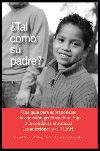 Dr. Marisol Muñoz-Kiehne, host of the Nuestros Niños radio show for parents, has published a helpful new book, ¿Tal Como Su Padre? The volume advises Spanish-speaking parents on how to observe, understand, and respond to problematic behaviors in their children. Dra. Marisol, a psychologist, discusses childhood issues in Spanish every Sunday morning at 8 a.m. on La Kalle, 100.7 and 105.7 FM, La Nuestra KBBF 89.1 FM, Tricolor KLOK 99.5 FM, Jose KSES 107.1 FM, and KMBX 700 AM. The show is rebroadcast on Fridays at 11 a.m. on KVMR-FM 90.5 and 89.7 FM. For more information, en español, visit www.nuestrosninos.com.
Posted by Eileen Walsh
Tags: Child Health Initiatives
Lack of Pediatric Specialists Delays Care, Puts Kids with Special Needs at Risk
Journalist Vivian Po, of New America Media, has written an article that focuses attention on a critical issue for children with special health care needs: long waits to be seen by a pediatric specialist.
Many kids with special needs have multiple medical issues, and require the attention of one or more specialists with expertise in caring for children. California, like the rest of the United States, suffers from a severe lack of these specialists. Last year, the Children’s Specialty Care Coalition, a non-profit association, surveyed the medical directors from nine California medical groups, representing 2,000 pediatric specialists. Results of that survey, released in December, indicated that the waiting time for a specialist is between 16 and 114 days. Children with diabetes, for example, must wait 56 days to see a pediatric endocrinologist, and children with heart conditions wait 39 days before they can see a pediatric cardiologist.
Delaying needed specialty care for children, or forcing them to be seen in emergency rooms, is inadequate medical care, and can put lives at risk. The dearth of pediatric specialists results from several factors, most notably poor reimbursement for physicians who treat children, and extended training requirements that leave young physicians deeply in debt when they begin to practice.
Our foundation is working toward improving the systems of care for kids with special needs, including finding ways to provide more specialty care. See our website at http://www.lpfch.org/informed/cshcn/.
Posted by David Alexander, MD
Tags: CSHCN
California’s Unparalleled Data Offerings
 California may be money-poor these days, but it’s surely data-rich, and that’s got to count for something. After all, is there anywhere else in the country where you can find so many useful data websites focused on the well being of a state and its inhabitants? Today, California’s offerings became even more robust with the launch of HealthyCity, which provides access to numerous local-level datasets and listings of wide-ranging services. Our congratulations to our colleagues at the Advancement Project for making HealthyCity available statewide.
Kidsdata.org and HealthyCity have a lot in common, particularly a goal to provide easy access to data and a desire to present these facts in a number of formats, from charts to maps. While our two sites both offer measurements of key indicators, they are inherently different, and undoubtedly will be used in different ways across the state. That’s a good thing. Given the magnitude of California’s problems these days, it’s critical that we have multiple tools to analyze issues and propose solutions. To that end, we’re looking forward to working with HealthyCity to ensure that Californians have a wealth of data at their fingertips. That’s a big first big step toward improving the health of California’s kids.
Posted by Andy Krackov
Tags: Data Projects
Palo Alto City Council’s Top Priorities Include Kids
Our office is located in Palo Alto, CA, just down the street from city hall, so it’s gratifying to see that the Palo Alto City Council voted a few weeks ago to make a focus on youth well being one of the cities top 5 priorities for 2010. Adolescents in Palo Alto have gone through a tough period, with a recent spate of teenage suicides. But kids in communities across California face steep challenges, so it’s important that local governments make them a priority. Do you know of any others that have?
For those interested in more about Palo Alto’s kids, here’s a data summary.
Posted by Andy Krackov
Tags: Child Health Initiatives
How Do You Want to Hear From Us?
Here at kidsdata.org, we want to deliver news and data about kids in a way that’s convenient for you. Please take a moment to answer 3 quick questions, to tell us what you’d like to receive, and how you want to hear from us.
Posted by kidsdata.org
Post Comment
Bill to Tax Sodas Would Fund Childhood Obesity Programs
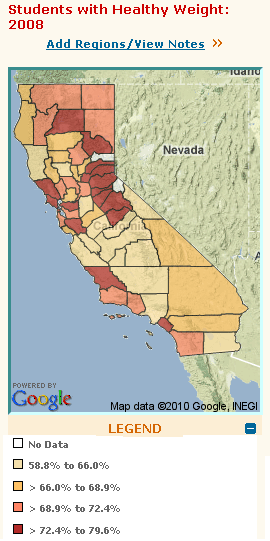 Last week, CA’s Senate Majority Leader Dean Florez introduced legislation to tax sodas and other sugar-sweetened beverages to fund childhood obesity programs in cities and school districts across the state. Given that this legislation may lead to more discussion in Sacramento about kids’ weight, we thought we’d note some related facts:
- The percent of 7th graders at a healthy weight has barely budged over the last decade. In 1999, 67% of CA’s 7th-graders were at a healthy weight; in 2008, that percentage inched upward just slightly, to 68%. Percentages and trends were similar for other grade levels.
- The percentage of kids at a healthy weight varied greatly by county, with several Eastern California counties (Nevada, Plumas, Calaveras, Placer, and Mariposa) having the highest percentages of 7th-graders at a healthy weight in 2008.
- And there also were some vast racial/ethnic disparities. About 80% of Asian-American 7th-graders in California were at a healthy weight, compared to 56% of Pacific-Islanders and 61% of Hispanic/Latinos.
School district-level data are available, too, by clicking on any of the links noted above. And if you know of effective programs or awareness campaigns in your community to help ensure that more kids are at a healthy weight, please add your comments below.
Posted by Andy Krackov
Tags: Child Health Initiatives
ITUP Conference Re-Cap: A Focus on Special Needs
 On Feb. 10, I attended the Insure the Uninsured Project conference for the first time, and was extremely encouraged to see such a large and diverse group of key governmental players coming together to talk about health care.
Although I was attending the conference as an exhibitor, I had the opportunity to attend a session focused on insuring kids, which featured a panel of knowledgeable and distinguished speakers, led by Wendy Lazarus of the Children’s Partnership, a veteran in the realm of children’s issues:
- Toby Douglas, from the state Department of Health Care Services
- Dr. Richard Pan, a pediatrician at UC Davis and now candidate for state assembly
- Suzanne Shupe, executive director of the California Children’s Health Initiatives.
Interestingly, the session on insuring kids didn’t focus as much as I expected on the federal health care debate and its impact on kids, especially with reference to the Children’s Health Insurance Program (CHIP), but instead the speakers focused on California’s kids — and, in particular, children with special health care needs. The panel was quick to point out the importance of considering this population when discussing health care for kids. In particular, panelists said, kids with special needs face a system that needs reform.
If you serve kids in your work, or have an interest in making sure all kids in California are insured, I encourage you to listen to this panel’s discussion online at ITUP’s website. (Materials and audio will be posted soon at http://www.itup.org/this-years-conference.html.) I didn’t get a chance to attend any other sessions. But, if you also attended the conference and you’d like to leave a re-cap here, feel free!
Posted by Felicity Simmons
Tags: Child Health Initiatives, CSHCN
Do CA Kids Eat Breakfast?
Just launched on kidsdata.org: Indicators measuring student reports of whether they ate breakfast that day, available both by grade level (7th, 9th, and 11th) and gender, and by race/ethnicity. These data come from the California Department of Education’s California Healthy Kids Survey (CHKS), which is administered by WestEd.
So do California students eat breakfast? Here are some state-level highlights:
- The majority of 7th, 9th, and 11th graders say they eat breakfast.
- In 2006-2008, California 7th-grade students were more likely than 9th and 11th graders to say they ate breakfast that morning.
- Among 7th and 9th graders, boys were more likely than girls to say that they ate breakfast that morning.
- Asian American and Caucasian/White students were most likely to say they ate breakfast.
Posted by Sarah Marxer
Tags: New Data, Statewide Expansion
The Status of Kids’ Dental Care in California
 Any guesses as to how many kids have cavities in CA? It may be hard to say with certainty, but some experts in the state think as many as one-half of kindergartners have cavities – and this issue, plus numerous other dental-related problems, causes a significant number of kids to miss school. These problems are highlighted in Viji Sundaram’s article, Kids’ Dental Decay Takes a Bite out of School Attendance, from New America Media. The article is the result of a partnership with our foundation.
Since it’s National Children’s Dental Health Month, we thought we would note some related data from kidsdata.org. Unfortunately, California lacks a broad array of locally available, statewide measures of kids’ dental health, but what we have from the California Health Interview Survey still helps illuminate how California is faring. For example:
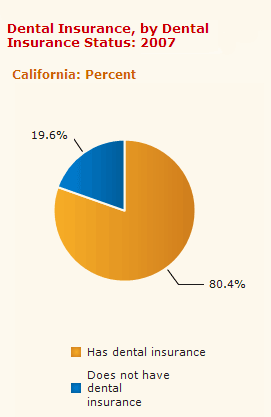
- About one in five kids in CA lack dental insurance, according to 2007 data, and county-level percentages vary greatly across the state.
- Here in California, it’s not unusual for kids to have never seen a dentist. These same 2007 data show that 13% of California’s kids – 1 in 8 – have never been to the dentist.
Fortunately, there are numerous statewide organizations focusing attention and resources onto dental care for California’s kids, including the Dental Health Foundation and the California Dental Association. And on the local level, there are some excellent models – such as San Mateo County’s participation in the national Give Kids a Smile Day, which offers free dental care for the kinds of kids noted in the data above – those who lack insurance or otherwise have limited access to a dentist.
Posted by Andy Krackov
Tags: Health Observances