


Archive for the ‘Kidsdata News’ Category
Study Reveals Different Health Impacts of Living in Rural and Urban Areas
Despite the often-held image of clean air, fresh food, and physical activity in rural areas, a recent article in the Wall Street Journal notes that Americans who reside in cities tend to live longer, healthier lives than those in rural areas, according to a study. Among the specific findings, city-dwellers rate their own health more highly and are less likely to die prematurely than those living in rural areas.
Both urban and rural areas have positive and negative health trends, though. For example, obesity appears to be more prevalent in rural areas, with 55% of rural children ages 2 to 19 categorized as obese or overweight, compared to 45% of urban kids, according to the article. On the other hand, urban dwellers tend to have more low-birthweight babies than those in the rural areas, and children in rural areas tend to have less asthma and fewer allergies and autoimmune disorders than urban children.
According to data recently added to kidsdata.org, of the 10 million kids ages 0-17 in California, 92% (about 8.7 million) lived in urban areas in 2005-2009, while about 8% (nearly 750K) lived in rural areas (as defined using the U.S. Census Bureau’s 2009 American Community Survey definition).
Posted by kidsdata.org
Tags: Child Health Issues, New Data
Top 5 Reasons to Use Kidsdata.org: Reason #5 – Stay Up to Date on the Data You Need
 We finish this summer’s countdown of the top 5 reasons to use kidsdata.org with reason #5 — stay informed on the child health topics that matter to you.
Kidsdata.org offers several options to keep you up to date on child health and well being:
- Sign up for e-mail alerts to receive notifications from kidsdata.org when data of interest to you are updated. Only interested in child abuse data? Or only data for Los Angeles County? E-alerts are tailored just for you.
- In addition to e-alerts, you can sign up for our regular Kidsdata Advisory e-mail newsletter, for timely data summaries about children’s health issues and news about enhancements to the site.
- And, if you’re a social media buff, you can follow us on Twitter, or “like” kidsdata.org on Facebook for daily facts and highlights of key child health issues.
- Last, but certainly not least, you can sign up to receive updates from this blog! Using the sign up box in the right column of this page, you can receive an e-mail every time we add a new post.
With all these ways to stay informed about how the kids in your community are faring, rest assured you’ll have the data you need for all your work on behalf of kids.
Posted by Felicity Simmons
Post Comment
Children Now Make Up the Smallest-ever Percentage of the U.S. Population
According to a Wall Street Journal article citing 2010 Census data, the percentage of the U.S. population under age 18 is the smallest it ever has been, at 24%. This percentage is slightly lower than it was about 10 years ago (26% in 1990), but almost half of what it was at the turn of the last century (40% in 1900). See an interactive map of all states>>
In addition, 2010 Census data indicate that the child population is becoming more racially and ethnically diverse. The number of children of color in the U.S. has grown since 2000, while the number of non-Hispanic white children has declined. Currently, children of color make up almost half (46%) of the national child population; non-Hispanic white children still comprise the majority (54%).
In California, unlike the nation, the total number of children rose slightly over the past decade. The state has almost 10 million kids, comprising 26% of the total population, according to 2009 data. In comparison to national figures, children of color make up a larger percentage of the child population in California (about 70%). Specifically, the racial/ethnic make-up of the state’s child population is about 49% Hispanic/Latino, 31% Caucasian/White, 10% Asian/Pacific Islander, 6% African American/Black, 4% from multiracial backgrounds, and less than 1% Native American. Consistent with national trends, the number of children of color in California has grown since 2000, while the number of Caucasian children has declined. Find data for your county>>
Also see kidsdata.org’s Research & Links section for websites and reports with more information on demographic issues, including race/ethnicity, and how that relates to child well being, such as this article from the American Academy of Pediatrics, “Racial and Ethnic Disparities in the Health and Health Care of Children” (2010).
Posted by kidsdata.org
Post Comment
Data Report Paints Bleak Picture of the ‘State of America’s Children’
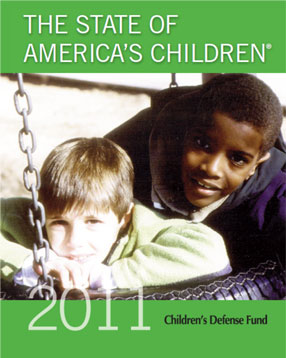 The Washington D.C.-based Children’s Defense Fund (CDF) recently released a report, The State of America’s Children 2011, which illuminates striking differences between the U.S. and other industrialized countries in terms of child health and well being. In addition, the report presents state-level data for a variety of important indicators related to poverty, family structure, nutrition, juvenile justice, and gun violence.
According to the report, the U.S. ranks first in gross domestic product (GDP), first in the number of billionaires, and first in military technology. However, the U.S. ranks 30th in infant mortality, 31st in math scores, and last in teen birth rates.
Despite having the highest GDP in the world, the Census Bureau estimates that one in every five children in America is living in poverty. The numbers are the same here in California – 20% of children lived in families with incomes below the federal poverty level, according to 2009 data. In addition, more than half of California students are poor enough to qualify for free or reduced price school meals.
Read more about the report or download the PDF version at http://www.childrensdefense.org/child-research-data-publications/data/state-of-americas-children-2011-report.html.
Posted by Jordan Handcox
Post Comment
Top 5 Reasons to Use Kidsdata.org: Reason #4 – Share Your Data
 Once you’ve found the exact data you need on kidsdata.org – and customized it how you want – there’s no need to keep it all to yourself, right? After all, with kidsdata.org, our foundation’s goal is to help promulgate data about how kids are faring, in order to help elevate the visibility of children’s issues in California.
So reason number 4 of the top 5 reasons to use kidsdata.org? You can share your results instantly using the tools in the top right corner of every data page.
For whatever data you’ve chosen, you can copy your customized graph or chart into a Word document or Powerpoint slide. Or, you can download the data directly into Excel – either just the data you’re looking at or the entire dataset – to create your own graph.
And, you can share the graph you’ve created with your friends and colleagues instantly via Facebook, Twitter, bookmarking sites such as Digg and Reddit, or via e-mail.
Finally, using the “<embed>” button, you can take a customized graph from kidsdata.org and put it directly on your website. Then, the graph on your site will automatically update when we add new data to kidsdata.org.
For example, this blog post on greatschools.net uses an embedded graph from kidsdata.org to show the rise in autism diagnoses over time.
Posted by Felicity Simmons
Post Comment
A Looming Threat to Public Insurance Programs for Children with Special Health Care Needs
Negotiations now under way in Washington, DC, regarding the U.S. debt ceiling could have a catastrophic effect on some of California’s children with special health care needs and their families.
Many children in our state depend on public health insurance programs to meet all or part of their health care costs, through Medi-Cal (California’s Medicaid program) or Healthy Families (California’s State Children’s Health Insurance program). The State Flexibility Act, currently under debate in Congress in conjunction with the debt negotiations, would reduce spending and allow states to make cuts in eligibility for these vital programs. Potential scenarios for California could include complete elimination of Healthy Families, and limits placed on the number of children eligible for Medi-Cal.
Such changes would have a particularly negative effect in California, where more than a third of California’s children with special health care needs already have insurance that is not adequate to meet their requirements, according to Children with Special Health Care Needs: A Profile of Key Issues in California, a report commissioned by our Foundation. Our state ranks 46th out of the 50 states on adequacy of insurance for children with special health care needs, the report notes.
The Medicaid and Healthy Families programs have contributed substantially to improving the health and well being of children, and these programs are especially critical for children with complex and chronic conditions. A new study from Georgetown University’s Center for Children and Families documents how much is at stake if these programs are cut or lost. Without insurance, children may lose access to primary care, specialists, early intervention programs, or preventive services that help keep their conditions from worsening. Medicaid also helps many children live and be cared for in their homes and communities rather than in institutions.
Attempts to alter these essential public insurance programs have been made before. This time around, however, the crisis is so severe that some supporters in Congress are pessimistic. In a recent Wall Street Journal article, Senator Jay Rockefeller (D-WV), a longtime Medicaid advocate said, “There has been an unsettling silence around Medicaid even from members of my own party.”
As the negotiations about reducing the national debt proceed, it is imperative that we add our voices to the debate. Let your Congressional representatives and the Obama Administration know what it means for children and families to lose access to the health care they deserve.
You can find your representatives at http://www.govtrack.us/congress/findyourreps.xpd, or call
(202) 225-3121 for the Capitol switchboard and (202) 456-1414 for the White House. Ask them to protect Medicaid and the State Children’s Health Insurance Program.
I also encourage you to join the new California Collaborative for Children with Special Health Care Needs, a statewide group developed by our Foundation that will be working toward a better system of care for children in California with special health care needs.
Posted by David Alexander, MD
Tags: Child Health Issues, CSHCN
Using Kidsdata for Storytelling
Originally posted on Health Databytes, the UCLA Center for Health Policy Research blog
 They say every picture tells a story. At the Lucile Packard Foundation for Children’s Health, we believe that every data point has the potential to tell a story. That’s why we operate our flagship website, www.kidsdata.org.
Kidsdata.org consolidates hundreds of indicators at the state, county, city, and school district level that help paint of picture of how children in California are faring. Data are drawn from the California Department of Education, the Census Bureau, the California Healthy Kids Survey, and dozens of other sources – including, of course, the California Health Interview Survey. The stories these data tell can be used to help bring attention to key children’s issues, and to support funding requests.
At the foundation, we’ve developed number of approaches – mostly through trial and error – for using data for storytelling. Here are some relatively low-cost tactics that have proven particularly effective for us.
• Tell a Story Yourself; Create a Data Slideshow. For a number of recent announcements about updated data on kidsdata.org, we’ve build simple data slideshows to summarize how children are faring for a particular topic, such as weight or child welfare. We like to make these slideshows visually compelling by showing data in multiple views – trend and pie graphs, maps, etc. – and we design them as high level, compact summaries of an issue.
Since we’ve begun to highlight these data slideshows in e-mail announcements about recently updated data, they’ve become the most clicked-on links. It’s not unusual for us to hear about people making use of these slideshows in their own work, such as an instructor who wanted to download the weight slideshow for use in an online class for California teachers.
• Localize the Data. While it’s not always easy to do, it pays to invest time to provide, or just link to, local data when you can. Websites like AskCHIS or kidsdata.org can help you accomplish this. We’ve found, for example, that our e-mails are more viral when we include direct links to data by school district. Similarly, when we meet with staff for elected officials, we prepare some graphs to show with data for their region.
 Through kidsdata.org, you can drill down to find the data you need at the specificity you desire, and once you do, you can download your graphs and tables for use in Word or PowerPoint, or even embed charts and maps into your own website or blog.
• Treat Data Storytelling as a Campaign, not a One-Time Mention. If you’re getting ready to communicate data from a study you’re releasing, or if you want to use data to support an advocacy position your organization is taking, think about how you can communicate these data in a sustained way, given that some key constituents may not necessarily pay attention at a particular moment. The story you’re telling with the data doesn’t need to be told all at once; sometimes installments can work well. With kidsdata, for example, we offer a fact of the day through Twitter, and journalists/policymakers sometimes retweet these facts to their audiences.
Know of other strategies? We encourage you to add them to this list.
Posted by Andy Krackov
Post Comment
Top 5 Reasons to Use Kidsdata.org: Reason #3 – Customize Your Data
 Reason number 3 in our countdown of the top 5 reasons to use kidsdata.org helps you get exactly what you want. Customize.
On kidsdata.org, you can tailor the data to reflect the region, year, and/or demographic breakdown relevant to you or the kids you are serving. Depending on the source, data are available by age, gender, grade level, racial/ethnic group, or socioeconomic status.
Want to know the percentage of 9th grade Asian American students in your school district who are at a healthy weight? Or how many low-income third graders are proficient in reading? Kidsdata.org can tell you.
And once you’ve drilled down to find what you’re looking for, you can view your results as maps, bar graphs, pie charts, tables, or trends over time. All the tools you need to tell your story — right at your fingertips.
Posted by Felicity Simmons
Post Comment
Data Updates: Injury Hospitalization and Self-Inflicted Injury Rates
We recently updated two related measures of children’s health and well being – injury hospitalizations and self-inflicted injuries. Following are some highlights about what these data tell us about how kids in California are faring:
- 2009 data from the California Department of Public Health show that, for California children/youth ages 0-20, the rate of hospitalizations for non-fatal injuries has generally declined since 2000. Unintentional injuries account for the vast majority (almost 75% in 2009) of the total number of injuries, and injury hospitalization rates vary greatly among California counties, from about 150 per 100,000 kids/youth to more than 400 in 2009. Learn more about these data>>
- The rate of youth self-inflicted injury hospitalizations in California also has dropped since 2000. County-level rates varied from about 19 per 100,000 children/youth ages 5-20 to more than 60 per 100,000 in 2009. Learn more about self-inflicted injuries>>
- Injury hospitalizations, whether self-inflicted or due to other causes, are most common among youth ages 16-20.
Posted by kidsdata.org
Post Comment
Government Plans to Collect Health Data on LGBT Population, Improve Data Collection Standards
 The Department of Health and Human Services recently announced that it will begin collecting data on lesbian, gay, bisexual and transgender (LGBT) populations, to better understand and address health disparities. The department also announced new draft standards for collecting and reporting data on race, ethnicity, sex, primary language and disability status. According to HHS Secretary Kathleen Sebelius, “The data we will eventually collect in these efforts will serve as powerful tools and help us in our fight to end health disparities.” The race/ethnicity standards, for example, will improve data collection for various racial and ethnic subgroups, especially among Asian, Hispanic/Latino and Pacific Islander populations.
Posted by kidsdata.org
Post Comment