


Archive for the ‘Kidsdata News’ Category
Not Only Is CA’s Infant Mortality Rate Decreasing, it’s the Lowest Recorded
In order to provide reliable data at a county level, kidsdata.org offers infant mortality rates over three-year periods. The most recent data we have – from ’07-’09 – show a declining rate of infant mortality in California, from 5.9 infant deaths per 1,000 live births in ’96-’98 to 5.1 in ’07-’09. See county-level data >>
However, when examining California as a whole, as opposed to individual counties, one-year rates are reliable, and according to data just released from the California Department of Public Health, the 2009 infant mortality rate – 4.9 per 1,000 live births – was the lowest recorded. The infant mortality rate has dropped considerably over the years; about 20 years ago, in 1991, the rate was 7.5 infant deaths per 1,000 live births.
The 2009 data released by the state also show that disparities persist, with infant mortality rates that are more than twice as high for Multiracial and African American/Black infants as for Hispanic/Latino, Caucasian/White, and Asian infants.
For analysis on these California-wide data, visit HealthyCal.org.
Posted by Andy Krackov
Post Comment
Making Visual Sense of Data–What Does 7 Billion Look Like?
At our foundation, we’re always on the lookout for innovative ways to express data visually. So following the United Nation’s recent announcement that world population has reached the seven billion mark, we took note of this National Public Radio video to help audiences visualize this mind-boggling population growth:
Using just water, food colors, and glass vials, the video employs volume to help audiences understand changes over time in global population growth. A simple, innovative visualization translates and humanizes these data into a story of our species over several centuries.
What stories do you want to tell with data measures on kidsdata.org?
We have many options for you to communicate data visually:
So get creative and play around with the various ways that Kidsdata offers visualized data to discover the way that best conveys pressing issues –and victories!– in child health. Just leave a comment, and let us know what you’ve come up with.
Posted by kidsdata.org
1 Comment
A ‘Patchwork of Progress’ on Childhood Obesity, but the Story Is Incomplete
How can we make sense of the just-released data on childhood obesity? On one hand, more than half of California counties registered increases from 2005 to 2010 in rates of overweight and obesity among fifth-, seventh-, and ninth-graders. Yet statewide, the prevalence of obesity largely held steady at 38%, a sign that our state may be getting a handle on the pressing issue of childhood obesity.
The researchers from UCLA and the California Center for Public Health Advocacy (CCPHA) describe the results in their press release as a “patchwork of progress.” And Harold Goldstein, executive director of the CCPHA, observes, “Increased awareness and a growing array of school and community policies and programs are beginning to have an impact.”
As with data on so many other topics, however, the story is still incomplete – and that may be one of the key points to remember here. In five or 10 years, we’ll know more about whether this period from 2005 to 2010 marked the beginning of a decline in California’s childhood obesity rates or whether progress is stalling.
Researchers involved in this study note that a patchwork of progress is no reason for California policymakers to become complacent, pointing out the need for continued attention to programs and policies that prevent and address childhood obesity. “Children’s health is still at risk in a significant number of counties,” says UCLA’s Dr. Susan Babey, the lead author of the study. CCPHA’s Goldstein notes, “In light of the huge number of counties where childhood obesity rates continue to climb, our efforts must continue and even expand, especially in those areas where we now know children are most at risk.”
For more information on policies to influence childhood obesity, see kidsdata.org’s Policy Implications section.
Posted by Andy Krackov
Post Comment
CA’s Youth Suicide Rate Has Declined: A Summary of Data
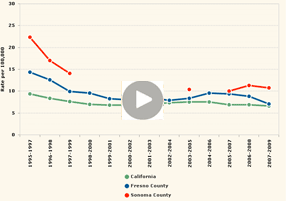 Data just posted to kidsdata.org show that California’s youth suicide rate declined to its lowest level in more than 10 years. The rate, which was 6.6 suicides in ’07-’09 per 100,000 youth ages 15-24, was about 30% lower than the rate of 9.4 in ’95-’97. In case you missed our recent advisory, view this slideshow for a summary of key data findings on suicide and self-inflicted injuries.
Posted by kidsdata.org
Post Comment
November is National Adoption Month
National Adoption Month helps raise awareness about the thousands of children and youth nationwide in the child-welfare system who are awaiting permanent families.
Data show that there were 58,012 children in foster care in California in 2010. And, according to 2009 data, 72% of California’s foster children waited 2 or more years to be adopted into a permanent home.
See more data on foster care children in California>>
See a related Data Points blog post on “Helping Adopted Children Overcome Adversity“
Posted by kidsdata.org
2 Comments
‘Growing Up Poor in the Bay Area’ Forum Comes to Silicon Valley
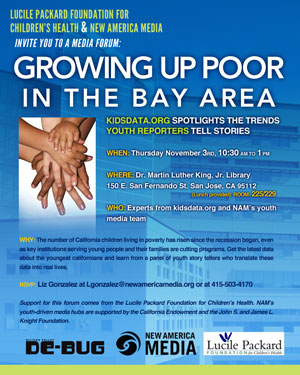
New America Media is partnering once again with the Lucile Packard Foundation for Children’s Health to join the latest data on child health with local youth perspectives, in order to tell on-the-ground stories about what it’s like Growing Up Poor in the Bay Area.
This forum, which will be held on Thursday, Nov. 3, from 10:30 a.m. to 1 p.m. in San Jose, will feature information about youth poverty from several perspectives:
- A presentation of local poverty data on kidsdata.org;
- Multimedia stories from youth reporters who will translate these data into real lives, describing how they’ve seen poverty affect local youth; and
- Comments/discussion from youth development organizations and others about troubling trends and recommendations for action.
We hope that this forum will help illustrate challenges faced by low income youth and families — and perhaps inspire some media coverage of these issues. Stay tuned to Data Points for a re-cap of this event.
If you’d like to attend Thursday’s event, RSVP to Liz Gonzalez at [email protected] or at (415) 503-4170.
See our Recap and Video from our last New America Media Forum event in San Francisco.
Posted by kidsdata.org
Post Comment
How to Use Kidsdata.org to Map Data for Your Legislative District
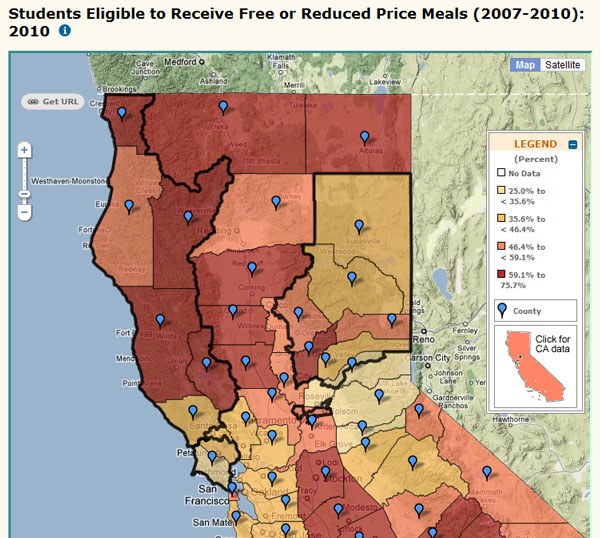
We’ve added a new legislative district overlay tool to maps on kidsdata.org. This tool allows you to see the data you care about, and then overlay legislative district boundaries, to help visualize what’s happening in your district.
How to Overlay Legislative District Boundaries:
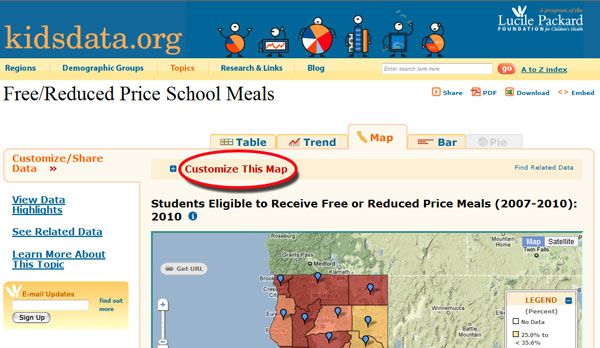
1. Find data of your interest on any kidsdata indicator page. Next, select the map tab, and click the “Customize This Map” bar.
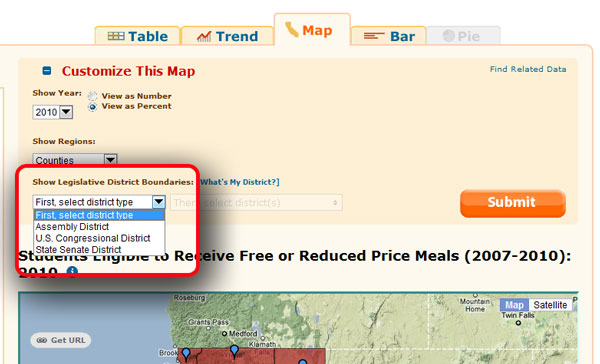
2. Next, select your district type (Assembly, State Senate, or U.S. Congressional districts) under “Show Legislative District Boundaries.”
3. Then, select the districts you’d like to see on the map. You can select as many districts as you want, or, click “Check All” to view all districts.
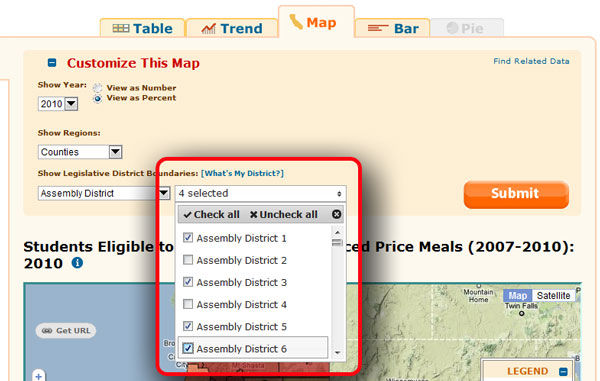
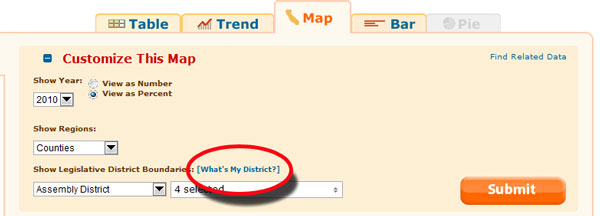
4. Don’t know your district? Hit the “What’s My District?” link. When you’re finished customizing, click the big orange “Submit” button to build your legislative data map.
5. Print your map and take it with you to advocacy or policy meetings.
Posted by Jordan Handcox
Post Comment
Poverty on the Increase in Suburban Areas, Data Show
A recent analysis of Census data by the Brookings Institution has found a significant increase in the number of suburban households living in poverty.
According to a New York Times article about the analysis, poor populations in suburbs have grown by more than half since 2000. These areas have been hit hard by foreclosures and unemployment, the article notes, and can’t support residents who need the kinds of public services typically only available in urban areas.
On kidsdata.org, we offer poverty data for California school districts, cities and legislative districts, as well as data about students eligible for free/reduced price school meals, which is a proxy measure of poverty. These data encompass all regions in California – urban, suburban, and rural. Additionally, kidsdata.org includes several demographic measures of children in suburban areas, including:
- Child Population
- Households with and without Children
- Family Structure
- Children in the Care of Grandparents
- Foreign-Born Children
You also can find a broader summary of data available for your community by choosing a region here.
Posted by kidsdata.org
1 Comment
A Round-Up of Recent News About Child Health: Drug Use, Special Needs, Homelessness, and More
Here’s a summary of some recent news articles about child health issues, along with related data available on kidsdata.org:
Alcohol, Tobacco, and Other Drug Use (See related data)
- Drugged Driving Takes High Toll Among Youth, Report Finds
(CBS News, 10/13/11, by Freeman)
Children with Special Health Care Needs (See related data)
- Non-Invasive Early Pregnancy Test for Down Syndrome Now Available in 20 Cities Nationwide
(LA Times, 10/19/11, by Roan) - Low Birthweight Infants at Increased Risk for Autism, Study Finds
(USA Today, 10/17/11)
Homelessness (See related data)
- Report: Youth Homelessness on the Rise in Richmond
(Richmond Pulse, 10/14/11, by Croom)
Infant Mortality (See related data)
- Article Explores Efforts to Reduce High Infant Mortality Rates Among Black Mothers
(NY Times, 10/14/11, by Williams)
- California’s Infant Mortality Rate Dips to New Low
(Healthycal.org, 10/21/11)
Teen Births (See related data)
- Study: National Teen Pregnancy Rate Drops; Contraceptive Use Up Among Boys
(MSNBC, 10/12/11, by Alexander)
Posted by kidsdata.org
Tags: Child Health Issues
Celebrate 30 Years of Down Syndrome Awareness
October is Down Syndrome Awareness Month, a health observance sponsored by the National Down Syndrome Society.
This year’s observance celebrates 30 years of public awareness efforts by both highlighting the diverse accomplishments of individuals with Down syndrome and challenging stereotypes.
In California, about 1% of children with special health care needs have Down syndrome, according to ’05-’06 data.
See other data about children with special health care needs >>
Posted by kidsdata.org
Tags: CSHCN