


Archive for the ‘Kidsdata News’ Category
San Diego, San Francisco Focus on Data to Help Address Civic Issues
It’s encouraging to see that two major cities in California are turning to data to help solve civic problems.
The city of San Diego recently announced a $50,000 app challenge to “enhance city services and quality of life for San Diegans.” Data from kidsdata.org are among the many official data sources from which users can draw data for this challenge. Community members already have suggested ideas for apps that would map neighborhood air quality; provide nutritional information for local restaurants; assist in enrolling children in school; and list school testing results.
In San Francisco, Mayor Ed Lee last week announced a 2012 Innovation Portfolio that, among other initiatives, will provide coders with access to city data. Roughly 60 apps already have been built with data from San Francisco, and the city will look to legislation to make datasets more accessible to the public.
Our foundation, too, has participated in a data challenge. See this blog post, “Developers Find Intriguing Ways to Display Data from Kidsdata.org,” for information on the results, which were announced last June.
Posted by Andy Krackov
Post Comment
February Is National Teen Dating Violence Awareness Month

February is National Teen Dating Violence Awareness Month, a health observance to promote awareness about youth relationship violence and programs that are effective in preventing it.
Teen dating violence has negative effects on a young person’s physical, emotional, social, and academic well being. A recent opinion piece in The Bay Citizen highlighted the devastating repercussions of teen dating violence through the discussion of a tragic 2011 case in San Leandro that ended fatally for both teens in an abusive relationship.
Around 7% of 11th graders in CA public schools in 2006-2008 reported experiencing dating violence (i.e., having been hit, slapped, punched, or otherwise hurt by a boyfriend/girlfriend) within the previous year.
See data about dating violence in your community >>
Posted by Stacey Angeles
Post Comment
2012 Santa Clara County Children’s Summit Focuses on Improving Access to Education
“Changing the odds for children” was the theme that brought together an assortment of health and education professionals, advocates, and government officials to Kids in Common’s 2012 Santa Clara County Children’s Summit on January 27. The event, sponsored in part by the Lucile Packard Foundation for Children’s Health, offered eight workshops that addressed issues such as school safety (see related data) and chronic absence from elementary schools. Improving the quality of and access to education, a prominent message throughout the day, was championed by keynote speaker Joanne Weiss, chief of staff to the U.S. Secretary of Education, Arne Duncan.
One workshop, led by Fernando Mendoza, MD, service chief of General Pediatrics at Packard Hospital, focused on health disparities, and highlighted education as a pathway to success for children of immigrant families. During the workshop, Mendoza noted the importance of embracing multiple dialects in the classroom, as well as the connection between the quality of education and access to quality health care.
See data about immigrant children in Santa Clara County>>
To see more data about children in Santa Clara county, visit the Santa Clara County profile on Kidsdata.org.
Posted by kidsdata.org
Post Comment
Preteen Vaccine Week: Keeping the Spotlight on Adolescent Immunizations
This guest post was written by Jeff Good, PharmD, MPH, President of the California Immunization Coalition.
In 2011, a new school immunization mandate went into effect in California, requiring adolescents to provide proof that they have received a tetanus, diphtheria, and acellular pertussis (Tdap) vaccine to attend school. The new mandate increased Tdap vaccination rates and put a spotlight on the important role that immunizations play in keeping adolescents healthy. It also called attention to the fact that adolescent immunization rates in California remain low, leaving hundreds of thousands of adolescents vulnerable to diseases that can be serious, including pertussis, meningococcal disease, and human papillomavirus-related cancers.
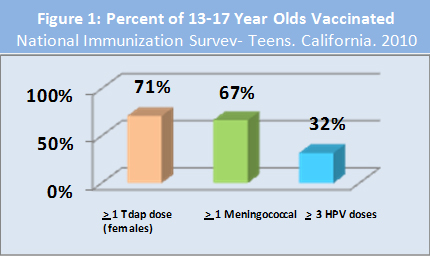
Immunization coverage levels in California fell far below the national Healthy People 2020 target of 80%. In 2010, only 67% of California’s adolescents had received a dose of meningococcal vaccine; 71% had received a Tdap vaccine; and only 32% of females had received the 3 doses of HPV4 vaccine recommended to protect against genital warts, cervical cancer, and other cancers (Figure1).
The recognition that adolescent immunization rates are low has invigorated the efforts of health, adolescent, and immunization stakeholders to increase awareness about adolescent immunizations, improve office-based immunization systems, and link families with low-cost and no-cost vaccinations. Join the California Immunization Coalition and its partners in celebrating Preteen Vaccine Week (February 12-18, 2012). This campaign is an opportune time to increase immunization awareness and test new strategies to:
- encourage parents and providers to schedule a comprehensive preventive visit for all preteens at 11-12 years of age to provide recommended immunizations and discuss other preventive health recommendations
- encourage providers to use proven systems to bring adolescents into the office and reduce missed opportunities to vaccinate
- educate parents and teens about the importance of immunizations and the risks of skipping or delaying immunizations
- raise awareness about two new laws impacting adolescent immunizations and
- link families with resources that provide no-cost and low-cost immunizations.
To learn more about adolescent immunizations, school immunization requirements, and Preteen Vaccine Week, please review our issue brief and visit www.immunizeca.org and www.shotsforschool.org.
Posted by kidsdata.org
Post Comment
Congenital Heart Defect Awareness Week: February 7-14
Congenital Heart Defect Awareness Week runs from Tuesday, February 7 to February 14. Congenital Heart Defects are the most common birth defects, affecting nearly 1% of American newborns and an estimated 1.8 million American families. Unfortunately, they also are one of the most dangerous; Congenital Heart Defects are one of the leading causes of infant death in the United States.
California data show that the leading cause of infant mortality in 2007-09 was congenital malformations and abnormalities (which include congenital heart defects) at a rate of 1.3 deaths per 1,000 live births.
To learn more about Congenital Heart Disease, visit the Congenital Heart Information Network website.
Posted by kidsdata.org
Post Comment
Achievement Gap Between Rich and Poor Children Is Widening; Find Related CA Data
Recent analyses of long-term studies show that the educational achievement gap between white and black students has narrowed over the past 60 years, but the gap between rich and poor students has widened substantially over time.
The studies, highlighted in today’s New York Times, discuss possible reasons for the large gap in academic performance between socioeconomic groups. One possible explanation is that higher-income parents have the means to invest more in children’s extracurricular activities, such as musical instrument lessons and academic tutoring, which can contribute to increased educational success.
Kidsdata.org offers a number of education-related indicators including reading proficiency, by socioeconomic status.
Posted by Stacey Angeles
Post Comment
U.S. Teen Births Hit Lowest Rate in Years; See Animation of CA Data
A report released today by the Guttmacher Institute shows that teen pregnancy rates in the U.S. have reached their lowest level in 40 years and that the nation’s teen birth rate declined by 35% from 1991 to 2008. A recent NPR article covers the report, highlighting that 7 percent of U.S. girls between ages 15 and 19 were pregnant in 2008, compared to 11 percent in 1990.
We recently updated teen birth data on kidsdata.org. These data show that California mirrors this nationwide trend with a nearly 50% decrease statewide in teen birth rates between ‘95 and ’09.
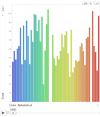
Want to see a visual display of declining teen birth rates across California counties? This interactive motion chart highlights the change. First click the bar graph tab toward the top and then press play. Hint: To follow the progression of a particular county, change the “order” pull-down from “data” to alphabetical, and select your county in the right column.
Posted by kidsdata.org
Post Comment
The Work-Family Balance
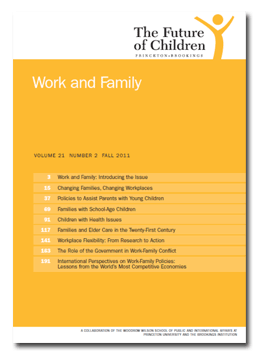 The fall 2011 issue of The Future of Children, Work and Family, focuses on the tensions many parents experience when juggling a career and family. Overall, the journal issue suggests expanding workplace and time flexibility; making work-family policies more equitable across the income scale; and increasing the role of child caretakers in the community tohelp relieve pressures on family caregivers.
See the table of contents for the Work and Family issue >>
In California, parents of children with special health care needs experience particular work-life tensions. In fact, 24% of children with special health care needs had parents who cut back or stop working to care for their child, according to a federal survey, and that percentage grows to 45% if the family has public insurance.
See more data about the impact of children with special health care needs on families>>
Among all parents, family structure contributes to parents’ feelings of having adequate time for their families, an issue related to work-life balance. According to our foundation’s 2010 Parent Survey, 18% of California children have parents who report feeling they do not have enough time with their families; that percentage is higher for children in single-parent families (25%).
Posted by Stacey Angeles
Post Comment
Prenatal Care, Low Birthweight, Prematurity: How is CA Faring?
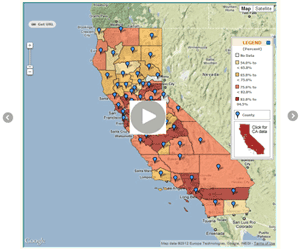
This July, two laws take effect in California requiring individual and small group health plans to provide coverage for maternity services, including prenatal care. This mandate could positively influence the overall health of children. Prenatal care greatly reduces the risk of infant mortality. Timely prenatal care also lowers the risk of premature birth and lower birthweight, both of which can leave babies at increased danger for long-term disabilities.
How is the state faring on these critical measures of infant health? As California approaches the enactment of these laws, newly posted data on kidsdata.org provide insight. See this kidsdata.org slideshow for details >>
Posted by kidsdata.org
Post Comment
Where Does CA Rank in New State Index of Child Well Being?
A new state-by-state index of child well being ranks California 30th overall in child well being, just ahead of neighboring Oregon and one behind Missouri. In order, the northeastern states of New Jersey, Massachusetts, and New Hampshire ranked best, according to this index from the Foundation for Child Development, while New Mexico came in last.
This index, a summary score from 25 individual indicators, is based off of the Foundation for Child Development’s national Child Well-Being Index, which was developed by Kenneth Land of Duke University. In 2009, our foundation commissioned Prof. Land to create the California Index of Child and Youth Well-Being.
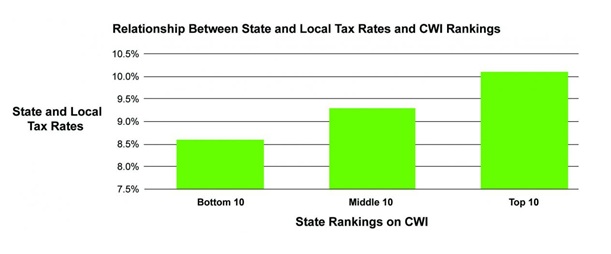
The Foundation for Child Development’s new State Child Well Being Index (CWI) also finds a strong correlation between state policies and children’s health, noting that states with higher tax rates “generate higher revenues and have higher CWI values than states with lower tax rates.”
Posted by Andy Krackov
Post Comment