


Archive for the ‘Kidsdata News’ Category
June is National Safety Month
 Unintentional injuries/accidents are the leading cause of death among children ages 1 to 14, so it is worth noting that June is National Safety Month, which promotes awareness about preventable injuries and deaths.
In California, from 2007-2009 more deaths per 100,000 children ages 1-4 and 5-14 were due to unintentional injuries than to cancer, birth defects, or homicide, according to www.kidsdata.org. In 2009, 23,449 children ages 0-20 in California were hospitalized because of unintentional injuries.
Help to ensure your child stays safe this summer by following these simple tips:
Make sure your child wears a helmet when riding a bike, and that the helmet fits well enough not to rock from side to side during riding. When your child is on the playground, be mindful of clothing that can easily get caught in equipment or cause an unintentional fall (e.g., untied shoelaces, drawstrings on jackets, etc.). And be prepared by making and carrying a first aid kit.
Find more tips on child safety for both outdoor and indoor activities.
See related data on kidsdata.org:
- Leading Cause of Children’s Deaths Ages 1-4
- Leading Cause of Children’s Deaths Ages 5-14
- Number of Injury Hospitalizations, by Age and Cause
- Unintentional Injury Hospitalizations Rate, by Age
Posted by Lindsey Nguyen
Post Comment
Roundup of Recent News Stories: Health Care, Teen Health, Childhood Cancer
Following are some recent news highlights about children and families, along with related data from kidsdata.org:
Health Care (see related data):
- Proposed Changes in Healthy Family Insurance Program Put Low-Income Children from Rural Counties At Risk
(Huffington Post, 5/29/12, by Snyder) - Medi-Cal Managed Care Dental Program Provides Sub-Par Service to Low-Income Children
(Sac Bee, 5/29/12, by Bazar) - Survey: Medi-Cal Gets High Marks in General, But Enrollees with Disabilities, Poorer Health Report Less Favorable Experiences
(SF Chronicle, 5/31/12, by Colliver)
Teen Health (see related data):
- Study: Low-Fiber Diet May Raise Teens’ Risk for Heart Disease, Diabetes
(U.S. News, 6/5/12) - CDC: Teen Suicide Attempts Increased from 2009 to 2011
(Fox, 6/8/12) - Percentage of U.S. Teens Diagnosed with Kidney Stones Has Steadily Increased, Study Shows
(Reuters, 6/8/12, by Norton)
Childhood Cancer (see related data):
- Pediatric Cancer Genome Project Explores Connection Between DNA and Childhood Cancers
(Time, 5/30/12, by Park)
- Girls at Greater Risk for Early Breast Cancer After Chest Radiation for Cancer Treatment, Study Shows
(Yahoo, 6/4/12)
- Study: Cancer Rates Go Up Among Children, While Survival Rates Improve
(Bay Citizen, 6/11/12, by Jewett)
Posted by kidsdata.org
Post Comment
Critical National Data Source in Jeopardy
On May 9, citing concerns over cost and privacy, the U.S. House of Representatives voted in favor of eliminating all funding for the Census Bureau’s American Community Survey (ACS). The social, economic, and housing questions in the ACS, which formerly were asked as part of the “long-form” decennial census, are administered annually to a smaller sample of Americans, providing continually updated data in the 10 years between censuses. De-funding the ACS would eliminate the only existing source of objective, consistent, comprehensive, and recent information about the nation’s social, economic, and demographic characteristics for every community (down to the neighborhood level) in the United States.
Experts note that eliminating the ACS would hinder data-driven decision making in both the public and private sectors. According to a 2010 report by Andrew Reamer of the Brookings Institution, the federal government allocates more than $400 billion annually in program funds to state and local governments based in whole or in part on ACS data. Private businesses consult ACS data when deciding where to locate and expand, what goods and services to offer, employee training needs, and long-term investment opportunities, as reported by Matthew Phillips of Bloomberg Business Week. Non-profit organizations also use the ACS to guide service planning and evaluate how well their programs are working. All these entities would have to find other, less comprehensive and less recent data sources upon which to make decisions.
As a compromise, backers of de-funding may advocate making the ACS voluntary in future years. However, this would significantly reduce the quality of the data and it would cost the government more money to ensure accurate results.
A House-Senate conference will decide the fate of the ACS later this year.
For more information, please contact Phil Sparks ([email protected]) at The Census Project.
Posted by kidsdata.org
Post Comment
Roundup of Recent News Stories: Pregnancy, Kids Living with Relatives, Autism
 Special Health Care Needs (see related data)
- Study: Fever During Pregnancy Linked to Autism Diagnosis in Child
(LA Times, 5/23/12, by Healy) - Many Infants with Developmental Delays May Go Untreated, Study Shows
(Chicago Tribune, 5/22/12, by Grens)
- Article Explores Major Hurdles for Latino Parents with Autistic Children
(New America Media, 5/23/12, by Castillo) - Health Care Costs Place Financial, Emotional Strains on Families of Children with Chronic Illness
(CNN, 5/21/12, by Landau) - Nearly 1 in 4 U.S. Teens Has Diabetes or Its Precursor, Research Shows; Much Higher Percentage than in 2008
(Time, 5/21/12, by Rochman)
Family Structure (see related data)
- Census Shows More U.S. Children Live with Relatives, Friends
(Reuters, 5/23/12, by Heavey)
Pregnancy (see related data)
- Babies Delivered by C-Section Are Twice as Likely to Be Obese by Age 3, Study Shows
(Time, 5/24/12, by Park) - Study: High Blood Pressure During Pregnancy Linked to High Blood Pressure in Child
(U.S. News, 5/25/12, by Reinberg) - Healthy Dieting in Pregnancy Improves Outcomes for Mother and Child, Study Shows
(U.S. News, 5/18/12) - Obesity During Pregnancy Strongest Predictor of Heavier Babies, Study Shows
(Fox, 5/23/12, by Rettner) - Caucasian Mothers More Likely to Smoke Cigarettes While Pregnant, Study Shows
(Web MD, 5/10/12, by Nierenberg)
Posted by kidsdata.org
Post Comment
Don’t Miss the Health Datapalooza
On June 5 and 6, data mavens will have the opportunity to explore innovative applications of health and health care data at the Datapalooza in Washington, DC. Here’s a chance to see demonstrations of cutting-edge apps; listen to experts in health care, technology and policy; and network with VCs, funders, policy makers, and potential partners.
The event is hosted by The Health Data Initiative, the Department of Health and Human Services, the Robert Wood Johnson Foundation, and the Lucile Packard Foundation for Children’s Health, among many others.
To take advantage of the discounted registration rate of $50 for government, nonprofit, and academic employees, visit the additional information and registration page.
Posted by kidsdata.org
Post Comment
Kids’ Emotional and Mental Health Comes Into Focus This Week
 May 6 through May 12 is National Children’s Mental Health Awareness Week, a time to focus on the emotional and behavioral health of children, as well as on the long-term effects of poor child mental health, such as depression and suicide.
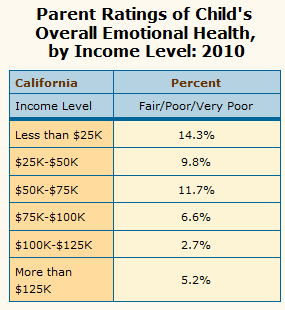
In a 2010 survey, California parents from low-income households were more likely than higher-income parents to rate their child’s emotional health as very poor, poor, or fair.
Depression can diminish the quality of a young person’s life, resulting in fewer friends, less social support, greater stress, and lower academic achievement. Evidence suggests that in adolescence, depression and suicidal behavior are linked. Depression also is linked to exacerbation of chronic illnesses such as asthma and diabetes.
See related data on kisdata.org:
- Parents’ perception of behavioral and emotional health>>
- Suicide and self-inflicted injury>>
- Depression-related feelings>>
Posted by Stacey Angeles
Post Comment
Celebrate School Nurses During Nurse Appreciation Week
This is Nurse Appreciation Week, a time to celebrate nurses in all arenas – emergency rooms, schools, homeless shelters, and many others – for their dedication to improving the health and well being of children and families across the country.
Nurses connect school children to health care resources and, in some cases, provide basic health care and screenings. Nurses work to ensure that children are healthy and have the support they need to be successful learners. In California, there is one school nurse for every 2,035 students, according to 2009 data.
See data on kidsdata.org about pupil support personnel >>
Posted by kidsdata.org
Post Comment
Roundup of Recent News Stories: Obesity, Injuries, Maternal Health

Following are some recent news highlights about children and families, along with related data from kidsdata.org:
Obesity (see related data):
- Report: Heart Health Has Become Increasingly Problematic for American Children
(HealthDay, 5/4/12, by Gordon) - First Grade Students More Inclined to Bully Overweight and Obese Students, Study Shows
(Health.com, 4/24/12, by Storrs)
- Obesity Rates for Children Ages Six and Under Steadily Decreasing, Studies Show
(Reuters, 4/24/12, by Norton)
- Study: Overweight Teens Struggle to Control Diabetes
(CBS, 4/30/12, by Chang)
- Low-Income Mothers May Overfeed Their Infants, Study Shows
(MSN, 4/28/12)
Injuries (see related data):
- Accidental Death Rates Decline Among Infants, But Rates Among Teens and Young Adults Remain Steady, Reports Show
(USA Today, 4/24/12, by Healy)
- Child Concussion Diagnoses Double, ER Data Show
(USA Today, 4/27/12, Tanner)
Maternal Health (see related data):
- Number of Babies Born to Painkiller-Addicted Moms Rising, Study Shows
(Reuters, 5/1/12, by Pittman)
- Study: Above-Average Weight and Blood Pressure in Mothers Poses Potential Risk to Pregnancy and Newborns
(WSJ, 4/12/12)
- Older Moms Increasingly More Likely to Have More than One Child, Study Finds
(MSNBC, 4/12/12, by Rubin)
- Study: Exposure to Air Pollution During Pregnancy May Increase Obesity Risk for Children
(Time, 4/17/12, by Park)
Posted by kidsdata.org
Post Comment
May 1 Marks Beginning of Asthma Awareness Month

Today is World Asthma Awareness Day, which marks the beginning of Asthma Awareness Month. Also, this week is National Air Quality Awareness Week, which has been declared by the National Weather Service and the U.S. Environmental Protection Agency to urge Americans to consider the impact of their actions on air quality and pollution.
Recent studies have shown that environmental pollutants put children at risk of developing serious illnesses. Children are especially vulnerable to toxic substances, as their systems are more fragile and their skin is more permeable. Air pollution from traffic, lead in old paints and plastic, pesticides, and chemical contaminants in tap water potentially can harm children’s health by causing respiratory disease (e.g., asthma), cognitive defects (e.g., mental retardation), and cancer.
Learn more about how air pollution affects children>>
Sites like AIRNow help to heighten air quality awareness by tracking the various types of pollution around the country and color coding regions by severity of the pollution.
See related data on kidsdata.org:
Posted by kidsdata.org
Post Comment
County Health Rankings Aim to Create a Healthier Nation, County by County

The County Health Rankings and Roadmaps program, a project of the Robert Wood Johnson Foundation, has created a useful tool that ranks counties across the U.S. by various health measures and factors that influence health. The project tracks a wide variety of indicators that are linked to health, such as education, income, and health care, and also offers information on strategies to create healthier places to live.
See where your California county ranks in terms of health factors and health outcomes >>
In California, the five counties with the highest overall ratings are as follows:
1. Marin
2. Santa Clara
3. Placer
4. San Mateo
5. San Benito
Kidsdata.org offers several indicators of health data for all counties in California. Find your county on our regions page.
Posted by Stacey Angeles
Post Comment