


Archive for the ‘Kidsdata News’ Category
Proportion of uninsured children in CA drops 40% in past five years
As 2015 comes to a close, Kidsdata is pleased to deliver some very good news: More California children than ever have health coverage. Between 2010 and 2014, the estimated percentage of children who were uninsured in California fell to 5%, a 40% drop, according to the most recent data available on Kidsdata and collected by the American Community Survey. The shift, which represents an estimated 350,000 more children who now have insurance coverage, is largely due to the implementation of the Affordable Care Act (ACA). California’s downward trend echoes national trends: across the country, the rate of uninsurance fell to 6%, a 25% drop, during the same time period.
Still, with nearly 500,000 children in the state lacking coverage, many gaps remain. An estimated 11 percent of American Indian/Alaska Native children, for example, were uninsured in 2014—double the percentage for all children and higher than all other racial/ethnic groups. Immigrant children, especially those with undocumented parents or those who are themselves undocumented, are at particular risk of being uninsured and without regular health care.
Children with health insurance are more likely to receive needed medical care and have improved school performance, and they are less likely to have costly hospitalizations. Providing high-quality, accessible, and affordable health care to children requires comprehensive insurance coverage for all children; an appropriately trained and compensated provider base, including a sufficient number of subspecialists; parental understanding about what care is needed and how to obtain it; and effective systems of care, including “medical homes.”
Continued, effective implementation of the ACA, including efforts to streamline enrollment and renewal processes, will influence progress in future years.
Related Data:
Health Care (summary)
- Delayed or No Medical Care
- Length of Time Since Last Routine Health Check-Up
- Visited the Emergency Room in Last Year, by Type of Insurance
- Uninsured at Any Point in Last Year
- Health Insurance Coverage (Regions of 65,000 Residents or More), by Type of Insurance and Age
- Medi-Cal Enrollment
- Medical Home Access (California & U.S. Only)
- Adequate Health Services Provided at School (Staff Reported)
- School Health Centers
Helpful Links
California Coverage & Health Initiatives
The Children’s Partnership: Children’s Health Care/Health Reform
California 2014 Children’s Health Insurance Fact Sheet, American Academy of Pediatrics and National Academy for State Health Policy
Children’s Coverage at a Crossroads: Progress Slows, Georgetown University Center for Children and Families
Children’s Health Insurance Program (CHIP): Accomplishments, Challenges, and Policy Recommendations, American Academy of Pediatrics Committee on Child Health Financing
Portrait of Promise: The California Statewide Plan to Promote Health and Mental Health Equity (PDF), California Dept. of Public Health, Office of Health Equity
Racial and Ethnic Disparities in the Health and Health Care of Children, American Academy of Pediatrics Committee on Pediatric Research
Kidsdata Tip
Want an overview of the most important data trends in children’s health this year? Find all of our 2015 advisories here.
Posted by kidsdata.org
1 Comment
How to Embed Kidsdata on Your Own Site
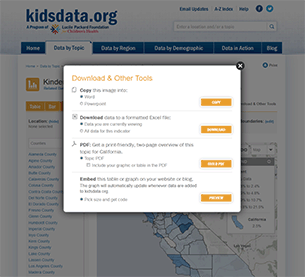 One of Kidsdata’s most helpful features is the ability to “embed” an interactive and customizable data visualization within your own website. Any time the data you select are updated on Kidsdata, your site will update automatically.
The process is simple. Just choose and modify the visualization you want, click on Download & Other Tools in the upper right corner of the graphic, and follow the short process to get the embed code. See this page for an example. The graphic on your site will retain the same functionality that is available on Kidsdata, so your users can customize and export data directly from your site.
Embedding is just one of several ways Kidsdata makes it easy to download and share data.
- Our PRINT option provides a printer-friendly version of your screen, including your customized visualization, along with contextual information about why the data are important, how children are faring, and policy implications.
- COPY tools insert your custom visualizations into Word documents or PowerPoint slides, complete with citations and links back to the site for easy reference.
- You can use our DOWNLOAD tools to export your data into Excel.
- Our PDF option offers a print-friendly overview of your selected topic, and can include customized visualizations.
- With a click on the icons below your data, you can SHARE information through Facebook, Twitter, or email.
- Another option is to just copy the selected URL from your browser and save, send, and share—your customization will remain intact.
Need more specific instructions or information about other useful Kidsdata features? See our brief videos.
Posted by kidsdata.org
Post Comment
Child care out of reach for an estimated 75% of children with working parents in CA
The mismatch between child care needs and availability in California is growing, according to data released today by a partnership between Kidsdata and the California Child Care Resource & Referral Network. The Network’s 2015 California Child Care Portfolio shows that in 2014, licensed child care was available for only an estimated 25% of children ages 0-12 with working parents in California. In some counties, availability was as low as 13%. In addition, the total number of slots available has declined in recent years—in the last year alone, the state lost the capacity to serve 18,000 children.
On top of that, many child care providers do not fill all of their slots due to shortages of qualified staff or other issues, and providers’ schedules do not always meet the needs of families. For example, in 2014, only 2% of licensed child care centers offered child care during non-traditional hours, including evening, weekend, overnight, flexible/rotating, or drop-in care. While family child care homes are more likely to provide care during non-traditional hours, they represent only about a third of the licensed child care slots in the state, and their numbers are on the decline, as well.
Research indicates that quality early care and education is related to higher levels of behavioral functioning, school readiness, academic achievement, and earnings. In such settings, children learn to relate to others and their environment while developing skills to successfully navigate social, emotional, and educational challenges.
However, finding affordable, quality child care is a major challenge for many families, and access differs based on geography, race, and income. In California, infant child care costs made up an estimated 14% of the median annual income for married couples and 44% for single mothers in 2013. In 2014, the average annual cost of licensed infant care was more than $13,000 in child care centers and nearly $8,500 in family child care homes. Care for preschool-age children was less expensive: more than $9,000 in child care centers and almost $8,000 in family child care homes.
To provide quality, affordable child care to all eligible children in the state, experts recommend increasing state funding for child care programs and tying that funding to measurable program quality. Other recommendations include providing full-day preschool for families with working parents, and properly training and supporting early child care educators and caregivers.
Related Data:
Early Care and Education (summary)
- Annual Cost of Child Care, by Age Group and Type of Facility
- Availability of Child Care for Potential Demand
- Availability of Child Care, by Facility’s Schedule and Type of Facility
- Number of Child Care Slots in Licensed Facilities, by Type of Facility
- Number of Licensed Child Care Facilities, by Type of Facility
- Parent Requests for Child Care, by Age
- Parent Requests for Evening/Weekend/Overnight Child Care
- Children Ages 3-5 Not Enrolled in Preschool or Kindergarten (Regions of 65,000 Residents or More)
- Children Ages 3-5 Not Enrolled in Preschool or Kindergarten (Regions of 20,000 Residents or More)
- Children Ages 3-5 Not Enrolled in Preschool or Kindergarten (Regions of 10,000 Residents or More)
Helpful Links
2015 California Child Care Portfolio, California Child Care Resource & Referral Network
California Child Care Resource & Referral Network
Community Care Licensing Division (CCLD) Facility Search, California Dept. of Social Services
Office of Child Care, U.S. Dept. of Health and Human Services, Administration for Children & Families
A Matter of Equity: Preschool in America (PDF), U.S. Dept. of Education
California Preschool Study, RAND Labor and Population
High Quality Child Care Is Out of Reach for Working Families, Economic Policy Institute
Putting it Together: A Guide to Financing Comprehensive Services in Child Care and Early Education, Center for Law and Social Policy
Starting Strong: Why Investing in Child Care and Development Programs Is Critical for Families and California’s Economic Future (PDF), California Budget & Policy Center
Kidsdata Tip
What else is new on Kidsdata? See a list of past advisories, which highlight new data and changing trends on our site. Want to make sure you don’t miss important updates? Sign up for our data e-alerts and email advisories.
Posted by kidsdata.org
1 Comment
Mental Health Once Again Most Common Cause of Hospital Admission Among CA Children
Nearly 40,000 California children ages 5-19, or 5 of every 1,000, were hospitalized for mental health issues in 2014, according to the most recent data available on kidsdata.org. In fact, since 2008, Mental Diseases and Disorders have accounted for the largest share of hospital admissions of children ages 0-17 in California.
These numbers only reflect the most acute mental health challenges (i.e., those requiring hospitalization). Other self-reported data suggest that the prevalence of less acute, but still distressing, mental health issues is even greater. Specifically, 30% of California students in 7th, 9th, and 11th grades, along with those in non-traditional schools, reported feeling sad or hopeless almost every day for two weeks or more during the past year, according to 2011-2013 data. When broken down by gender, the data show that 36% of girls reported depression-related feelings versus 23% of boys. And greater percentages of Native Hawaiian/Pacific Islander and Latino students reported depression-related feelings than students from other racial/ethnic backgrounds—35% and 32%, respectively.
Physical and mental health are intricately linked. Youth with depression are more likely to engage in suicidal behavior, drop out of school, use alcohol or drugs, and have unsafe sexual activity, in addition to having difficulties with school and relationships.
The vast majority of mental health problems begin in adolescence and young adulthood, with half of all disorders starting by age 14. Screening, early identification, and treatment are critical, as untreated mental illness can disrupt children’s development, academic achievement, and their ability to lead healthy, productive lives.
Experts recommend shifting from a focus on prevention and treatment of mental illness to promoting mental wellness. Mental health is influenced by socioeconomic, biological, and environmental factors, and promoting positive emotional health requires coordinated, cross-sector strategies that target underlying causes. Click here for a detailed list of policy recommendations.
Related Data:
Emotional/Mental Health (summary)
- Hospital Discharges, by Primary Diagnosis
- Hospitalizations for Mental Health Issues, by Age Group
- Depression-Related Feelings (Student Reported), by Grade Level
- School Emphasizes Helping Students with Emotional and Behavioral Problems (Staff Reported)
- Student Depression or Mental Health Is a Problem at School (Staff Reported)
- Students Who Are Well-Behaved (Staff Reported)
Helpful Links
MentalHealth.gov, U.S. Dept. of Health and Human Services
Parent’s Guide to Teen Depression, HelpGuide.org
Portrait of Promise: The California Statewide Plan to Promote Health and Mental Health Equity (PDF), 2015, California Dept. of Public Health, Office of Health Equity
Realizing the Promise of the Whole-School Approach to Children’s Mental Health: A Practical Guide for Schools, 2011, Education Development Center
Use of Medication Prescribed for Emotional or Behavioral Difficulties Among Children Aged 6-17 Years in the United States, 2011-2012, National Center for Health Statistics
Kidsdata Tip
Need to find something fast? Type your keywords into the search bar on our home page. Kidsdata offers data broken down by topic, region, and demographic group, but the search bar is sometimes the fastest route to finding your data!
Posted by kidsdata.org
Post Comment
Still too many SIDS deaths in CA
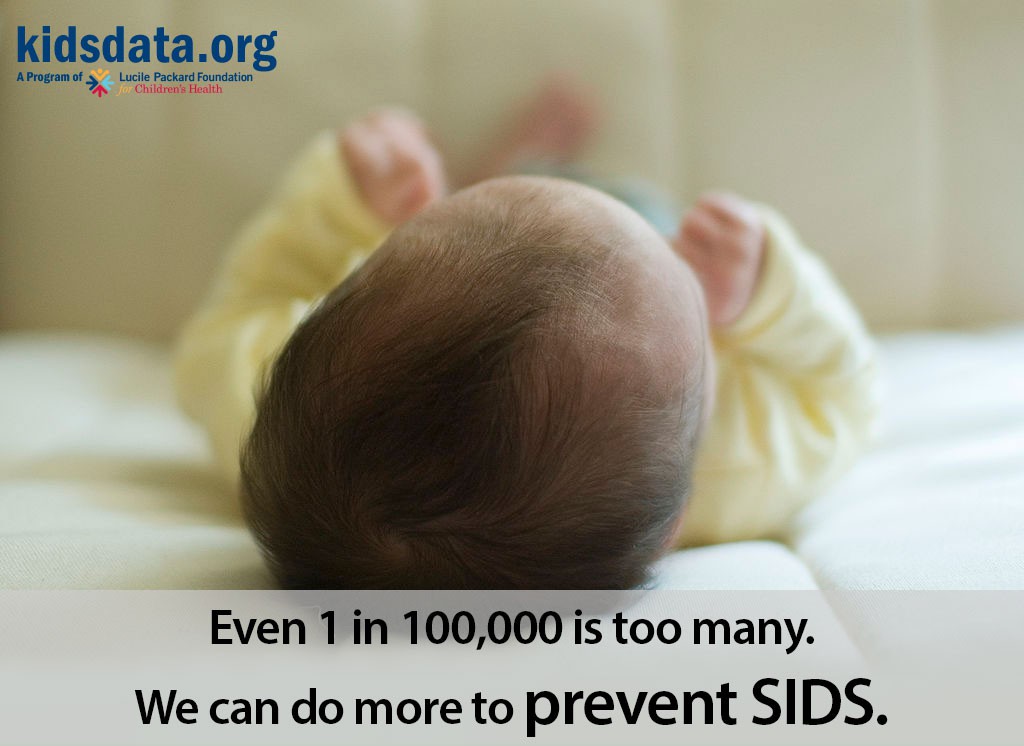
Sudden Infant Death Syndrome (SIDS) is the sudden death of an infant less than one year old that cannot be explained after a thorough investigation. Between 1996 and 2013, California saw a 50% decline in its rate of SIDS, Kidsdata reports this month for SIDS Awareness Month. Despite the decline, SIDS claimed 0.3 for every 1,000 live births—that’s 30 infants for every 100,000 born—in California in 2011-13.
SIDS is the state’s third-leading cause of death for infants, after birth defects and disorders related to short gestation and low birthweight. Between 1994 and 2013, California’s overall infant mortality rate fell by 33%, from 7.0 to 4.7. Nationally, the infant mortality rate has fallen by 25% since 1994, but at 6.0 deaths for every 1,000 births, the rate is still higher than most other developed countries (PDF).
Rates of infant mortality vary by race, with African Americans/Blacks as well as Multiracial children experiencing rates of 10.2, more than twice the rate for white, Latino, and Asian/Pacific Islander infants. Nationally, American Indians/Alaska Natives have the highest rates of SIDS, a disparity that the Centers for Disease Control and Prevention are addressing via its 1,000 Grandmothers Project, which encourages tribal elders to mentor young Native parents regarding safe sleep practices for babies.
Some of the leading causes of infant mortality, including Sudden Infant Death Syndrome, are preventable and can be addressed through public policy. California currently promotes newborn screenings for potentially fatal birth defects, as they can help avert long-term health consequences, and even death, through early identification and treatment.
Public policy also can affect the risk factors for SIDS and preterm births. Risk factors can be reduced through many different strategies, such as ensuring that women are in good health before conception, avoid smoking and substance abuse while pregnant, forgo elective deliveries before 39 weeks gestation, are provided with breastfeeding support, and that women and other caretakers are taught how to provide a safe, healthy living environment for infants.
Public education regarding SIDS should be culturally appropriate, and target a wide constellation of potential caregivers for infants to ensure that babies sleep on their backs rather than their stomachs, on firm mattresses without loose bedding, and that they sleep alone in a bassinet or crib rather than co-sleep with a parent or caretaker.
Related Data:
Infant Mortality (summary)
Helpful Links
Sudden Unexpected Infant Death and Sudden Infant Death Syndrome, Centers for Disease Control and Prevention, Division of Reproductive Health
Infant Mortality Toolkit, 2013, National Center for Education in Maternal and Child Health
International Comparisons of Infant Mortality and Related Factors: United States and Europe (2010) (PDF), 2014, Centers for Disease Control and Prevention, National Vital Statistics Reports
Preconception Women’s Health and Pediatrics: An Opportunity to Address Infant Mortality and Family Health, 2012, Academic Pediatrics
Understanding Racial and Ethnic Disparities in U.S. Infant Mortality Rates, 2011, National Center for Health Statistics
Kidsdata Tip
Want to feature a Kidsdata chart or map in your poster or presentation? Click the “Download & Other Tools” link on every indicator to copy images into Word, Powerpoint, Excel, or to create a PDF. You can also embed images directly onto your web site. Click here for more information.
Posted by kidsdata.org
Post Comment
California streets ‘home’ to 11,365 youth, 2015 count reveals
More than 10,000 transitional-age youth (ages 18-24) and nearly 1,000 unaccompanied minors (ages 0-17) were found to be living in places not meant for human habitation, such as cars, parks, abandoned buildings, transit stations, and on streets, during the 2015 national “Point-in-Time” homeless count in January.
For the past ten years, the US Department of Housing and Urban Development has required communities receiving federal funding for homeless prevention programs to conduct an annual count of homeless individuals within one 24-hour time period. For more information about the 2015 California count, read the California Homeless Youth Project’s full report, We Count, California!: Lessons Learned from Efforts to Improve Youth Inclusion in California’s 2015 Point-in-Time Counts (PDF).
Although critical to enhancing our understanding of the severity of this issue, the count of unsheltered homeless children and youth likely does not reflect the true extent of youth homelessness in California communities. For example, nearly 300,000 public school students in California, 5% of all public school students, were identified as homeless at some point during the 2013-2014 school year, per the McKinney-Vento Act education definition.
Homelessness contributes to a range of mental and physical health risks as well as academic challenges for children and youth. California has the second highest rate of homeless youth in the country and ranks 48th out of 50 states in addressing the issue. For example, two-thirds of California counties lack shelters for homeless youth.
Policies that can help alleviate youth homelessness include identifying families at risk of homelessness, offering housing support services to help families remain in their homes, explicitly addressing the needs of homeless students in Local Control and Accountability Plans, providing employment and job training for parents and youth, and connecting youth to trustworthy adults and/or support organizations.
Related Data:
Homelessness (summary)
- Unsheltered Homeless Youth (Point-in-Time Count), by Age Group
- Homeless Public School Students
- Very Young Homeless Children, by Age/Grade
Helpful Links
We Count, California!: Lessons Learned from Efforts to Improve Youth Inclusion in California’s 2015 Point-in-Time Counts (PDF), 2015, Lin, J., Petry, L., Hyatt, S., & Auerswald, C.
California Coalition for Youth (CCY)
California Youth Crisis Line (CYCL)
California Homeless Youth Project, California State Library, California Research Bureau, State of California
National Association for the Education of Homeless Children and Youth (NAEHCY)
National Center for Homeless Education (NCHE)
United States Interagency Council on Homelessness
Portrait of Promise: The California Statewide Plan to Promote Health and Mental Health Equity, 2015, California Department of Public Health Office of Health Equity
Child Trends Databank: Homeless Children and Youth
Kidsdata Tip
Need help with kidsdata.org? Watch our tutorials, send us an email or give us a call at (650) 736-0676. We’re here to help!
Posted by kidsdata.org
Post Comment
Childhood Cancer Diagnoses Rise in Northern California Counties
California’s rate of childhood cancer diagnoses has risen by 6% since the 2000-2004 time period, reaching 17.5 per 100,000 in 2008-2012. California’s upward trend in the rates of new cancer diagnoses of children/youth ages 0-19 closely mirrors that of the nation, but in a number of northern California counties, rates have risen precipitously between 2000-2004 and 2008-2012. Though not tested for statistical significance, in Napa and Marin counties, rates rose by 69% and 58%, to reach 22.8 and 21.5 per 100,000, respectively—the highest in the state. In San Mateo, Sacramento, Sonoma, and San Francisco, all counties with incidence rates of about 20 per 100,000, rates rose between 20-39% during the same period.
The state’s childhood cancer diagnosis rate varies by ethnicity: white children have the highest rate (19.2 per 100,000), compared to Native American children, who have the lowest (12.2 per 100,000). When it comes to cancer survival however, white children have the highest five-year survival rate (84%) compared to African American children, who have the lowest survival rate (75%).
Similar to adults, survival disparities for children with cancer may be associated with socioeconomic status, health coverage, early diagnosis, quality of care, and genetic factors.
To ensure that all children afflicted with cancer have the best possible health care, policies should prioritize providing care in the context of a “medical home,” supporting pediatric centers of excellence, supporting quality of life services, and working toward a unified, efficient, and comprehensive payment system for cancer treatment. Currently, families must navigate a complicated web of service systems with confusing payment policies, which can result in delayed or denied services for children and financial hardship for families.
Related Data:
Cancer (summary)
Helpful Links
California Cancer Registry, California Dept. of Public Health
National Cancer Institute: Childhood Cancers, National Institutes of Health
Cancer and the Affordable Care Act, 2015, American Society of Clinical Oncology
Costs of Environmental Health Conditions in California Children, 2015, California Environmental Health Tracking Program
Long-Term Survivors of Childhood Cancers in the United States, 2009, Cancer Epidemiology, Biomarkers & Prevention, Mariotto, A. B., et al.
Kidsdata Tip
September is Childhood Cancer Awareness Month. Follow kidsdata on Facebook and Twitter to learn more. Cancer is California’s second-leading cause of death for children ages 5-14.
Posted by kidsdata.org
Post Comment
Nearly 4,000 Foster Children in California Living in Group Homes
Children fare best in families. The same holds true for children in the child welfare system. The Adoption Assistance and Child Welfare Act of 1980 was meant to ensure that children in the child welfare system grow up in families—cared for in their own homes or the homes of relatives whenever possible, or in new permanent homes if not. (See First Entries into Foster Care in California, by Type of Placement.)
To preserve the well-being of children who enter the system, out-of-home placements must be in the setting that most closely resembles family life. While the vast majority (more than 80%) of foster children in California are living in family-like placements (i.e., in Foster Homes or Foster Family Agency Homes, with Guardians or Kin-Relatives, or in Pre-Adoptive families), between 1998-2014, the proportion of children living in these types of placements did not grow; rather, it saw a slight decline.
That means that each year, there remains a substantial number of foster children living in non-family placements, such as shelters, group homes, and other congregate or temporary placements. In 2014, there were nearly 4,000 foster children living in group homes, one of the least optimal placement options.
The U.S. foster care system aims to provide temporary living arrangements for children while attempting to safely reunite children with parents, or to find other permanent homes. In reality, many foster children spend years in the system, and move between multiple homes. Children age 6-20, as well as those with disabilities or illnesses, and those of African American and American Indian descent, comprise a disproportionate number of youth in the foster care system (see links below). Children in the system face higher risks of physical and mental health problems as well as academic barriers.
To provide all children with safe, permanent homes, policymakers can ensure that prevention services, mental health resources and educational support are available to foster children, their biological parents, and their foster parents. Efforts should also be made to recruit and support foster families who are kin to the children in their care, as well as non-kin families who are well-suited to provide homes to these children in need.
Related Data:
Foster Care (summary)
- First Entries into Foster Care
- Number of Children in Foster Care
- Length of Time from Foster Care to Adoption
- Median Number of Months in Foster Care
- Placement Distances from Home
- Placement Stability, by Number of Placements
- Re-entries into Foster Care
- Exit Status After One Year in Foster Care
- Exit Status After Four Years in Foster Care
Helpful Links
Every Kid Needs a Family: Giving Children in the Child Welfare System the Best Chance for Success, 2015, Annie E. Casey Foundation
Children and Family Services Division, California Dept. of Social Services
At Greater Risk: California Foster Youth and the Path from High School to College, 2013, Stuart Foundation, Frerer, K., et al.
From Foster Home to Homeless: Strategies to Prevent Homelessness for Youth Transitioning from Foster Care, 2014, Jim Casey Youth Opportunities Initiative
Immigration and Child Welfare, 2015, U.S. Dept. of Health and Human Services, Child Welfare Information Gateway
Strategies to Reduce Racially Disparate Outcomes in Child Welfare, 2015, Center for the Study of Social Policy, Alliance for Racial Equity in Child Welfare, Miller, O., & Esenstad, A.
Kidsdata Tip: Get Custom Data Delivered to Your Inbox
Did you know you can sign up for customized e-mail updates that will let you know when we have new data related to your interests? Just sign up here.
Posted by kidsdata.org
Post Comment
Not All Kids Are Going Back to School
Of the California students who entered high school in 2010, 12 percent, or one in every eight students, dropped out before graduation, according to the most recent data available on kidsdata.org.
Twelve percent is high, but dropout rates among students from some racial/ethnic backgrounds are even higher. Rates among African American and American Indian students are nearly double the state average—at about 20 percent, or one in five students, according to 2014 data. Latino and Native Hawaiian/Pacific Islander students, as well as English Learners, youth in foster care, and special education students, also have high rates of non-completion.
Research shows that students who drop out of high school are more likely to struggle with employment, live in poverty, have poor health, and engage in criminal activity than those with higher education levels. Society also faces associated costs in terms of increased spending on public assistance and lower tax revenues. In California, students dropping out of high school costs the state an estimated $46 billion annually.
Students don’t finish high school for a variety of reasons. Risk factors include behavioral problems, suspension, and course failure. Underlying causes for these factors may be related to chronic health or mental health conditions, poverty, and other issues. Children at risk of poor educational outcomes can be identified early and supported to stay engaged in school. School-based health services can address student health issues and promote social and emotional skills.
Policymakers also can ensure effective implementation of California’s Local Control Funding Formula (LCFF). Signed into law in 2013, LCFF moved decision-making power over K-12 spending from the state to the school districts. LCFF allocates additional funding to districts serving students with increased educational needs, such as low-income, English Learner and foster youth students.
Researchers also recommend avoiding a “zero tolerance” school discipline approach, and instead suggest implementing discipline policies that are non-punitive, transparent, fair, consistent, and aim to keep students in school when possible.
Related Data:
Helpful Links
California Dropout Research Project, UC Santa Barbara, Gervitz Graduate School of Education
Everyone Graduates Center, Johns Hopkins University’s School of Education
Back to School: Exploring Promising Practices for Re-engaging Young People in Secondary Education, 2014, Center for Promise at America’s Promise Alliance
Black Lives Matter: The Schott 50 State Report on Public Education and Black Males, 2015, Schott Foundation for Public Education
Don’t Call Them Dropouts: Understanding the Experiences of Young People Who Leave High School Before Graduation, 2014, America’s Promise Alliance and the Center for Promise at Tufts University
In School + On Track: Attorney General’s 2014 Report on California’s Elementary School Truancy & Absenteeism Crisis, 2014, California Department of Justice, Office of the Attorney General
Transitions from High School to College, 2013, The Future of Children, Venezia, A., & Jaeger, L.
Building a Grad Nation: Civic Marshall Plan State Indices and Annual Updates, 2015, Every1Graduates.org, Johns Hopkins University’s School of Education
Kidsdata Tip
How do YOU use kidsdata? See examples of Data in Action and tell us your story!
Posted by kidsdata.org
Post Comment
Archived Webinar: Vaccination and Vaccine-Preventable Childhood Diseases: Data and Trends
The recording of our July 8 webinar on vaccine-preventable childhood diseases, with a special focus on California data, is now available.
California has 39% of the nation’s whooping cough cases. Vaccines are one of the simplest, most cost-effective tools to improve public health. This webinar explored trends in vaccination and vaccine-preventable childhood diseases and the policy implications of these trends.
Regan Foust, Senior Manager for Data and Research at the Lucile Packard Foundation for Children’s Health, highlights trends for the U.S. and California and gives an overview of kidsdata.org. Beth Jarosz, research associate at the Population Reference Bureau, and Reshma Naik, senior policy analyst at the Population Reference Bureau, present trends in vaccination coverage and vaccine-preventable childhood diseases for major world regions.
Questions? Email us at [email protected]. To sign up for announcements of upcoming webinars, data alerts and other news from kidsdata.org, click here.
RELATED CONTENT:
California Home to 39 Percent of Nation’s Whooping Cough Cases
National Immunization Awareness Month: Data and Resources from Kidsdata.org
Posted by kidsdata.org
Post Comment