


Archive for August, 2012
News Roundup of Recent Stories: Palliative Care, Asthma, Vaccines
Following are some recent news highlights about children and families, along with related data from kidsdata.org:
Palliative Care (see related data):
- Palliative Care Agency Provides In-Home Assistance to Children
(Healthycal.org, 8/7/12, by Flores) - UCLA Study: Pilot Medi-Cal Program Reduces Hospital Time and Costs, and Increases Quality of Life for Children and Families
(LA Times, 8/29/12, by Knoll)
Asthma (see related data):
- Asthma-Resistant Therapy May Be Caused by Poor Adherence to Therapy, Environment
(Family Practice News, 8/28/12, by Boschert) - Study: Child’s Risk of Asthma Associated with Smoking During Pregnancy
(HealthDay News, 8/22/12, by Dotinga) - Study: Asthma Risk Associated with Exposure to Certain Types of Mold
(HealthDay News, 8/10/12, by Dallas) - Common Asthma Drug May Help Children with Sleep Apnea
(Web MD, 8/7/12, by Mann)
Vaccines (see related data):
- Bill to Make Acquiring Vaccine Exemption More Strict Passes California Senate, Moves to Assembly
(KQED, 8/23/12, by Aliferis) - Whooping Cough Vaccination Required for Incoming California 7th Graders
(Bay Citizen, 8/3/12, by Lin) - Report: Most U.S. Kindergartners Get Vaccines, but Unvaccinated Children Still Cause Health Risks
(Reuters, 8/23/12, by Beasley)
Posted by Stacey Angeles
Post Comment
National Immunization Awareness Month
 August is National Immunization Awareness Month. Immunizations are among the most successful and cost-effective preventive health care interventions, according to the U.S. Department of Health and Human Services.
In California, the three counties with the highest percentage of kindergarteners who received all immunizations required for admission to school in 2010 include Colusa County (96.5%), Tulare County (96.4%), and Kings County (96.2%), according to kidsdata.org.
Other counties, however, had immunization percentages that were much lower. In some counties, less than 75% of kindergarteners received all required immunizations. See immunization data by county>>
View this one page printable fact sheet to learn more about immunizations in California.
To help inform parents and children about immunization, the Centers for Disease Control and Prevention has provided downloadable fact sheets, flyers, and immunization schedules for children and teens.
See related data:
– Kindergarteners with all Required Immunizations 2010
– Why Immunization is Important
Posted by Lindsey Nguyen
Post Comment
Data by County: The State of Children’s Health
 The UCLA Center for Health Policy Research just released printable one-page profiles on child and teen health in California counties. The downloadable PDF summaries provide easy-to-read snapshots about children’s health for every county, using 2009 data from the California Health Interview Survey. These summaries provide numbers on childhood and teen obesity, asthma, how often children engaged in physical activity, and more.
For more easy-to-use data on key health indicators for kids, view PDF summaries for a variety of topics provided by kidsdata.org.
Posted by kidsdata.org
Post Comment
A Snapshot of Children’s Physical Fitness in California
A look at kidsdata.org shows that 38% of all California 5th, 7th, and 9th graders were considered overweight or obese in 2010 according to federal standards.
In addition, only 32% of California 7th graders met all fitness standards in 2011. In order to meet the standards of the California Fitness Test, students must score in the “Healthy Fitness Zone” on 6 out of 6 tests. According to our recent weight and fitness data advisory, 25% of 5th graders, 32% of 7th graders, and 37% of 9th graders met all state fitness standards.
Despite these statistics, severe budget constraints have meant that many California schools have cut gym classes from their budgets or are considering doing so, according to an article by New American Media.
Physical activity is vital for children. Regular exercise helps build healthy bones and muscles, lowers the risk of becoming obese, and promotes overall psychological and physical well-being, according to the Centers for Disease Control and Prevention. Kids who exercise at an early age also increase their odds at maintaining this healthy habit as adults.
See related data on kidsdata.org:
– Students Meeting All Fitness Standards by Grade Level: 2011
– Overweight/Obese Students (Federal Definition): 2010
– Weight and Fitness Data for Students in Your Community Advisory 2012
Posted by Lindsey Nguyen
Post Comment
The California Budget Challenge
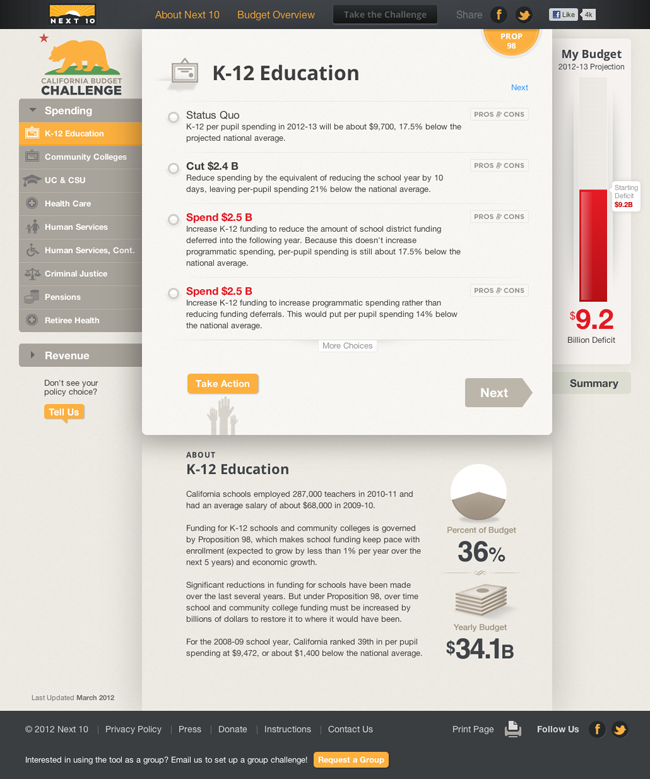 Next 10, a nonpartisan organization dedicated to educating the public about state policies and civic engagement in California, has released the updated California Budget Challenge: an interactive, online tool that allows users to allocate the state’s funds as they see fit while also keeping in mind how to finance their decisions.
This year’s budget balancing tool is sleek and easy to navigate, but the challenge itself is a difficult task. With a $15.7 billion starting deficit, the introduction of voter propositions, and the ability to see how your decisions would affect California citizens in real-time, the challenge is much harder than at first glance. This, however, is all part of Next 10’s effort to make the tool resemble the real process of creating the 2012-2013 California state budget.
There are more than 10 sections of the budget that users must work with to make spending and revenue-increasing decisions. Users can analyze four or more options to “cut” or “spend” any section of the budget or, if they prefer, to keep the ongoing policy. A detailed summary about the section, voter propositions, and a “pros and cons” tab helps users weigh their options. Depending on what you choose, a red bar will indicate an increase or decrease to the deficit. Users also can dip into the reserve if they believe all of their decisions are necessary. Not only is this an interesting, fun way to see how balancing our state budget works, but also it is an engaging way to learn more about state policies—what they are, why they are important, and whom they affect.
If users are happy with their final budget, they can choose to send their proposed solutions to California’s elected officials.
Think you’re up for the challenge? Give it a try here.
Posted by Lindsey Nguyen
Post Comment
Celebrate World Breastfeeding Week 2012
 This week, August 1st through August 7th, marks the 20th anniversary of World Breastfeeding Week. Though health organizations such as the American Academy of Pediatrics and the World Health Organization support exclusive breastfeeding for at least the first six months of a child’s life to receive the full health benefits, only a little more than half of newborns (56.8%) in California were exclusively breastfed in the hospital after birth, according to 2010 data.
Counties with the highest percentages of exclusively breastfed infants include Trinity County (87.1%), Shasta County (86.7%), and Nevada County (85.6%).
According to 2010 data, 74% of Caucasian/white infants and 67% of multiracial infants in California were breastfed exclusively in the hospital after birth, the highest percentages of all racial/ethnic groups with available data.
Infants who are breastfed receive protection against infections, allergies, and other serious health conditions. In addition, studies have shown that breastfeeding helps mothers in the recovery process post-childbirth, can reduce the risk of breast and ovarian cancer, and may even minimize the chances of developing diabetes and cardiovascular disease.
Breastfeeding is not recommended, however, for women who use certain prescription drugs, test positive for HIV, or have active, untreated tuberculosis.
For more information on breastfeeding, please visit the breastfeeding section on kidsdata.org.
Posted by Lindsey Nguyen
Post Comment