


Archive for the ‘Kidsdata News’ Category
Just Announced: RFP from kidsdata.org on Using Data to Improve Health of CA Children
 We just announced the following RFP:
The Lucile Packard Foundation for Children’s Health seeks proposals for up to $10,000 from nonprofits, government-based organizations, university-based entities, or collaboratives for projects that use quality data, including data from the foundation’s kidsdata.org website, to enhance the health and well being of children and families in California. Projects can address a specific community/region or the state as a whole. More information
Projects may involve a range of activities:
- Data development/improvement
This is the first time our foundation has offered RFPs associated with kidsdata; we look forward to seeing the proposals. So if you have a project in mind that makes use of data to promote children’s health and well being, we encourage you to apply by Monday, Nov. 1, 2010.
Application instructions and more details >>
Posted by Andy Krackov
Tags: News About Kidsdata.org
Can’t Find What You’re Looking For?
We just added a help page to kidsdata.org, including a brand-new kidsdata.org tutorial. If you can’t find the data you’re looking for, or want to learn more about the features available on kidsdata, we recommend a visit to that page.
The tutorial is a brief video that gives a tour of the site, pointing out some of the most useful features.
Still can’t find what you’re looking for after taking the tour? Ask a question on our Data Points page, or contact us — we want to help!
Posted by Felicity Simmons
Post Comment
Health Care Reform for Kids Begins Now
 |
This video about health reform from the Kaiser Family Foundation notes changes coming now and in the future. |
Several key aspects of national health care reform will take effect this week – including two important provisions for kids.
- Insurance companies no longer will be able to deny coverage to children with pre-existing conditions.
- Parents can keep children on their health insurance policies until age 26.
In addition, several other reforms will be implemented this week that will surely help families.
A few highlights:
- Insurers will not be able to charge co-payments, deductibles or co-insurance for certain preventive care.
- Insurance companies cannot drop coverage for people who are sick.
- There will no longer be lifetime limits on coverage.
For more information and explanation about health reform laws, visit http://www.healthcare.gov.
Also, the Kaiser Family Foundation has created a comprehensive and easy-to-use online tool that, among other features, offers timeline noting when each aspect of reform begins. http://healthreform.kff.org/
Posted by Felicity Simmons
Tags: Child Health Issues
Using Kidsdata.org to Advocate for Your School District
Are you a PTA member? Work for an education foundation? Advocate for education improvements?
If so, kidsdata.org can help you. The site offers wide-ranging data about students statewide – at the county and school district levels. You can use these data to monitor trends, assess needs, educate your constituents, and advocate for improvements.
Examples of Data Available for School Districts Across California:
(Click “see related data” on the pages below to see all available indicators for that topic)
- Student Reports of Bullying & Harassment | Gang Involvement and Perceptions of School Safety — among the indicators that are available from the California Healthy Kids Survey (CHKS).
- Special Education Enrollment
- Math Proficiency | Reading Proficiency
- Enrollment in the Free/Reduced Price Meal Program
- Weight Scores | Fitness Scores
Data can be viewed as maps and tables or bar, trend, and pie graphs, and many measures can be customized by locale, year, ethnicity, grade, and more. You even can obtain summaries of data for every school district in California — and customize those summaries to suit your needs.
Posted by kidsdata.org
Tags: News About Kidsdata.org
The Great Divide Between Parents’ Worst Nightmares and What Really Happens to Kids
 Bad things happen, and for parents, every news flash and tragic headline can make them fear the worst about their child’s safety. What is the greatest fear you have for your child? Terrorists? Dangerous strangers? According to a recent article on NPR, these are among the more common fears that parents have. But they’re extremely detached from reality, experts say, and many parents may not be paying enough attention to everyday risks, instead focusing on and fearing these unlikely scenarios.
Topping the list of parents’ greatest fears are kidnapping, school snipers, and terrorists, when in reality, the most common cause of death or harm to children is car accidents. This misplaced focus on the extremely unlikely is detrimental to kids because it distracts parents from the dangers that matter, says Christie Barnes, author and mother of four, whose work was featured in the NPR article. By focusing their energies instead on the simple, everyday safeguards to a child’s health – such as buckling them up in the car or teaching them proper pool safety – parents can take charge of their child’s well being.
Here are the top five ways kids are hurt or killed in this country, accompanied by related data for kids in California:
1. Car accidents. Unintentional injuries, including accidents, were the leading cause of death in ’07 among CA kids of all ages
2. Homicide. Accounted for 39 deaths of CA kids ages 5-14 in ’07 – and 388 among California kids ages 15-19
3. Abuse. In California, there were 97,220 substantiated cases of child abuse in ’08
4. Suicide. 383 children/youth ages 5-24 committed suicide in ’07
5. Drowning. There were over 25,000 hospitalizations due to unintentional injuries, including drownings, in CA among kids under age 20 in ’06
Posted by Jordan Handcox
Post Comment
School Support Personnel: Gains Mask Needs
What to make of the fact that here in California, we have higher numbers of school support staff (counselors, psychologists, nurses, librarians, social workers, resource specialists, and speech/language/hearing specialists) than a decade ago?
If we were placing bets, most of us probably would guess that over the last decade, schools’ ability to offer resources beyond the classroom would have diminished, perhaps even greatly.
But we’ve made gains – no doubt about that. California students’ access to support staff improved from a ratio of 340 students to 1 pupil support personnel in ’98 to 211:1 in ’09.
Despite that progress we still have a long way to go – and that may be the key take-away from these data. After all, when measured up against national recommendations, we’re not doing well in California. For example, while the students-to-counselor ratio improved markedly from ’98 to ’09, the actual ratio – 668:1 in 2009 – is much worse than the American Counseling Association’s recommendation of 250 to 1. Likewise, there are more nurse FTEs in our schools – about 25% more in ’09 than ‘98. However, California’s 2009 ratio of nurses per student – 2,035:1 – is nearly three times worse than the Centers for Disease Control and Prevention recommendation of 750 students per nurse.
And keep in mind, too, that the pupil support indicators on kidsdata, while quite recent, may not yet take into account the ramifications from the Great Recession. In the graph above, it’s hard to miss the fact that the growth in pupil support FTEs stalled in 2009. We’ll check back next year to see what 2010 data tell us.
Student support staff provide a crucial range of services. Counselors offer prevention programs; speech/language/hearing and resource specialists work with children who have special needs; and nurses serve as a link to health resources and often provide basic health care and screening.
As the increasing poverty rate due to recent economic woes takes its toll on children, these kinds of in-school services are all the more crucial. Are school budgets so lean now that we’re finding it harder to address students’ overall well being? We can see what’s happening statewide – gains followed by a possible retrenchment – but we want to hear your local insights. Please add a comment below or on kidsdata’s Facebook page.
Posted by Andy Krackov
1 Comment
News Round-Up Features Articles About Autism, Whooping Cough, Special Needs, and More
The September issue of the Kidsdata News Round-Up now is available — read it here.
A few highlights:
Autism
Mother of Autistic Child Shares Back to School Stories and Struggles
(SF Chronicle, 8/26/10, by Shumaker and Winegardner)
Immunizations (Whooping Cough)
San Francisco Public Health Department Plans to Order Unvaccinated Kids to Stay Home if Classmates Get Whooping Cough
(Bay Citizen, 8/17/10, by Mieszkowski)
Vaccination Rates Remain Steady, but Cases of Whooping Cough Are Surging Nationwide
(NY Times, 8/16/10, by Parker-Pope)
Special Health Care Needs
Schwarzenegger Announces Launch of Nation’s Largest ‘Telehealth’ System; Will Make Specialty Care More Accessible for Children with Special Needs in Medically Under-Served Areas
(LA Times, 8/18/10, by Hennessy-Fiske)
Young Adults with Special Needs Find it Hard to Part with Their Pediatrician
(WSJ, 8/10/10, by Beck)
Posted by Jordan Handcox
Tags: Child Health Issues
September is National Childhood Cancer Awareness Month
 Having a loved one diagnosed with cancer can turn a family’s life upside down, especially if that loved one is a child. A child’s days are supposed to be spent playing and learning about life’s wonders, not sitting in a hospital awaiting painful chemotherapy treatments.
To help raise awareness, September is recognized as Childhood Cancer Awareness Month; we thought we would mark the occasion by highlighting data on childhood cancer in California.
More than 8,500 children in California were diagnosed with cancer from 2002-2006, the most recent period for which data are available. Moreover, the rate of childhood cancer diagnoses increased 49% from the 1997-2001 period to the 2000-2004 period; it held steady from 2000-04 through 2002-06.
Among California children diagnosed with cancer from 1996 through 2006, an estimated 76% survived for at least five years after their diagnosis. Survival rates vary by type of cancer. The most common form of childhood cancer, by far, is Leukemia.
Caucasian/White children have the highest rate and number of cancer diagnoses of all racial/ethnic groups, but also the highest survival rate.
Share these data with your colleagues, friends, and family members to help raise awareness about childhood cancer.
Posted by kidsdata.org
Post Comment
Effective Advocacy: Turning Data into Stories that Work
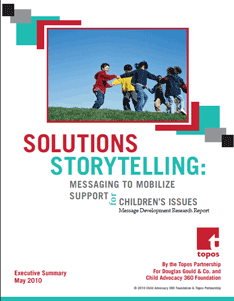
At kidsdata.org, we aim to give you the data you need to tell the stories you need to tell, whether those stories are about policies that need to change, programs that need support, or issues that need attention. New research commissioned by Child Advocacy 360 sheds light on the kinds of stories that move people to action on behalf of children and youth.
According to this report, child advocates will be most effective when they tell stories focused on solutions, not just problems. In their efforts to raise awareness about the problems facing many children and youth, advocates may undermine their effectiveness, leaving people with a feeling that “nothing works.” In contrast, effective stories about the many programs and policies that make a difference for children achieve the following:
- Connect to the Community: Help people see how communities can address the problems children face, rather than seeing children only in the context of individual families
- Help People See the Big Picture: Highlight several kinds of solutions to problems, or illuminate the role of public structures in solving the problem
- Reinforce the Need: Stories position the solutions they’re advocating as necessary, not just nice
- Invite and Inspire Action: Offer examples of people who are doing what you want others to do
- Demonstrate Effectiveness: Provide evidence that the proposed solutions work
You can find a video highlighting the report’s key findings, along with the full report and recommendations for advocates, here: http://sparkaction.org/content/telling-right-stories-new-national-research-messaging-child-advoc
How do you weave data into compelling stories? Please share your own examples from grant proposals, public testimony, letters to the editor, etc.
Posted by Sarah Marxer
Post Comment
Tough Economy May Threaten CA Child Care Supply
Imagine losing a trusted, licensed child care provider for your toddler because their home – their place of business – was foreclosed. Then imagine finding a new provider, only to be laid off from your job.
This is a true story highlighted in a press release by the California Child Care Resource & Referral Network. According to their 2009 California Child Care Portfolio, an already tight supply of quality, licensed child care in California is getting even harder to find due to the economic downturn.
Despite a roughly 20 percent increase between 2000 and 2008 of licensed child care facilities and the number of slots within those facilities, licensed child care in California was available for only 27 percent of children ages 0-13 with working parents.
Of course, not all working parents require licensed child care, but the potential demand for child care still far outweighs supply. In a time when foreclosures are high and jobs are hard to find, difficulty finding child care puts additional strain on working families.
Some other highlights from the newly available childcare data on kidsdata.org:
- From 2000 to 2008, the number of licensed child care facilities – and the number of slots within those facilities – increased by about 20 percent statewide. However, due to shortages of qualified staff and other issues, many child care providers do not fill all of their slots; therefore, the number of slots may overestimate the available care.
- In 2008, licensed child care in California was available for 27 percent of children ages 0-13 with working parents. As noted above, not all children with working parents need licensed care; some may be cared for by family members, nannies, or others.
- Almost 10 percent of parents statewide request child care during the evenings or weekends, according to the 2009 California Child Care Portfolio, and only 1-2 percent of licensed centers offer this type of care.
- While family child care homes are more likely to provide care during evenings or weekends, they represent only about a third of the licensed child care slots in the state.
On kidsdata.org, you can find child care data for counties statewide, as well as a “dashboard” of data highlights on child care in California. And please add a comment below to share your insights or experiences regarding child care issues in California.
Posted by kidsdata.org
Post Comment