


Archive for the ‘Kidsdata News’ Category
Interactive Map Displays Distribution of Wealth in California
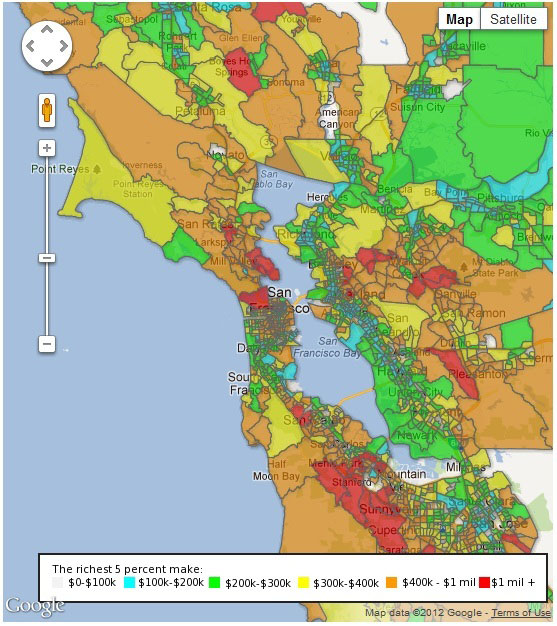
The Bay Citizen published this intriguing map on the distribution of California’s wealthiest neighborhoods. Ten of the richest areas are in San Mateo County, making it the county with the largest amount of wealthy neighborhoods in California. These hyper-local data, which provide income breakdowns for census tracts across the state, are based on 5-year estimates from the Census Bureau’s American Community Survey. See the level of wealth where you live>>
Related Data from Kidsdata.org:
Data on families’ ability to meet self-sufficiency standards>>
Posted by kidsdata.org
Post Comment
2011 Index on Child Well Being Notes Losses in Family Economics
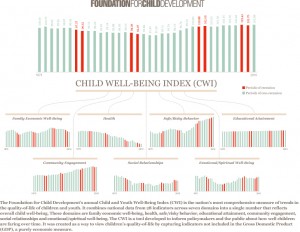
The Foundation for Child Development released its annual Child and Youth Well-Being Index for 2011. The index, compiled by Duke University’s Kenneth Land, provides a summary measure of how child well being has evolved over time in the U.S.
According to the 2011 index, children are struggling with social and economic instability. Some of the key findings from the report include:
- Families have lost all economic gains they’ve made since 1975, and are likely to continue losing ground.
- The percentage of children living in poverty stands to increase.
- There has been no substantial improvement in health insurance coverage for children. Seven million American children are still uninsured, and the number is growing.
- As additional funding from the Federal Stimulus Package ends, conditions may deteriorate further for children if federal and state governments don’t make investments to fill this gap.
In 2009, our foundation commissioned Prof. Land to create the California Index of Child and Youth Well-Being. See our index>>
Also see: Related data on kidsdata.org:
Posted by kidsdata.org
Post Comment
Some Recent Enhancements: Fact Sheets, Leg Map Overlays and Data Alerts
As we gear up for some large-scale enhancements to kidsdata.org in 2012, we thought we should highlight some recent improvements our foundation has made to the site, based on input from our users.
Legislative Map Overlays
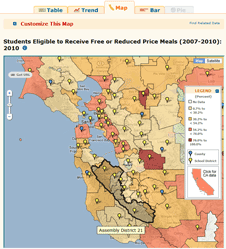
Last fall, we launched a mapping tool that makes it easy to overlay legislative district boundaries over other data sets. This tool allows you to select the data you want and then add legislative borders, so that you can visualize what’s happening in one or more Congressional, State Senate, and Assembly districts statewide. More info >>
See a step-by-step tutorial on how to use this legislative map overlay tool >>
One-Page Fact Sheets
One-page fact sheets now are available in an easy-to-print PDF format and provide a concise summary of data for each of our 60+ topics, 1,800 regions (every county, city, school district, and legislative district in California), and 10 demographic groups. The data summaries, designed to be one page (front and back), are populated with continually updated data, and are valuable for a variety of uses: Quick, up-to-date handouts about the status of children for meetings or advocacy work; inexpensive brochures for events and presentations; and offline reference material about children’s health in your community. More info >>
Data E-Mail Alerts
With e-mail alerts, you will know whenever data about kids in your community are updated on kidsdata.org. Only interested in children in Los Angeles? Or San Jose? Or Clovis Unified? Perhaps your work focuses on a particular topic — child abuse, or asthma, or education? Sign up to receive an e-mail alert from us as soon as data that you select are updated. More info >>
Policy Implication and Research Links
Because Kidsdata.org offers literally millions of data points, kidsdata.org added two sections to the website that put the data into context and offer options for taking action on issues. Policy Implications are summaries of evidence-based policy options for addressing issues. Research & Links provide key websites, additional research, and reports related to each topic. More Info>>
Stay tuned through this blog for news of other enhancements we’ll be adding to kidsdata.org in the coming year – and if you have any recommendations for features you’d like to see on this site, please add them as comments below.
Posted by kidsdata.org
Post Comment
Report Details Recession’s Impact on U.S. Kids
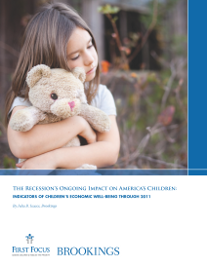
A new report published by the Brookings Institute discusses the economic toll of the recession on kids in California and throughout the United States. The data evaluated in the report, The Recession’s Ongoing Impact on America’s Children, is gathered by measuring three state-by-state indicators: children with an unemployed parent, individuals receiving nutrition assistance benefits, and child poverty.
According to the report, an estimated 6.5 million U.S. children under the age of 18 live in families where a parent was unemployed during at least one month of 2011, and more than 1 million of these children live in California.
Additionally, 8 million more children received supplemental nutritional assistance in 2011 than four years prior, indicating that children’s overall economic well-being has declined from 2010 to 2011.
Related Data on kidsdata.org:
• See more data about child homelessness >>
• See more data about family income and poverty >>
• See more data about unemployment >>
Posted by kidsdata.org
Post Comment
An In-Depth Look at Weight, Poverty, Special Ed, and Foster Care/Child Abuse
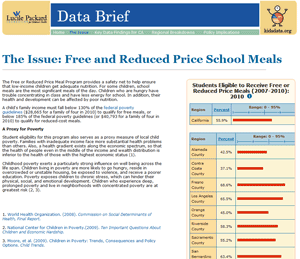 Kidsdata.org, a program of the Lucile Packard Foundation for Children’s Health, has just posted Data Briefs on four key topics in children’s health. Each brief includes:
- Recent California/local data
- A description of the importance of the issue
- Links to related research
- A summary of high-level policy implications
These Data Briefs also include printable fact sheets on each topic.
Data recently posted to kidsdata.org show declining rates in California of both substantiated (verified) cases of child abuse/neglect and of first entries into foster care, both of which are important measures related to child welfare.
Free and Reduced Price School Meals
In almost every California county, the percentage of public school students eligible for the free or reduced price meal program increased from 2008 to 2010. More than 3.4 million California public school students in 2010 were eligible for this program, which is a proxy measure for poverty.
In California, the percentage of public school students meeting all six state fitness standards has improved over the last decade for 5th, 7th, and 9th graders. Despite these improvements, nearly 40 percent (38%) of 5th, 7th, and 9th graders in California were overweight or obese in 2010, and this prevalence largely held steady between 2005 and 2010.
About one in 10 California public school students was enrolled in special education in 2010 (11%), similar to recent years. Among the state’s 680,164 students in special education, learning disabilities and speech or language impairments are the most common disabilities.
Posted by kidsdata.org
Post Comment
A Link Between the Recession and Declines in California Births?
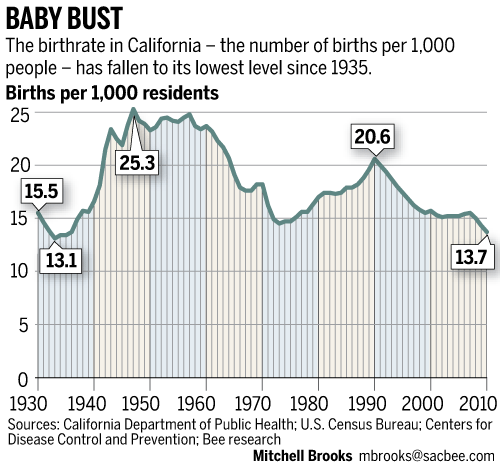
California recently released 2010 birth data, and the resulting news coverage noted a connection between the economic downturn and historically low birth rates.
Said the Sacramento Bee: “California’s birth rate tumbled last year to its lowest point since the Great Depression, new state figures show, yet another indication that the difficult economy is reshaping everyday life.”
In 2010, there were 512,000 births across California, down 10% from 2007 (see related graph of birth rates over time in California). The decline in Latino birth rates is a driving force behind this trend. Birth rates among young Latina moms (under age 25) dropped by more than 20% from 2007 to 2010, “a seismic shift that normally takes decades,” according to the Sacramento Bee.
While the article plays up the connection between the recession and lower birth rates, demographers point to other causes, too, for this drop-off: children of immigrants have fewer kids than their parents did; couples now wait longer to start families; and the population in California is growing older.
Given all of these trends, state demographers predict historically low birth rates throughout the decade. Experts point out, though, that California’s population is still growing — partly a result of immigration — even if the growth is slower than it once was.
See related coverage in the Orange County Register.
Posted by kidsdata.org
Post Comment
Report Ranks California, Other States on Child Homelessness
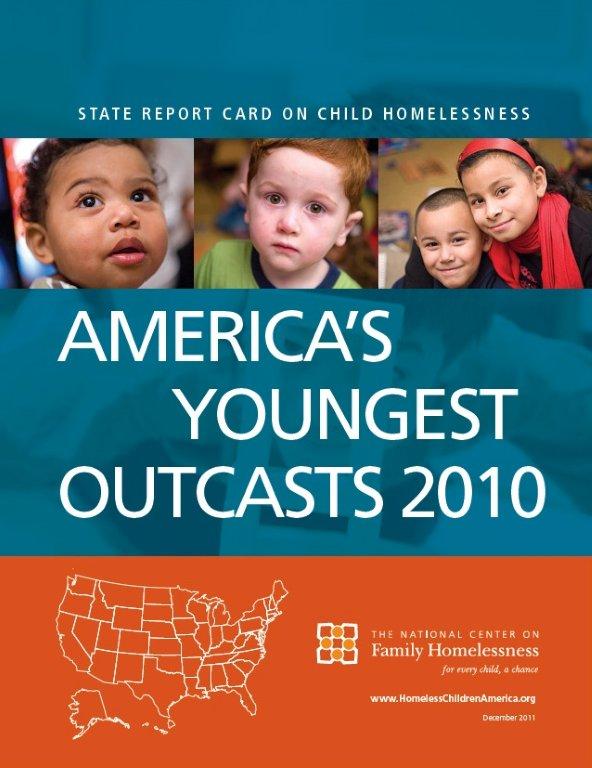
A new report published by the Campaign to End Child Homelessness ranks both U.S. states’ risk for child homelessness, as well as related state planning and policy activities. According to the report, America’s Youngest Outcasts, California is ranked at 46 overall alongside Arizona at 47 and New Mexico at 45 on a scale from 1-50, where Vermont ranked the best at number 1.
The report notes that an estimated 334,331 children were homeless in California in 2010. Although the state’s ranking has improved and the overall the number of homeless children has gone down since 2009, the data still indicate that a large number of California residents are unable to meet self-sufficiency standards. In the report’s risk of homelessness category, California ranks 38th, and the report indicates that California ranked 47th for home foreclosures.
Related Data on kidsdata.org:
• See more data about child homelessness >>
• See more data about family income and poverty >>
Posted by kidsdata.org
Post Comment
Our 10 Most Popular Data Releases of 2011
 We recently looked back at the most popular data releases on kidsdata in 2011, in terms of e-mail open rates. Below are the top 10. Does anything on this list surprise you?
- Asthma: How Many CA Kids Have Asthma? Find Data for Your Region
- Child Care: Released Today: New Child Care Data for All California Counties
- Data for Smaller Regions: Small Communities in CA: More Children’s Data Now Available
- Fitness: More CA Kids Meeting Fitness Standards: Find Local Data from ’10
- Health Care: New on Kidsdata: 2009 Data on Child Health Insurance and Doctor Visits
- School Enrollment: The New School Year – Find Local Enrollment and Other Education Data
- Self Sufficiency: What It Costs to Make Ends Meet for CA Families: Local 2011 Self-Sufficiency Data Now Available
- Truancies, Suspensions, and Expulsions: Local Data: How Many Students Are Truant, Suspended, or Expelled?
- Weight/Obesity: Just Updated: Kids’ Weight Data for Your Community
and
Are Childhood Obesity Rates Leveling Off? New Data Provide Insight
See the full list of data e-mail advisories from 2011: http://www.lpfch.org/programs/news.html
Coming up in early 2012: data on births and prental care/low birthweight.
Posted by kidsdata.org
Post Comment
December is National Impaired Driving Prevention Month
 On November 30th, 2011, President Obama proclaimed December as National Impaired Driving Prevention Month. The president shared this message:
“Though we have made progress in the fight to reduce drunk driving, our nation continues to suffer an unacceptable loss of life from traffic accidents that involve drugs, alcohol, and distracted driving. To bring an end to these heartbreaking outcomes, we must take action by promoting rigorous enforcement measures and effective substance abuse prevention programs. During National Impaired Driving Prevention Month, we recommit to preventing tragedy before it strikes by ensuring our family members and friends stay safe, sober, and drug-free on the road.”
Self-reported data on kidsdata for 2006 to 2008 indicate that more than 40% of 7th grade public school students in California have, on at least one occasion, ridden in a car with a driver who had been drinking. On that same survey, over 20% of 9th graders and over 25% of 11th graders reported that, at least once, they had driven after drinking or been in a car driven by a friend who had been drinking.
Kidsdata offers more data, too, on Alcohol, Tobacco, and Other Drugs, including Drinking and Driving or Riding with a Driver Who Had Been Drinking:
Posted by kidsdata.org
Post Comment
The Gift of Data
 |
Watch this video about the Top 5 Reasons to Use Kidsdata.org |
This holiday season, we want to honor the many organizations and individuals statewide who work on behalf of the 10,000,000 children in California. So in the spirit of giving, we note below the many ways in which Kidsdata – a public service from the Lucile Packard Foundation for Children’s Health – can help policymakers, researchers, advocates, nonprofits, and others who are committed to advancing and elevating the status of child health in California.
Kidsdata.org can be an invaluable resource for grant writing, program planning, community assessments, communications and advocacy work, policymaking, and many other initiatives.
Earlier this year, we blogged about the Top 5 Reasons to Use Kidsdata.org. In case you missed them, here they are again.
Kidsdata.org helps you…
- Use resources more efficiently by bringing together more than 35 trusted public data sources into one, free public service.
- Find and compare local data — for every city, county, and school district in California.
- Customize data for regions or demographic groups, and find the data display (map, bar graph, table, etc.) that works best for you.
- Share data instantly via social media, e-mail, or by downloading into Word, PowerPoint, or Excel.
- Stay up-to-date on new data for the children you serve via customized e-mail alerts, Kidsdata Advisory newsletters, Facebook and Twitter.
Learn how others have used kidsdata.org on our Kidsdata In Action page.
Posted by kidsdata.org
Post Comment