


Archive for October, 2020
New: Demographic Summaries on Youth Sexual Orientation
Youth Sexual Orientation of Public School Students by Grade Level, 2015-2017
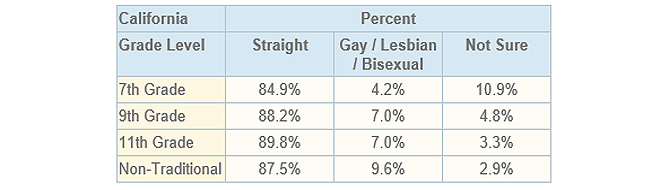
You can now access demographic summaries by sexual orientation on kidsdata.org. In this section, find data summaries for gay, lesbian, and bisexual youth; straight youth; and youth not sure of sexual orientation. These data are located in the “Data by Demographic” tab on the website which has additional summaries on other demographic groups of children and youth such as race/ethnicity, income level, and immigrant status.
Gay, lesbian, and bisexual youth have an increased risk for victimization, substance abuse, and child maltreatment. Four to 10% of California public school students in grades 7, 9, 11, and in non-traditional programs were gay, lesbian, or bisexual. They reported very different experiences and behaviors in 2015-2017 as compared to students who were straight:
- 60% of gay, lesbian, and bisexual students reported being bullied and harassed at least once in the previous year, and 45% were harassed because of their sexual orientation
- 63% of gay, lesbian, and bisexual students reported having depression-related feelings in the previous year compared with 26% of straight students
- 24% of gay, lesbian, and bisexual students reported being highly motivated in school compared with 37% of straight students
We hope you will use the demographic summaries on sexual orientation to share key findings with your community and tailor comprehensive supports. Expect newly updated data in this set of summaries in the coming months.
Children’s Health Resources
In Implications of COVID-19 for LGBTQ Youth Mental Health and Suicide Prevention The Trevor Project outlines how LGBTQ youth may be impacted by the pandemic and offers suggestions on how to support LGBTQ youth during this time.
The Lucile Packard Foundation for Children’s Health continually updates a curated list of COVID-19 Resources for Children with Special Health Care Needs.
Posted by kidsdata.org
Post Comment
Latinx Children in California

With an increasingly diverse child population across California, acknowledging and addressing health inequities is more critical than ever. In an effort to inform and educate the public on the many factors that contribute to disparate health outcomes, The Children’s Partnership developed a series of fact sheets as part of its “A Child is a Child” campaign. In honor of Latinx Heritage month, we welcome Mayra E. Alvarez, president of The Children’s Partnership, to share important findings from their fact sheet, Latinx Children’s Health Snapshot, released in partnership with the Latino Coalition for a Healthy California.
Latinx Child Health Inequities
California is home to 4.7 million Latinx children and youth. They form a large and diverse population of California who navigate multiple intersecting identities, cultures, and languages. Latinx children and youth face disproportionate structural barriers as they navigate through life, whether it’s accessing health coverage and services, having enough healthy food to eat, or living in communities with the highest rates of environmental pollution.
A collective equity agenda transforms current programs and policies in order to ensure all children, no matter their background, have the resources and opportunities they need to reach their full potential and lead healthy lives.
As a result of the pandemic, these inequities in our child-serving systems have only been made worse, especially for children of color, such as Latinx children:
COVID-19 and Latinx Child Health
The pandemic is wreaking havoc on millions of Latinx, Black and immigrant families in California, while simultaneously shouldering the front-line work that has kept our state’s economy running. Nearly 75% of children and youth diagnosed with COVID-19 are Latinx, even though they make up just over half of the state’s population.
Latinx Child Health Coverage
California has made critical strides to improve children’s access to health coverage, expanding Medi-Cal to cover all low-income children, regardless of immigration status in 2016. Today, 1 in 2 Latinx children are enrolled in Medi-Cal. Despite California efforts to expand coverage, Latinx children are almost 1.5 times more likely to be uninsured compared to other kids. Nearly 190,000 Latinx children remain without health coverage.
Latinx Youth Mental Health
As a result of community trauma and exacerbated by the pandemic, mental health concerns have been growing for Latinx young people. Between 2007 and 2014, Latinx youth mental health hospitalizations rose 86% compared to a 21% increase among white youth. Latina youth are more likely to consider suicide than their male counterparts and white female youth. Over 1 in 3 (34.3%) Latina youth has considered suicide and nearly 1 in 7 Latina youth (13.3%) have attempted suicide. For lesbian, bisexual and queer Latina youth, the reality is even worse: nearly half (48%) has considered suicide; and 1 in 3 (33%) lesbian, bisexual, and queer Latina youth attempted suicide.
Community Environments and Food Access
Systemic racism is at the root of health, income, and other inequities, which have widened as a result of the current crises. For Latinx families, access to healthy foods and safe environments has historically been a challenge and has only grown more difficult as a result of COVID-19. Latinx households with children are twice as likely to be experiencing food insecurity during the pandemic than white households with children. Latinx children make up 4 in 5 of children living in California census tracts impacted by the highest environmental pollution burdens and over half of students enrolled at schools impacted by
unsafe drinking water are Latinx.
Prioritizing Latinx Child Well-being
Latinx children comprise a growing part of California’s children. Recognizing their critical importance to California’s future, these data suggest that caring for our kids must prioritize the specific needs of Latinx children. These data also drive home the need to address systemic racism in order to address the multiple challenges impeding the well-being of the state’s Latinx children. With this global emergency, an impending recession and a national reckoning on racial justice comes an even greater moral imperative to develop a more equitable infrastructure that increases safety net supports, health access, and mental health services so that California’s Latinx children and families can achieve their right to thrive.
Learn more about child health inequities for Latinx and other children at The Children’s Partnership.
Additional Resources
The Children’s Partnership is a California nonprofit advocacy organization working at the intersection of research, policy and community engagement to ensure all children have the resources and opportunities they need to grow up healthy and lead productive lives. In addition to highlighting Latinx children’s health and well-being, The Children’s Partnership also has released fact sheets about these groups:
- Lesbian, Gay, Bisexual, Transgender, Queer+ youth
- Asian American, Native Hawaiian, and Pacific Islander children
- Black children
Posted by kidsdata.org
Post Comment