


Archive for March, 2012
A Closer Look at the Growth in Autism Diagnoses
You may have seen today’s New York Times article highlighting the rise in autism diagnoses. In light of this news, we are republishing this post on the growing number of autism diagnoses.
______________________________________________________________________________________
Originally posted Feb. 3, 2011
A few years ago, we published an issue brief, “Autism Diagnoses on the Rise,” that explored the steep climb in autism diagnoses across California. So what does the trend look like these days? About the same, it turns out. Newly released data from the California Department of Education show that the growth in special education students diagnosed with autism continues unabated, from roughly 17,500 California public school students in 2002 to nearly 60,000 in 2010.
As you dig deeper, however, some other trends emerge. First, while students with autism comprise a greater share of all special education students in California compared to roughly a decade ago (from about 3% of all special education students in ’02 to about 9% in ’10), numbers are on the rise for another diagnosis, too — “other health impairment.” The California Department of Education defines this as “having limited strength, vitality or alertness, due to chronic or acute health problems, such as a heart condition, tuberculosis, rheumatic fever, nephritis, asthma, sickle cell anemia, hemophilia, epilepsy, lead poisoning, leukemia, or diabetes.” Meanwhile, the percent of special education students diagnosed with a learning disability has dropped considerably, from 52% of all special education students in 2002 to 42% in 2010.
This Google animation, which uses data from kidsdata.org indicators, shows the relative growth/decrease in special education enrollments by the three conditions noted above. First click on the bar graph icon in the top-right, then press play in the bottom left.
Posted by kidsdata.org
Post Comment
The Recession’s Impact: New Release on How Poverty Affects Child Well Being

Despite the understandable desire for up-to-the-minute information on childhood poverty, it can take time for such data to be reported. The recently released 2010 childhood poverty data unfortunately confirm what many anticipated – that more than one in five children (22%) statewide lived below the federal poverty level in 2010 ($22,113 for a family of two adults and two kids in ’10), compared to 17% in 2007.
Today, the First 5 Association, First 5s of Southern California, HealthyCity, and our foundation are releasing the results of a project to communicate the broad impact that poverty can have on a young child’s health and well being. The release provides related data that describe how children are faring in Southern California.
With poverty rates steadily climbing across California, this issue is becoming increasingly significant, even with talk of an economic recovery. And given the high cost of living in many areas of California, a family can earn twice the poverty level and still suffer the effects of poverty. So it’s particularly concerning that about one half of California children (46%) live in families earning less than two times the federal poverty level (roughly $44,000 for a family of four).
How does poverty exert such a strong influence on child well being? See these sections of the just-launched website to learn more.
- Children in poverty are more likely to experience abuse and neglect.
- Children in poverty are less likely to obtain dental care.
- Poverty can have a long-term, negative impact on the educational achievement of children.
- Research links poverty with a greater likelihood of asthma in children.
- Low-income women are less likely to receive first trimester prenatal care.
- And poverty can exacerbate factors associated with childhood obesity.
Posted by kidsdata.org
Post Comment
School Health Centers Focus of Sacramento Conference; Find Related Data

Our foundation enjoyed attending and sponsoring last week’s California School Health Centers Association conference in Sacramento. The event advocated for the creation of school-based health centers that can address multiple issues – physical and mental health, dental and vision services, etc. — with the understanding that students can achieve more academically when they are healthy.
Attendees included health professionals that work directly with children in the schools, as well as in district offices, and counties and regions across California were represented at the event, from Truckee to Los Angeles to the Bay Area.
In California, there were 183 school health centers (or school-linked health centers) in 2011, compared to 153 in 2009. See more data on school health centers in California>>
Posted by kidsdata.org
Post Comment
Nobel Laureate James Heckman Advocates for Early Childhood Investment

“What’s the answer to global competitiveness, better health and education outcomes, and less crime and poverty?” asked Professor James Heckman, Nobel Laureate of economics, at a lecture at CSU Monterey Bay last week that pertained directly to California’s 3.3 million children ages 0-5. As an answer, Professor Heckman focused on investment in early childhood and its long-term importance in improving America’s struggling economy. The talk, hosted by First 5 Monterey County, was streamed live by First 5s across the state and highlighted evidence that support the development and funding of programs for early childhood (from birth to 5 years old).
Professor Heckman emphasized character skills as essential to a child’s long term success in life. Cognitive skills and measures, such as IQ, are all too often regarded as the ultimate determining factor of how successful, both academically and professionally, a child will be later in life, he said. However, Professor Heckman encouraged a broader focus, encompassing both character skills, such as self-esteem and motivation, as well as cognitive skills to foster success.
The essential role that family and parents have in influencing a child’s level of performance also was highlighted by Professor Heckman. He noted that since a child spends the most time with his/her parents in the first years of life, they have the most influence on the child’s development. Heckman championed child participation in substantive preschool programs, supplemented with attention at home. Skills gained early in this manner will set a foundation for the development of additional skills later in life, he said.
Ultimately, Professor Heckman urged his audience to consider early childhood investment as a form of prevention of economic decline, rather than a remediation. By building an intelligent and capable population, the country will benefit long-term from these early investments, he said.
Kidsdata.org offers numerous data specific to children 0-5. See demographic highlights of infants and early childhood in California.
Posted by Stacey Angeles
Post Comment
Data Map Shows How Urban Population Is Growing Rapidly Around the Globe
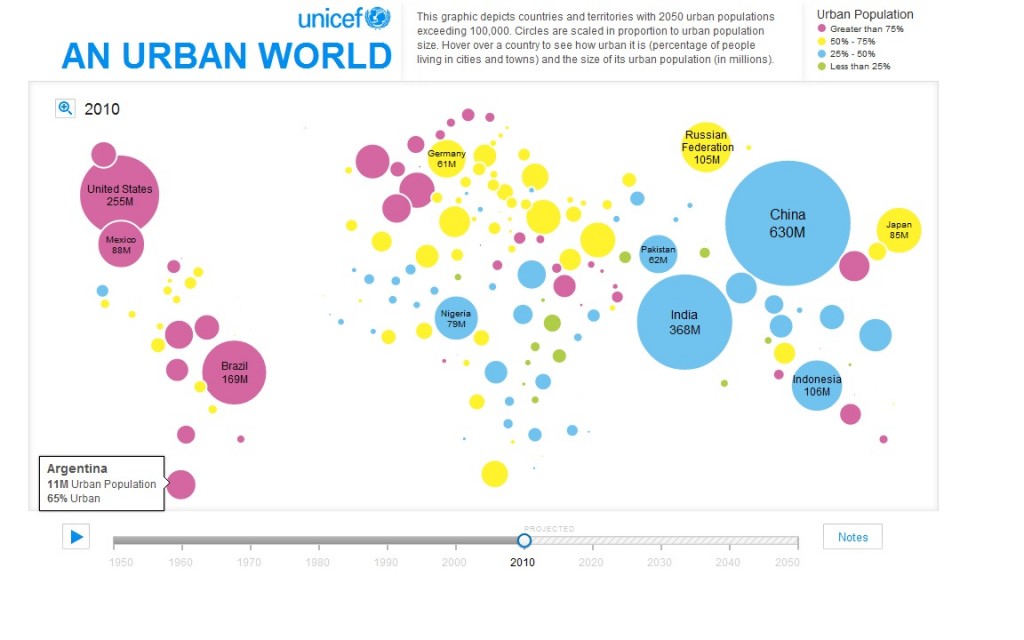
We all might assume that the world’s urban population has grown considerably in recent decades. Now, UNICEF has provided some visual documentation of this trend, in the form of a data map that displays country-level population shifts from 1950 to 2050. The map shows that in the United States, the urban population in 2010 was roughly 255 million people (the urban population was 82% of the total population) and will be home to 365 million urbanites in 2050 (90% of the total population). In 1950, the United States was 64% urban. Other nations contain urban populations that are growing at a similarly rapid pace.
According to data about children living in rural and urban areas in California, 92% of children in California live in urban regions compared to 8% that live in rural areas.
Posted by Stacey Angeles
Post Comment
An Upward Trend for California’s Math Scores, but Disparities Persist
The good news in the 2011 math proficiency data just published on kidsdata.org is that the majority of California 10th graders are passing the math portion of the high school exit exam. Additionally, passing rates have improved in recent years, from 74% in 2004 to 83% in 2011.
Despite these statewide gains, disparities persist. Passing percentages for economically disadvantaged students – that is, students enrolled in the Free or Reduced Price Meals Program — continue to lag behind those of their non-economically disadvantaged peers (76% vs. 91% in 2011).
And while the percent of 10th graders passing this math exam has improved for all racial/ethnic groups with available data from 2004 to 2011, there are notable differences among these groups, as the accompanying graph shows.
Posted by kidsdata.org
Post Comment
Fewer CA Children Live in Poor Neighborhoods, Despite Increase in National Poverty Rates
An Annie E. Casey Foundation analysis released last week shows that the percentage of children in California living in poor neighborhoods has decreased since 2000, despite the national increase in poverty levels. According to the breakdown in the analysis, the percent of California children living in neighborhoods where 30% or more residents live below the poverty threshold decreased by 9% from 2000 to 2010. In 2010, 11% of children statewide lived in neighborhoods where 30% or more of residents are in poverty. Figures vary widely by county, ranging from 37% of children living in such poverty-stricken neighborhoods in Fresno County to just 1.4% in Marin County.
See related coverage in CaliforniaWatch.org.
Related to this issue, an intriguing data map from USA Today helps document the increase in poverty levels nationwide. In particular, the map selection for poverty rates above 20% shows a noticeable increase in the rate as you wipe across the map from 1980 to 2010 data.
To help humanize the issue of family poverty, a PBS piece, Portraits of Hunger: Stories of Americans on Food Stamps, features the stories of several families who have found themselves in poverty and participate in the food stamp program.
Find data for your community about family income and poverty>>
Posted by kidsdata.org
Post Comment