


Archive for August, 2020
New Data on School Suspensions Highlight Educational Inequities
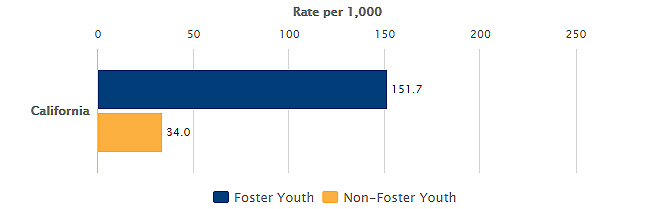
Students Suspended from School, by Foster Youth Status: 2018-2019
Kidsdata.org recently released new data on school suspension and expulsion rates. Compare rates for foster youth, homeless students, and economically disadvantaged students as well as by disability status and by race/ethnicity.
In California public schools, 35 students for every 1,000 were suspended in 2019. Foster youth, in particular, experienced high rates of suspension. In 2018-2019, 152 per 1,000 foster youth were suspended from California schools compared with 34 per 1,000 among non-foster youth.
While foster youth were suspended at almost five times the rate of other students, some student groups were suspended at about double the rate.
For every 1,000 students,
- 60 homeless students were suspended compared with 34 non-homeless students.
- 45 socioeconomically disadvantaged students were suspended compared with 19 socioeconomically advantaged students.
- 66 students with disabilities were suspended compared with 30 students without disabilities.
- 92 African American/Black students, 73 American Indian/Alaska Native students, 36 Hispanic/Latino students, and 30 white students were suspended.
For these student groups, being subjected to higher suspension rates than their peers represents another example of inequity among our youth. Suspensions, expulsions, and frequent absences for any reason are linked to lower test scores, higher dropout rates, and more frequent entries into the juvenile justice system, all of which can have lifelong effects on employment and earning potential. Recent California legislation provides momentum in a positive direction by restricting out-of-school suspensions, a change that should decrease rates and address educational inequities.
Educational Equity Resources
The Civil Rights Project at UCLA asks, Is California Doing Enough to Close the School Discipline Gap? A trend analysis showed that disparities in suspension rates have narrowed but remain in recent years.
A guidebook, Building Educational Equity Indicator Systems by the National Academies of Sciences, Engineering, and Medicine, helps state and school district leaders develop ways of tracking educational equity within their Pre-K – 12 systems.
Children’s Health Resources
The Rapid Assessment of Pandemic Impact on Development – Early Childhood (RAPID-EC), a nationally representative longitudinal survey conducted by the University of Oregon’s Center for Translational Neuroscience, addresses the role of caregiver emotional support in buffering children in their latest report, How Long Can the Levee Hold?
The Lucile Packard Foundation for Children’s Health continually updates a curated list of COVID-19 Resources for Children with Special Health Care Needs.
Posted by kidsdata.org
Post Comment
The Digital Divide
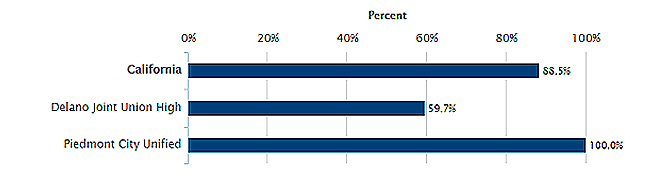
California Children Living in Households with a Broadband-Connected Device by School District: 2014-2018
As the school year begins, access to technology, including suitable devices for schoolwork and a sufficient broadband internet connection, is both a requirement for effective learning and a source of division in this new mode of mass education. Educational inequities become more acute when some children lack a dedicated device or have an inadequate internet connection. This digital divide compounds inequities and may have long-term consequences on educational outcomes.
Kidsdata.org now offers data on access to broadband-connected devices under the recently updated Housing Affordability and Resources topic. Access to technology varies greatly across California school districts. In districts with data, as few as 60% of children ages 0-17 live in households connected to high-speed internet through a desktop, laptop, tablet, smartphone, or other computer, in 2014-2018.
Access in California also varies by demographic characteristics. In 2018,
- 84% of children in families living below the poverty threshold have access to a broadband-connected device compared with 96% of children in families living at 200% or above the poverty threshold
- 81% of children in limited English-speaking households have access to a broadband-connected device compared with 94% of children in English proficient households
- 90%-91% of Black, Hispanic/Latino, American Indian/Alaska Native children have access to a broadband-connected device compared with 96%-97% of white and Asian American children
Efforts are underway to address students’ technology needs. Some districts are providing laptops and internet hotspots for students. Furthermore, The California Bridging the Digital Divide Fund, a joint effort of the Governor’s Office, State Board of Education, California Department of Education, and Californians Dedicated to Education Foundation, offers a centralized set of resources to address the digital divide. These and other approaches to increase access to technology for all children can contribute to equity in education.
Digital Divide Resources
California Parent Poll: COVID-19 and School Closures reported that 41% of parents felt they did not have enough devices in the home in late March 2020 and 29% lacked reliable internet access. This survey was conducted by Ed Trust-West.
California’s Digital Divide reported that 16% of school-aged children had no internet connection at home in 2017. This survey was conducted by the Public Policy Institute of California.
The Common Sense Census: Media Use by Tweens and Teens, 2019 reported that 73% of lower-income families in the United States with 8 to 18-year-old children had computers compared with 94% of higher-income families. This survey was conducted by Common Sense Media.
Children’s Health Resources
How the Pandemic is Affecting Every Aspect of Children’s Lives, by Children Now, shares findings and the steps California must take to address the complex needs of children and families.
Coping with Stress During the COVID-19 Pandemic, available on ACEs Connection, shares resources and information on ways Californians can take care of themselves and their families during the pandemic.
The Lucile Packard Foundation for Children’s Health continually updates a curated list of COVID-19 Resources for Children with Special Health Care Needs.
Recently Released Data
We recently released data about Housing Affordability and Resources, Math and Reading Proficiency, and School Attendance and Discipline. See links to the latest here.
Posted by kidsdata.org
Post Comment