


Archive for February, 2019
Newly Expanded Demographic Topic
Child Population, Ages 0 to 2: 2018
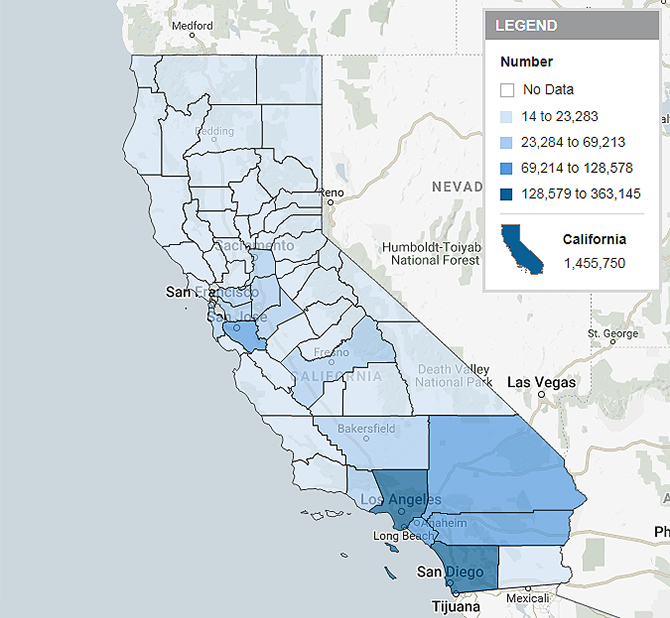
Kidsdata has expanded its demographic topic content with 22 new indicators and 14 updated indicators. New indicators include sexual orientation, transgender youth, and projected population to 2060. Updated indicators include births, child populations, and school enrollments. Use demographic data to understand the size and composition of the populations in your area and plan appropriate programs to meet your changing community needs.
California had nearly 1.5 million babies, ages 0-2, in 2018 – that is 1.5 million lives where we have an opportunity to ensure safe, nurturing, and healthful environments and supportive infrastructure from the start. Each child is more important to California than ever before. How many babies does your county have?
Data in Action
The Office of Child Abuse Prevention in the CA Department of Social Services are using data to inform prevention strategies against child abuse. They debuted state and county-level dashboards, drawing from kidsdata.org and other sources.
Now Available: LGB Webinar Recording and Slides
Across many indicators of health and well being, lesbian, gay and bisexual (LGB) youth reported troubling behaviors and consequences at about twice the rate of straight youth. Listen to our recent webinar on this topic and see the latest data on transgender youth.
Posted by kidsdata.org
Post Comment
California LGB Youth: Issue Briefing and New Data
A positive school climate is paramount to addressing disparities in health and well being among LGB youth in California. We were pleased to host Jenny Betz from WestEd to discuss the latest research on school climate and Hannah Herrick, a UC Berkeley student, to share her high school experience as part of the LGB community. For an overview of key health data, see our latest issue brief.
Issue Briefing Recording:
New to Kidsdata: Data on Transgender Youth
See the latest data on transgender youth in California.
- by Gender and Grade Level
- by Level of School Connectedness
- by Parent Education Level
- by Race/Ethnicity
- by Sexual Orientation
Additional Resources
Below are some additional resources that we hope will be helpful in your work:
Thanks to all who joined us for this enriching and thought-provoking issue briefing. Explore more data on school climate and LGB youth. We always appreciate feedback and are happy to share any additional resources that you may have on this topic. Please email [email protected].
Posted by kidsdata.org
Post Comment
New to Kidsdata: Population Projections on California’s Children
Projected Child Population Counts, by Race/Ethnicity: 2020 to 2060
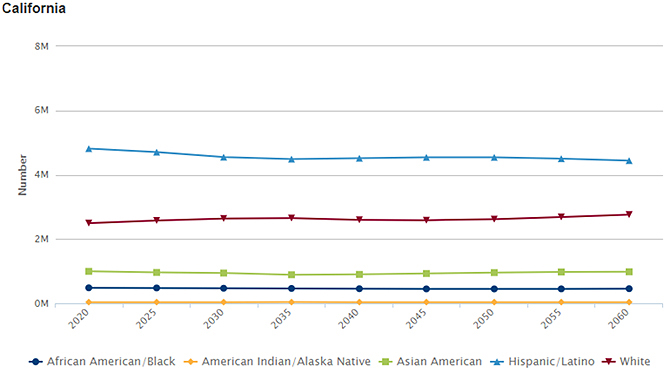
New indicators on projected population point to stagnation of the child population from 2020 to 2060 across all racial/ethnic groups. With an unchanging child population and growing adult population, the importance of children becomes ever greater. Guest author, Beth Jarosz from the Population Reference Bureau, explores these new indicators and explains how they can help inform policies and programs that support children’s health and well being.
California’s total population is expected to grow by more than 10 million people (25 percent) to nearly 51 million between 2020 and 2060. However, the child population is expected to remain virtually unchanged, at just over 9 million, over this same period of time. This forecast, from the California Department of Finance, is based on the current population as well as projections about birth rates, death rates, and migration patterns. Low birth rates contribute to the stable child population forecast while long life expectancy and net in-migration result in projected population growth at older ages.
Population forecast information is valuable for many reasons. Forecasts provide decision makers and the public with valuable clues about the future size and characteristics of the population. At the most basic level, a forecast suggests whether a population is going to grow, shrink, or remain about the same. Many forecasts, including those presented here on Kidsdata.org, also provide predictions about the age and gender, racial/ethnic composition, and geographic location of the population in the future.
Forecast data are used to predict and plan for future needs such as schools and health care facilities. If a community is expected to grow, local officials would plan for additional school and health care facilities to meet the needs of the growing population. If a community is expected to shrink, officials would want to start planning for how to use any no-longer-needed space. Forecast data are also helpful in what-if analysis. For example, an analyst might ask, “If we could eliminate racial/ethnic disparities in child poverty, what would the effect be on the overall child poverty rate?” Forecast data help to answer those questions.
Additional Resources
The New Importance of Children in America
A report from the Lucile Packard Foundation for Children’s Health explores the economic impact of declining birth rates. Ensuring the health and well-being of children in the U.S. has never been more critical to the nation’s economic and political future. The shortage of children means each child—regardless of gender, ethnicity, geographic residence or economic background—is proportionately more important to our future than ever before.
Demographic Analyses and Enrollment Forecasts
See how San Francisco Unified School District is using forecasts to predict future needs.
Recently Released Data
Births Outside of Marriage (California & U.S. Only)
Child Population (Regions of 65,000 Residents or More)
Child Population, by Race/Ethnicity (Regions of 10,000 Residents or More) [NEW]
- by Legislative District [NEW]
Children in Rural and Urban Areas (California & U.S. Only)
Projected Child Population, by County [NEW]
- by Age Group and Gender [NEW]
- by Race/Ethnicity [NEW]
Projected Total Population [NEW]
Highest Level of Parent Education, by Child’s Grade Level [NEW]
- by Child’s Gender and Grade Level [NEW]
- by Child’s Level of School Connectedness [NEW]
- by Child’s Race/Ethnicity [NEW]
- by Child’s Sexual Orientation [NEW]
Youth Sexual Orientation, by Grade Level [NEW]
- by Gender and Grade Level [NEW]
- by Level of School Connectedness [NEW]
- by Parent Education Level [NEW]
- by Race/Ethnicity [NEW]
Transgender Youth, by Grade Level [NEW]
- by Gender and Grade Level [NEW]
- by Level of School Connectedness [NEW]
- by Parent Education Level [NEW]
- by Race/Ethnicity [NEW]
- by Sexual Orientation [NEW]
Posted by kidsdata.org
Post Comment